
Can Bitcoin's 21 Million Cap Be Changed? Source Code and Fork Analysis
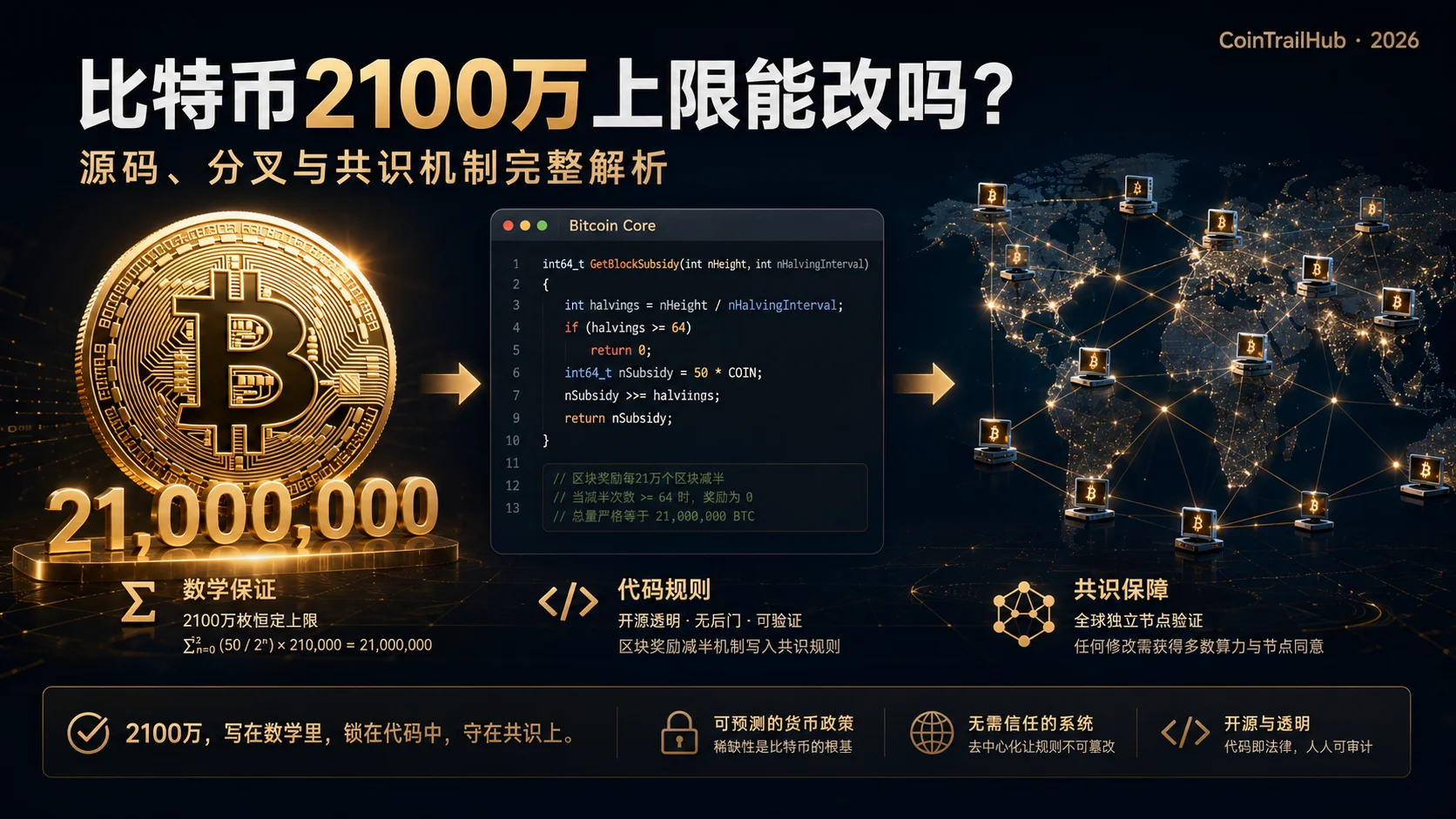
Table of contents

Binance new user rewards
20% trading fee rebate
Official Binance registration. Complete identity verification (KYC) to trade and withdraw.
Bitcoin's 21 million cap is not "absolutely unchangeable" in the mathematical sense — technically anyone can fork the code and change the issuance rules. But in the real consensus system it is extremely hard to change unilaterally: it cannot be decided by one person, one company, or even a group of miners. I spent 3 months reading the Bitcoin Core consensus code, retracing every node of the 2017 BCH fork war, and reasoning through the game-theory matrix between miners and full nodes. The conclusion is three sentences: there is no "print more" switch in the code; every attempt in history to change Bitcoin's core rules while still being accepted by the market as "Bitcoin" has so far failed; and what guarantees all of this is not "trust in Satoshi" — it is the large number of independently run full nodes around the world that each verify and each reject any block that doesn't conform to the rules.
If your long-term allocation thesis includes the premise "BTC's scarcity is real", then this article is the complete process of verifying that premise.
Reminder: this is a record of technical verification, not investment advice. Crypto assets are extremely volatile; please judge independently according to your own risk tolerance.
It helps to first understand Bitcoin's basics: What Is Bitcoin (BTC)? How It Works, Value and Risks (2026).
Core info: will the 21 million cap ever be changed?
| The scenario you fear | The reality | In one line |
|---|---|---|
| Satoshi left a backdoor to print more anytime? | No backdoor. Satoshi gradually left the community between late 2010 and 2011, and the roughly one million BTC mined early (usually estimated at ~1.1 million) has not moved on-chain for a long time | The founder left, the code stayed |
| Bitcoin Core devs secretly change the code to print more? | Even if changed, nobody installs it. Devs can only propose; full-node operators decide whether to upgrade | Code is not law, full nodes are |
| Miners team up and vote to print more? | Full nodes reject it. A miner producing an invalid block gets it dropped by full nodes, wasting hashpower | Hashpower cannot overturn consensus rules |
| Another hard fork to create a "new Bitcoin"? | BCH already proved it — a fork coin ≠ Bitcoin. The market chose the original chain through liquidity, price and ecosystem size | 2017 already answered this |
| Quantum computers destroy Bitcoin? | They only threaten the signature scheme, not the supply cap. The worst case of quantum is "coins get stolen", not "coins get printed" | Two completely different problems |
Core conclusion: what guarantees the 21 million cap is not a variable in the code, but game theory — anyone can propose a change, but no one has the ability to get the large number of independent node operators worldwide to install the new rules at the same time. This is not a technical problem, it is a coordination-cost problem. The coordination cost is so high it's infeasible — that is Bitcoin's deepest moat.
The key to understanding the 21 million cap is not "can anyone change the code", but "after it's changed, will anyone still consider it Bitcoin". This is the single most important judgment in the whole article — if you only remember one sentence, remember this one.
Who needs to read this / who doesn't
| Your situation | Recommendation |
|---|---|
| Want to hold BTC long-term but worry "the supply might be secretly changed" | Read it — this is exactly the core premise you need to verify |
| Evaluating whether "scarcity" is BTC's real value foundation | Read it — focus on Verification 1 and 3 |
| Get nervous when you see "Bitcoin fork" news and aren't sure if it affects your holdings | Read it — focus on Verification 3, understand fork ≠ printing more |
| Short-term trader, don't care about long-term fundamentals | Skim the "Core info" table |
| Already understand full-node consensus and know the BCH fork history | Skip the first half, jump to "My judgment logic" and the FAQ |
| Firmly believe BTC is a scam and won't listen to anything | Skip it — I respect your judgment |
My verification method: not reading articles, but checking code + retracing history + reasoning the game
Before breaking it down one by one, let me first explain how I verified it — the method matters more than the conclusion, and you can use the same process to verify any core property of Bitcoin.
Three methods:
1. Read the source code directly. I wasn't satisfied with "the official docs say 21 million" — I went to GitHub and read the block reward calculation logic (the GetBlockSubsidy function) in the Bitcoin Core consensus code. Less than 30 lines of code, clear enough for anyone with basic programming skills to understand. The takeaway: Bitcoin's supply rules aren't hidden in legal clauses — they're written in open-source code anyone can audit. Source: github.com/bitcoin/bitcoin.
2. Retrace historical events. The 2017 BCH fork was the closest Bitcoin has come to "core rules being changed". I spent two weeks reading the forum discussions, the developer mailing list and the post-fork market data. That review made me understand a key point: changing Bitcoin's core rules has zero technical barrier, but is nearly impossible in terms of game theory. It's not that "no one can change the code" — it's that "even if you change the code, no one follows you".
3. Reason through the game-theory matrix. I divided Bitcoin's participants into four groups — developers, miners, full-node operators, and holders — then reasoned: if any one group wants to print more than 21 million, who do they need to convince? What's the resistance at each step? The conclusion: every party pushing for more issuance faces a prisoner's dilemma of "if I change it and others don't, I've changed it for nothing". This dilemma is the hardest guarantee of Bitcoin's supply cap.
Like verifying a Ponzi scheme, I also used the "look for counter-evidence" method — I asked myself: "if I believe 21 million can be changed, what evidence would convince me?" Then I went looking for it, one by one. I found none.
Verification 1: the math — 21 million is calculated, not made up
When I first started researching Bitcoin, the number I doubted most was "21 million". It sounded too round — like a marketing slogan. Later I realized I had it completely backwards: this number wasn't "designed", it was "calculated".
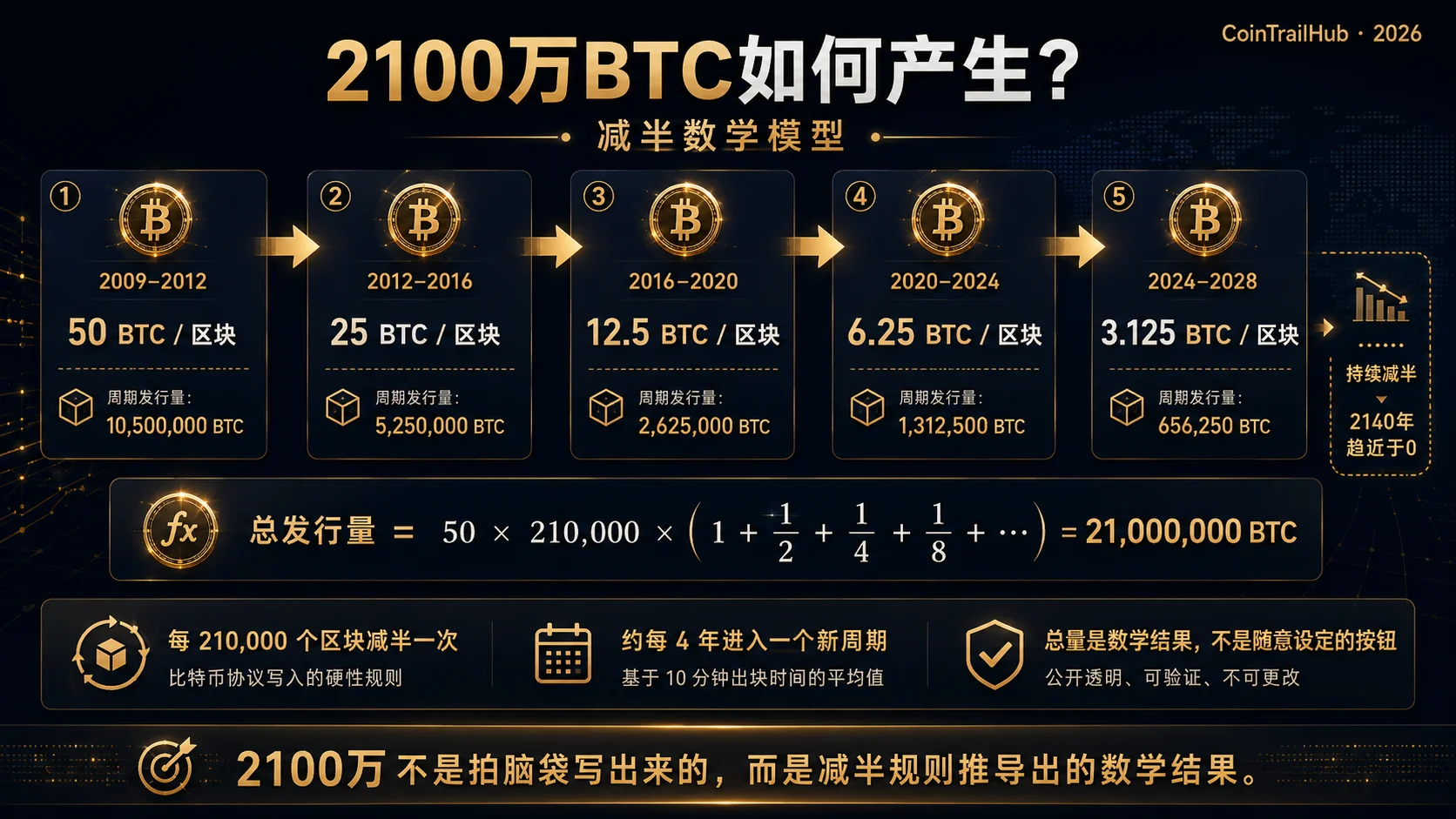
Bitcoin's issuance rules are determined by consensus parameters in the original code:
On January 3, 2009, Satoshi mined Bitcoin's first block (the genesis block). The two core parameters that determine the issuance rules are defined in the protocol code:
- Initial block reward = 50 BTC
- Halving interval = 210,000 blocks
Genesis block + code-defined issuance rules = the 21 million supply model.
These are the only two variables in Bitcoin's issuance rules. There is no third.
Summing a geometric series — junior-high math is enough:
With these two parameters, the total supply is a mathematical result:
- Cycle 1: 50 × 210,000 = 10,500,000 BTC
- Cycle 2: 25 × 210,000 = 5,250,000 BTC
- Cycle 3: 12.5 × 210,000 = 2,625,000 BTC
- Cycle 4: 6.25 × 210,000 = 1,312,500 BTC
- …… decreasing forever
Formula: total issuance = 50 × 210,000 × (1 + 1/2 + 1/4 + 1/8 + …) = 50 × 210,000 × 2 = 21,000,000 BTC.
An infinite geometric series with first term 1 and ratio 1/2 sums to exactly 2. This is junior-high math; anyone can verify it. The Bitcoin whitepaper mainly describes the design goals of an electronic cash system and does not spell out the full issuance formula in detail — the 21 million cap comes from the combination of issuance parameters in later code implementation, not from a direct declaration in the whitepaper.
This design has several elegant points:
| Design feature | Meaning |
|---|---|
| 21 million is a limit value, not a hardcoded constant | There is no MAX_SUPPLY = 21,000,000 variable that can be changed |
| Rewards halve rather than decline linearly | Simulates the diminishing marginal returns of gold mining — harder and harder to mine |
| Every 210,000 blocks ≈ 4 years | Roughly matches the US presidential election cycle and economic cycles (coincidence or design, unknown) |
| After the 33rd halving (≈2140) rewards approach 0 | Gives miners and the economy a transition period of over 100 years |
My first thought after reading this math: "So 21 million isn't a number written by marketing — it's the result of summing a geometric series. Then worrying about 'someone changing this number' is essentially worrying about someone changing the two parameters 50 or 210,000. And why changing those two parameters is impossible is what Verification 2 and 3 will explain."
For the economic impact of the halving mechanism, see Is Bitcoin Mining Still Profitable? Four Things to Calculate First (2026) to understand how miner revenue structure changes.
Verification 2: source-code audit — there is no "print more" switch in Bitcoin Core
This was the "hardest-core" step of my verification, and the one I gained the most from.
What most people imagine: there's a variable MAX_SUPPLY = 21000000 in the Bitcoin Core code, a developer secretly changes it to 42 million, submits a PR, the Bitcoin Core maintainers merge it (accidentally? intentionally?), and then "Bitcoin prints more".
The reality: this variable doesn't exist at all.
In the Bitcoin Core consensus code, the block reward calculation logic (the GetBlockSubsidy function) is as follows (logic illustration, the actual code is C++):
CAmount GetBlockSubsidy(int nHeight, const Consensus::Params& params)
{
    int halvings = nHeight / params.nSubsidyHalvingInterval;  // 210000
    if (halvings >= 64)   // after 64 halvings, reward is forced to 0
        return 0;

    CAmount nSubsidy = 50 * COIN;   // initial reward = 5 billion satoshis = 50 BTC
    nSubsidy >>= halvings;          // each halving, shift right one bit (÷2)
    return nSubsidy;
}
This code of under 30 lines explains several things:
There is no
MAX_SUPPLYconstant. The total is a limit value automatically calculated by combining the two parameters 50 and 210,000 with block height. To change the total, you must change one of these two parameters — not change one number, but change the mathematical result of the entire issuance rule.After 64 halvings the reward goes to zero. Because
CAmountuses satoshi (1 BTC = 100 million satoshis) as the smallest unit, each halving is essentially dividing by 2. After roughly 64 halvings, the 50 BTC (i.e. 5 billion satoshis) block reward falls below 1 satoshi under integer division and can no longer be issued — the code explicitly returns 0 via thehalvings >= 64check. Note: this is not a "check whether the total exceeds the cap" — it is the natural end point of the block-reward-declining rule. The code doesn't need to "check whether it exceeds 21 million" — the math itself guarantees it can't.This function is part of the consensus rules. Every full node independently executes this code to verify the blocks miners produce. A miner can't change this function's return value — if it produces a block whose reward exceeds the rule, the full node's
GetBlockSubsidy()result won't match the miner's, and the full node will reject it directly.
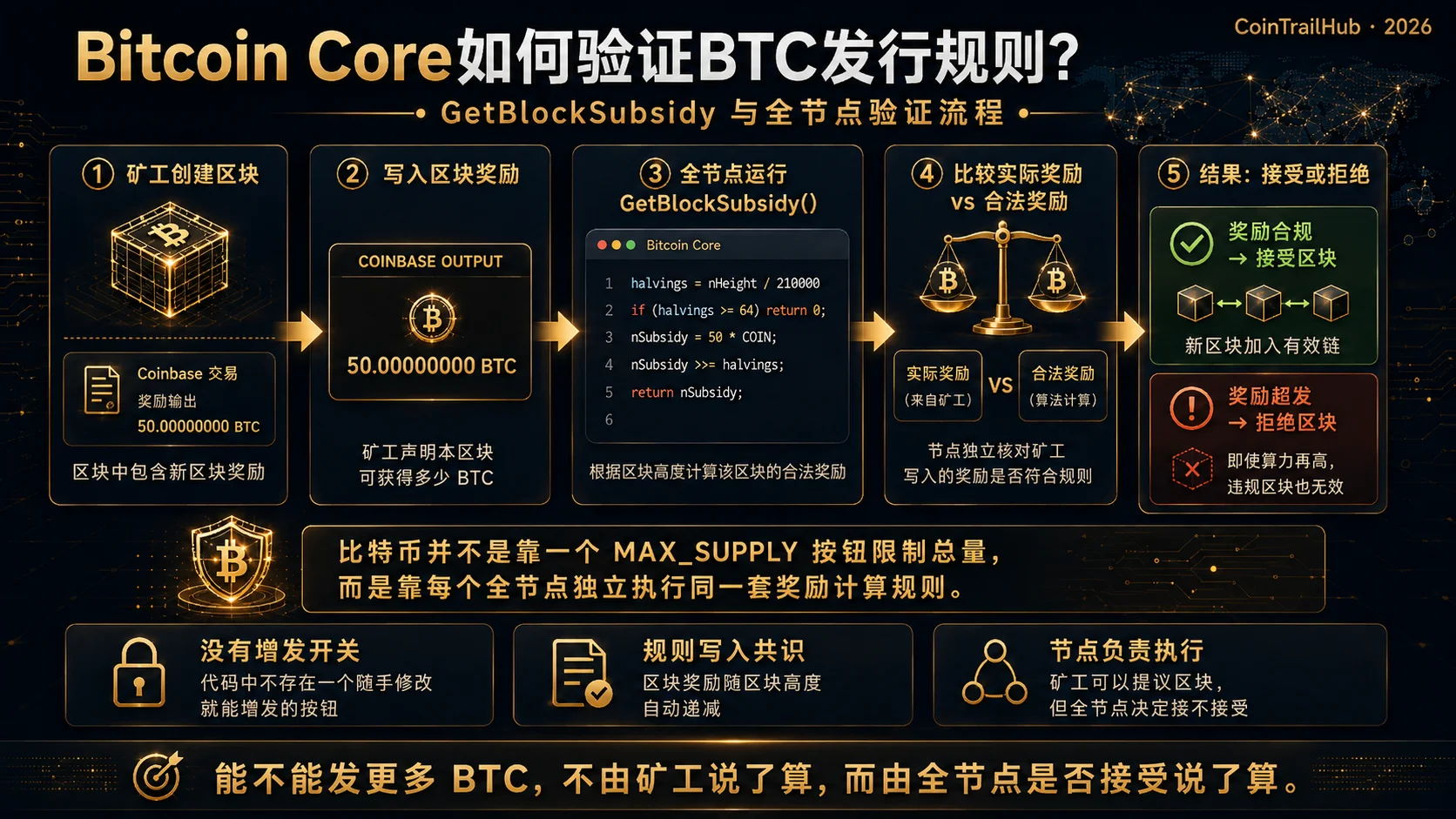
My feeling after reading this code: the hardest guarantee of Bitcoin's monetary issuance rules is that they don't need to be trusted — anyone can read this code, run it on their own computer, and verify that every block's reward conforms to the rules. This is completely different from central-bank monetary policy: you can look up the Fed's balance sheet, but you can't "run the Federal Reserve Act" to verify it didn't violate anything. Bitcoin, you can.
For how full nodes execute consensus rules, see Why Can't Anyone Control Bitcoin? A Breakdown of Its 17-Year Consensus Mechanism and What Is a Bitcoin Node? Full Nodes, Light Nodes and Miners Explained.
Verification 3: the fork game — the 2017 BCH scaling war already answered this
If Verification 2 tells you "there is no print-more switch at the code level", Verification 3 tells you: even if someone changes the code, they can't change Bitcoin.
This was the most information-dense step of the whole verification. The 2015–2017 "Blocksize War" (also called the Bitcoin Civil War) was the closest event in Bitcoin's history to "core rules being changed". It gives us a real, price-data-verifiable case to answer the question "can the rules be changed".
Background (30-second version):
At the time, each Bitcoin block only had 1MB of space, and as usage grew the network became congested. Miners and some businesses wanted to scale to larger blocks (8MB or even 32MB), while the mainstream developer community favored Segregated Witness (SegWit) + the Lightning Network — keeping the main chain decentralized.
After two years of debate, on August 1, 2017, the scaling camp executed a hard fork and created a new chain with an 8MB block limit — Bitcoin Cash (BCH). For the full history of this debate, Bitcoin Magazine has a detailed series; this was the closest real event to "core rules being changed" in Bitcoin's history.
The result as of August 2026:
The outcome of this fork is already very clear — the market voted with money and chose the un-tampered original chain.
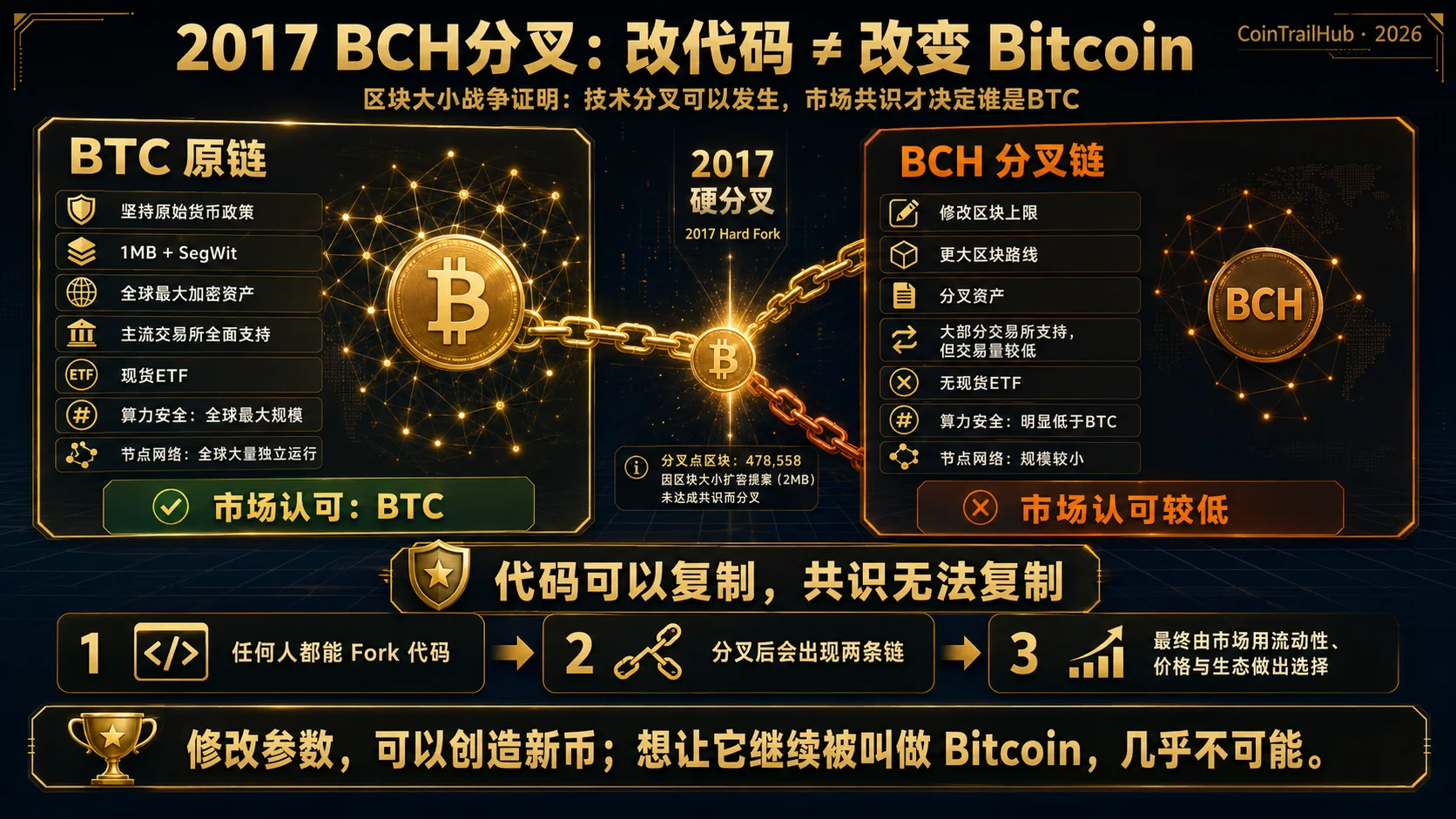
| Dimension | BTC (original chain, 1MB+SegWit) | BCH (fork chain, 32MB) |
|---|---|---|
| Rule consensus | The chain that stuck to the original monetary policy | The chain that changed the block limit |
| Market recognition | The world's largest crypto asset, trillion-dollar market cap | A fork asset, marginalized in the ecosystem |
| Ecosystem size | Fully supported by mainstream exchanges, has spot ETFs | Supported by most exchanges but with very low volume |
| Hashrate security | The largest in the world | Clearly below BTC |
| Node network | A large number of independently run nodes worldwide | Smaller scale |
This case proves three key points:
First, a hard fork has zero technical barrier. You can copy a copy of the Bitcoin Core code tomorrow, change the total to 42 million, name it "Bitcoin 2.0", compile it and run it. This needs no one's approval. The barrier to forking is zero — but the barrier to getting the market to follow you is astronomical.
Second, "changing the code" and "changing Bitcoin" are two completely different things. BCH chose a different direction on some parameters (e.g. larger block capacity, lower fees), but the market ultimately chose the "un-tampered" original chain through liquidity, price and ecosystem size. Bitcoin's value is not in its code parameters — it's in the inertia of consensus. Code can be copied; the global network of tens of thousands of nodes and a trillion-dollar market cap cannot.
Third, a failed change attempt actually strengthens the "unchangeable" consensus. Before 2017, "can Bitcoin's core rules be changed" was a theoretical question. After 2017, it's a market-verified question — the answer: technically yes, in the market no. And this answer itself has now become one of Bitcoin's deepest moats.
Back to the 21 million question: if someone wanted to create "42 million Bitcoin" via a hard fork, there's no technical obstacle at all. But the coin on that chain will never be recognized as BTC, and its value may trend toward zero — like the dozens of Bitcoin fork coins that already exist. And the 21 million cap on the original chain, because this fork attempt failed, has actually become even more "unchangeable".
For a more complete economic analysis of the underlying game-theory logic, see Why Is Bitcoin Valuable? Scarcity, Decentralization and Network Effects.
Verification 4: if someone really pushed 42 million BTC in the future, what would happen?
The first three verifications explained:
- why unilaterally changing the 21 million is nearly impossible;
- why developers and miners can't directly change the rules;
- why a hard fork can only create a new chain and can't automatically become BTC.
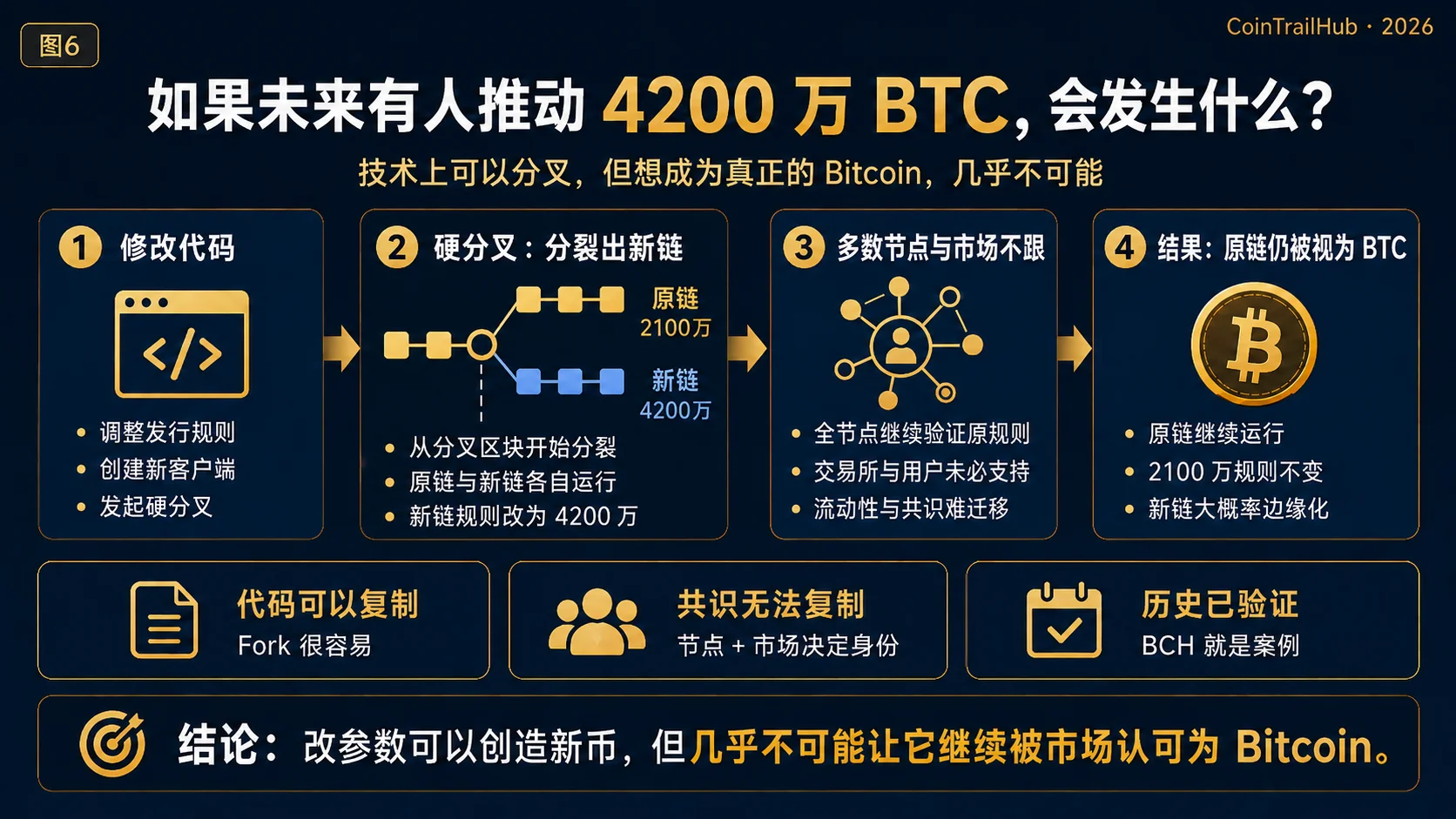
But there's a deeper question: what if an extreme scenario arises — and the majority actually agrees to print more?
This is a reasonable follow-up, and the key to understanding Bitcoin's governance model.
Assume an extreme scenario
Assume one day in the future:
- Bitcoin Core developers propose changing the total to 42 million (reasoning might be "miner revenue is insufficient, network security is threatened")
- Most miners support it (because printing more means more block rewards)
- Some users also support it (worried about network security)
What would happen?
Answer: it wouldn't "change" Bitcoin — it would "split off" a new coin
The result is not "Bitcoin becomes 42 million" — instead, two chains appear:
| Chain A (original) | Chain B (fork chain) | |
|---|---|---|
| Total supply | 21 million | 42 million |
| Nodes | Nodes that refuse to upgrade keep running the original rules | Nodes that upgraded to the new rules |
| What it's called | BTC (in the eyes of those who stick to the original rules) | Named by the market (a label like "BTC4200") |
| Who decides which is the "real Bitcoin" | The market. Which one exchanges list as BTC, which users hold, which new buyers buy | — |
This is the same logic as Ethereum Classic (ETC)
After the 2016 Ethereum The DAO incident, the community split over whether to roll back the hacker's transaction. The minority insisted "code is law" and refused the rollback — and so Ethereum Classic (ETC) and Ethereum (ETH) came to exist.
The same logic applies to the 21 million supply cap: if someone proposes printing more and executes a hard fork, the chain that sticks to the original 21 million rule will continue to exist. And history tells us — the market tends to choose the "unchanged" chain (BCH proved this; the ETC vs ETH case went the other way precisely because the rollback side had more supporters).
Consensus doesn't stop change — it decides which version is called Bitcoin
This is the single most important sentence for understanding Bitcoin governance: the role of the consensus mechanism is not to physically stop anyone from changing the code — it's to let the whole world know which version is the Bitcoin everyone recognizes.
Anyone can propose a change, write code, and execute a hard fork. But between "proposing" and "being accepted" lies the independent decision-making of a large number of independently run node operators, miners, exchanges, holders and developers around the world. This coordination cost is Bitcoin's most solid line of defense.
Will Bitcoin ever issue more BTC?
Rephrase the question and you get the answer above: technically possible (fork), in the market impossible (no one follows). Bitcoin's history has repeatedly verified this — not verified theoretically, but verified with real money.
Who actually decides BTC's rules?
Verification 4 made us understand a key point: consensus is not magic — it is the stacking of one-by-one independent decisions by each layer of participants.
Many people ask "who controls Bitcoin", and the answer is not a person or a group, but a coordination system with no central administrator:
Bitcoin Core developers → propose code improvements (anyone can propose)
         ↓
      Miners → choose which software version to run for mining
         ↓
    Full-node operators → independently verify each block conforms to the rules (drop non-conforming ones)
         ↓
      Exchanges → decide which chain's asset is called "BTC"
         ↓
      Users/holders → decide which to buy and which to hold
         ↓
      The market → delivers the final verdict through price and liquidity
Bitcoin Core developers are not Bitcoin's boss — they can only propose, not enforce. Miners are not Bitcoin's owners — they provide a security service but cannot overturn consensus rules. Full-node operators are not a voting body either — they each independently execute the same set of rules, forming a distributed execution network rather than a committee.
It is precisely this design of "no one is in charge, yet the rules still get enforced" that makes Bitcoin's consensus mechanism harder to change unilaterally than any centralized decision system. For how full nodes execute these rules, see What Is a Bitcoin Node? Full Nodes, Light Nodes and Miners Explained.

An overlooked number: actual circulating supply is far below 21 million
Many people discussing the "21 million cap" overlook a number that matters a lot for holding decisions: the actually-circulating BTC is far from 21 million.
I didn't understand why this mattered at first either, until I ran the numbers:
Lost BTC comes from three sources:
| Source of loss | Estimated amount | Note |
|---|---|---|
| Satoshi's early-mined coins | On the order of a million (usually estimated ~1.1 million BTC) | Mined 2009–2011, never moved, founder gone for 14 years |
| Lost private keys | ~2.5–3 million BTC | Not stored properly when early BTC was nearly worthless. Classic case: British engineer James Howells accidentally threw away a hard drive containing the private keys to 8,000 BTC |
| Sent to burn addresses | ~thousands of BTC | Deliberately or accidentally sent to addresses whose private keys no one holds, forever unrecoverable |
Estimates differ across on-chain research firms — Chainalysis, Glassnode and Coin Metrics each use different models and assumptions, so their specific numbers don't fully agree. But the consensus across all parties is: permanently lost BTC may reach the order of millions of coins.
Adding the roughly 1.25 million still to be mined, the truly tradable BTC supply is significantly below the theoretical 21 million maximum. (Specific numbers differ by methodology, and it's not recommended to use this for precise investment calculations.)
What does this mean for holding decisions?
| If you only stare at "21 million" | If you also consider "actual tradable supply far below 21 million" |
|---|---|
| Think ~6% of BTC remains to be mined → dilution risk is tiny | Annualized inflation is only ~0.83%, dropping to ~0.4% after the 2028 halving |
| Use 21 million as the denominator when pricing | Actual tradable supply is significantly reduced by loss, so scarcity is underestimated |
| Ignore the fact that loss is irreversible | The future total will only be less than 21 million, never more |
This is similar to gold — historically large amounts of gold sank to the seafloor or vanished with civilizations — but Bitcoin is more extreme: gold can still be salvaged, while BTC with a lost private key never comes back. Bitcoin's total supply "approaches 21 million" before 2140, and may then slowly decrease due to continued loss. It is not constant — it is irreversibly shrinking.
You can check the current total mined yourself using the Blockstream explorer or Blockchain.com — this is Bitcoin's most core transparency: supply data is not "officially announced", it is independently verifiable by anyone on their own computer.
My judgment logic: what does an unchangeable supply mean for holding decisions
After verifying the three dimensions above, I started thinking about a question: what does this conclusion mean for my decisions?
My judgment framework:
An unchangeable supply cap solves the "floor risk of long-term holding" — not "whether the short-term price goes up".
| What the supply cap guarantees | What it does not guarantee |
|---|---|
| Positive: no future "surprise issuance" diluting your holdings | Risk: doesn't guarantee BTC's price will rise |
| Positive: transparent monetary rules, not dependent on any person/institution's promise | Risk: doesn't guarantee no short-term drops (it has dropped 80%+ multiple times) |
| Positive: supply is known, verifiable, irreversible | Risk: doesn't guarantee demand growth (demand depends on adoption, macro environment, regulation, etc.) |
| Positive: after 2140 the total only decreases | Risk: doesn't guarantee Bitcoin will be widely adopted |
This is why understanding the supply cap matters:
If your core reason for allocating BTC is "this is a scarce digital asset", then you must be able to answer "is this scarcity real". If the scarcity can be changed, the foundation of the entire investment thesis collapses.
Conversely, if you only bought because "you saw others making money" — whether the supply cap can be changed doesn't matter to you, because you'll probably sell at the next 80% drop.
My personal conclusion: after this verification, I moved "BTC's scarcity is real" from "I heard it" to "I verified it" — which gives me the confidence not to be driven by panic during major market drops. The confidence of long-term holding doesn't come from "believing it will rise", but from "understanding what its underlying logic is".
The pitfalls I hit: because I didn't understand the supply mechanism, these claims scared me
Pitfall 1: seeing "Bitcoin fork" news and thinking the supply had been changed
Scenario: once in 2023 I saw the news "Bitcoin SV scales blocks to 4GB" — at the time I didn't understand it and thought "someone changed Bitcoin's rules, Bitcoin is doomed". Later I learned BSV was just a re-fork of the BCH fork chain, with nothing to do with the Bitcoin main chain.
Cause: I hadn't figured out the fork mechanism — "someone forked the Bitcoin code" and "Bitcoin was changed" are completely different things. Anyone can fork a Bitcoin, but that doesn't mean anyone in the market buys it.
Lesson: a fork coin ≠ Bitcoin. Next time you see "X forks Bitcoin" news, just look at two things: ① how many times lower the price is, ② how many times lower the hashrate is. If the price is 500x lower and the hashrate 300x lower — that fork chain has nothing to do with Bitcoin.
Pitfall 2: thinking "open source" means "anyone can change it", worrying about malicious developers
Scenario: when I first encountered open-source projects, I worried "the code is on GitHub and anyone can submit a PR — what if someone secretly merges print-more code?"
Cause: I didn't understand Bitcoin Core's code-review process — it's a project with dozens of maintainers, hundreds of contributors, and every line of code watched by countless eyes. More importantly, code being merged ≠ full nodes installing it.
Lesson: Bitcoin Core is not a project "anyone can change" — it may be one of the most strictly code-reviewed open-source projects in the world. Even if someone tampers with the code — full-node operators won't automatically upgrade. Bitcoin's rules are not decided by the code repository, but by each person running a full node, independently. On private-key security, see What Is a Crypto Wallet? Wallet Addresses, Seed Phrases and Asset Security (2026).
Pitfall 3: taking the S2F model's price predictions seriously
Scenario: when I first learned the S2F (stock-to-flow) model in 2024, I saw PlanB's chart — BTC's price following the S2F line — and thought "isn't this scientific prediction". But when BTC dropped to about $16,000 in 2022, the S2F model had predicted about $100,000. A deviation of over 80%.
Cause: S2F only considers the supply side and completely ignores the demand side, the macro environment and regulatory risk. It uses a single-line logic of "stronger scarcity → higher price", which looks right in a bull market — but that's correlation, not causation.
Lesson: S2F's core value is quantifying scarcity — Bitcoin's stock-to-new-supply ratio has already reached a high level, which is one of the quantitative indicators many people use to discuss its scarcity. But using it to understand the trend change in supply scarcity — correct. Using it to predict short-term price — wrong. These are two completely different uses. S2F data can be independently verified on Glassnode and Coin Metrics.
Decision framework: when the supply cap matters most to you
| Your situation | Importance of the supply cap | Recommendation |
|---|---|---|
| Considering long-term holding (3–5 years+) | 5/5, the most critical premise | Spend 2 hours verifying the supply-cap logic, confirm you can accept the risk |
| Just short-term trading (within months) | 1/5, not very important | The core short-term variables are market sentiment and liquidity, not supply scarcity |
| Allocating BTC as "digital gold" | 5/5, must verify | If you can't confirm the scarcity is real, the "digital gold" narrative doesn't hold |
| Comparing BTC's and ETH's long-term value | 4/5, a key difference | BTC's fixed supply and ETH's PoS issuance model are completely different logic — this directly affects long-term price trends |
| Worried about macroeconomics and currency debasement | 4/5, very important | In a fiat world of endless money printing, absolute scarcity is BTC's most fundamental value proposition |
| Just starting to learn about Bitcoin | 3/5, need to know but not dig deep | First understand what BTC is, then come back to this article |
Core principle: if your holding horizon is >3 years, the supply-cap logic verification is worth doing yourself — not just reading this article, but going through the three-step method in my "Verification method" chapter yourself. The confidence for holding BTC long-term comes from your own verification, not from anyone's article.
FAQ
Q1: So is 21 million absolutely 100% unchangeable?
If "unchangeable" means "technically impossible" — no. Anyone can fork the code and create a new coin. If "unchangeable" means "nearly impossible in game theory" — yes. No rational person would spend huge cost executing an action doomed to fail.
A more accurate statement than "100% unchangeable" is: so far, every hard fork that tried to change Bitcoin's core rules has failed; each failure makes the next attempt harder to succeed. The 21 million cap is not a static guarantee, but one that gets reinforced with each challenge.
The 21 million is not "unmodifiable", but rather a question of "after modification, can it still be called Bitcoin" — this is the most core sentence for understanding Bitcoin's supply cap.
Q2: Since there's no MAX_SUPPLY in the code, what if 21 million is calculated wrong?
It can't be calculated wrong — 50 × 210,000 × 2 = 21,000,000 is an exact mathematical relationship. But there's one subtlety: because the block reward's smallest unit is 1 satoshi (0.00000001 BTC), some block rewards, after many halvings, may have precision rounding when divided by 2. This means the actually-mined total will be slightly less than 21 million (by about tens of thousands of satoshis). Note the direction: it's less, not more.
Q3: Can quantum computers create more Bitcoin?
No. Quantum computers threaten the ECDSA signature scheme — if they can crack private keys, they can "steal" existing BTC, but they can't "create" new BTC. Because the only way to create new BTC is a block reward that conforms to the GetBlockSubsidy() rule — and this rule is enforced by full nodes, independent of the signature scheme.
Moreover, NIST standardized post-quantum cryptography (PQC) algorithms in 2024, and the Bitcoin community has a clear quantum-resistant upgrade path. The global banking system also relies on ECDSA and RSA — the quantum threat is not a Bitcoin-only problem.
Q4: Can a 51% attack change the total supply?
No. A 51% attack lets the attacker reorganize recent blocks (to double-spend), but not modify consensus rules. If a miner with 51% of hashrate produces a block that pays itself a 1,000 BTC reward, full nodes running GetBlockSubsidy() find the reward non-conforming and reject it directly — no matter how long that chain is or how much hashrate was spent.
Full nodes follow protocol rules, not blind "longest chain" obedience. For the details of this mechanism, see Why Can't Anyone Control Bitcoin? A Breakdown of Its 17-Year Consensus Mechanism.
Q5: Is there any way to recover lost BTC?
No. The Bitcoin network has no "recover password" feature — lost private key = coins permanently gone = network rules unchangeable. This is the "absoluteness" of Bitcoin property rights: no one can confiscate your coins, but no one can help you recover lost coins either. This is completely different from the fiat system — a bank can freeze an account and a government can seize assets, but in the Bitcoin world none of these things can happen (as long as you keep your private keys safe).
Q6: After everything is mined around 2140, will miners still have incentive to secure the network?
This is the most core question of Bitcoin's long-term security model. The reality: by the 2040s, each block's reward will fall below about 0.05 BTC — by then the vast majority of miner revenue must come from transaction fees.
The optimistic side: the 2023–2024 explosion of Ordinals and BRC-20 has already proven that when on-chain activity is active enough, single-day fee revenue can exceed the block reward. The cautious side: whether this can persist to 2140 is something no one can currently confirm.
The key point: even if hashrate declines, the Bitcoin network won't "stall" — difficulty adjusts automatically every 2016 blocks, and the network keeps running. It's a gradual process, not a sudden collapse.
Q8: Will Bitcoin be forced to change the 21 million cap in the future because miner revenue declines?
This is one of the most theoretically plausible reasons for a change to be proposed. As block rewards keep halving, if transaction-fee growth isn't enough to offset the decline in miner revenue, someone might propose printing more in the name of "maintaining network security".
But historical experience shows that when facing similar challenges, the Bitcoin community usually prioritizes adjusting the fee market, developing layer-2 networks (like Lightning) and boosting transaction demand, rather than changing the supply rule. The reason is simple: the 21 million cap is itself part of BTC's value narrative — changing it is equivalent to shaking the asset's entire fundamental.
And even if someone pushes for printing more, it returns to the logic of Verification 4: the proposer needs to convince global nodes, miners, exchanges and users — and this coordination cost shows no sign of decreasing in reality.
Q7: Should I buy BTC because of the 21 million cap?
No. A fixed supply is only one dimension of BTC's value logic, not the only one. Your reason to buy should be: you understand BTC's core value proposition (scarcity + decentralization + self-custody + censorship resistance), and these attributes make sense in your personal asset allocation.
If your only reason to buy is "21 million cap so it will rise" — that's still speculation, not investment. I personally decided to allocate only after understanding Bitcoin's complete value logic; the supply cap is just one cornerstone of that logic.
Summary
Looking back on these 3 months of verification, my biggest takeaway is: Bitcoin's most ingenious design is not "how meaningful the number 21 million is", but "the mechanism that guarantees this number can't be changed doesn't need to rely on anyone".
The final conclusion in three sentences:
Math guarantees that 21 million is the inevitable result of the supply rule. 50 BTC × 210,000 × 2 = 21,000,000, independently verifiable by anyone with junior-high math.
Code guarantees that the supply rule can be audited by anyone.
GetBlockSubsidy()is under 30 lines of code, with no switch called "print more" — the only way to change it is to change the initial reward or the halving interval, and any such change is a hard fork no full node will accept.Game theory guarantees that even if someone changes the code, the market won't follow. The 2017 BCH fork war already verified: forking is technically easy, but getting the global node network and a trillion-dollar market cap to follow you is a pipe dream. Each fork failure makes the original chain's rules even more unshakable.
So the 21 million is not maintained by "belief" — it's maintained by three layers of guarantees: math, code and game theory. Understanding this is the first step toward judging whether BTC is worth holding long-term.
Related reading
- What Is Bitcoin (BTC)? How It Works, Value and Risks (2026) — the first lesson of BTC, prerequisite reading for this article
- Why Is Bitcoin Valuable? Scarcity, Decentralization and Network Effects — the supply cap is the cornerstone of the value logic; here is the complete value-analysis framework
- Why Can't Anyone Control Bitcoin? A Breakdown of Its 17-Year Consensus Mechanism — understand why full nodes are the ultimate enforcer of the rules
- What Is a Bitcoin Node? Full Nodes, Light Nodes and Miners Explained — go deeper into the role and verification mechanism of full nodes
- Is Bitcoin Mining Still Profitable? Four Things to Calculate First (2026) — the impact of halving on miner revenue and mining economics
- Bitcoin vs Gold: Value, Risk and Liquidity Compared (2026) — if you're comparing scarcity assets, this helps you understand the difference between BTC and gold
- What Is a Crypto Wallet? Wallet Addresses, Seed Phrases and Asset Security (2026) — understand self-custody and private-key security, protect your BTC
Disclaimer
This article is only a record of technical verification of Bitcoin's supply cap and a sharing of a personal judgment framework, and does not constitute investment advice, financial advice or trading advice.
Crypto asset prices are highly volatile, and historical events (such as the BCH fork) do not represent future results. Supply scarcity does not guarantee that the price will rise. Users should judge carefully according to their own risk tolerance and be subject to local laws and regulations.
Any behavior involving crypto asset allocation should first fully understand the risks, then make independent decisions based on your own financial situation. Only use money you can completely afford to lose.
- Bitcoin Core consensus codeGetBlockSubsidy block reward calculation logic
- Bitcoin whitepaperDesign goals of an electronic cash system
- Glassnode on-chain dataSupply and S2F on-chain metrics
- Coin Metrics network status reportsNetwork and supply data methodology
- Blockchain.com block explorerCheck the total amount mined
- Blockstream explorerIndependently verify on-chain supply data
- CoinGecko market dataBTC/BCH market cap and price cross-check
- Bitcoin Magazine historical coverageSeries on the 2017 blocksize war
- NIST post-quantum cryptography standards2024 PQC algorithm standardization
See ourEditorial Policy and the correction process in ourCorrections Policy.
The CoinTrailHub editorial team focuses on crypto education for beginners, exchange security and P2P trading risk. This article is compiled from official sources and public data, reviewed by humans, and strives for accuracy but is not investment advice.
Last updated:2026-08-09 · Content reviewed by humans · Learn more
© 2026 CoinTrailHub · Original content. Reproduction or rewriting without permission is prohibited.