
Why Is Bitcoin Valuable? Scarcity, Decentralization, Network Effects

Table of contents

Binance new user rewards
20% trading fee rebate
Official Binance registration. Complete identity verification (KYC) to trade and withdraw.
Many people believe Bitcoin has no value because, unlike stocks, it doesn't generate profits, and unlike bonds, it doesn't pay interest. But over the past decade-plus, Bitcoin has grown from an experimental digital currency into a global asset that consistently tops the crypto market-cap rankings — and it has entered the traditional financial system. In 2024, the U.S. approved spot Bitcoin ETFs, allowing traditional financial institutions to access the Bitcoin market through regulated channels and further broadening its investor base.
So why is Bitcoin worth anything?
The answer is not a single factor — it's that scarcity, decentralization, security, global liquidity, and network effects together sustain the market's consensus on Bitcoin's value.
If you've been around crypto for more than a month, you've certainly heard: "Bitcoin is a bubble. It has no intrinsic value."
The criticism sounds reasonable. Stocks are backed by corporate profits, bonds pay interest, real estate can be rented out. What about Bitcoin? It produces no cash flow, pays no dividends, has no company behind it, and no government guarantee. Judged through a traditional valuation framework — the discounted cash flow (DCF) model — which only considers predictable cash flows, Bitcoin cannot produce a valuation result in the conventional sense.
But the problem is: the DCF model is designed for cash-flow-producing assets. Using it to measure something that produces no cash flow is like measuring length with a thermometer. This doesn't mean Bitcoin necessarily has value; it means this class of asset requires a different analytical framework. Gold also produces no cash flow, yet no one denies gold has value. The same goes for art and collectibles — their value comes from consensus, not profit.
This article is not trying to convince you to buy Bitcoin. But if you want to understand why an asset with "no cash flow" could grow from zero, over more than 17 years, to being included in U.S. spot ETFs and listed on public companies' balance sheets — this article gives you a systematic answer.
We recommend first reading What Is Bitcoin (BTC)? How It Works, Value, and Risks (2026) to understand the basics of BTC, then come back — this article will read more smoothly.
This article does not constitute investment advice; it is educational content on the logic of value.
TL;DR: Why does Bitcoin have value?
Simply put, Bitcoin's value comes from five factors:
- Scarcity: the protocol caps the maximum supply at about 21 million coins, with supply rules that are public, transparent, and independently verifiable.
- Decentralization: no single company or government controls the network's operation; globally distributed full nodes jointly verify transaction rules and block validity.
- Security: proof of work (PoW) and economic incentives protect the transaction record; the core protocol has been battle-tested for over 17 years with no major protocol-level attack causing network failure.
- Global liquidity: users, trading platforms, and financial institutions worldwide form a 24/7 uninterrupted market.
- Network effects: the more holders, developers, and infrastructure there are, the higher the network's value and the harder it is to replace.
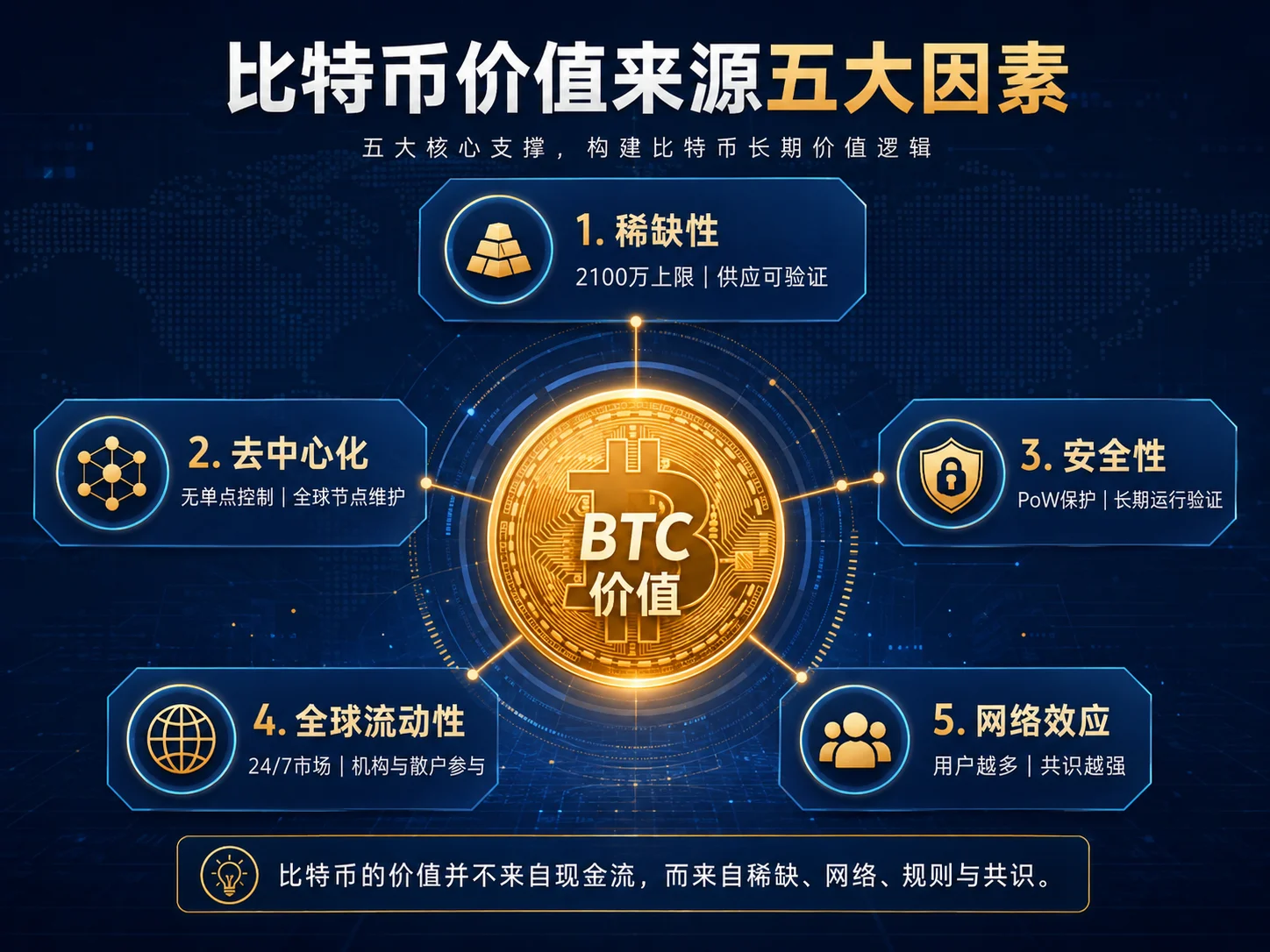
Each factor is analyzed in detail below.
Core thesis
Bitcoin's value does not come from corporate earnings, but from:
- Verifiable scarce supply — a 21-million total cap with public, transparent issuance rules
- A permissionless global network — anyone can send and verify transactions without approval
- A long-running security track record — a core protocol verified over more than 17 years of operation
- Liquidity and consensus formed by market participants — a global, 24/7 uninterrupted trading market
But it still faces regulatory, volatility, and technical risks; a value judgment must be based on a comprehensive understanding of these factors.
Does Bitcoin have intrinsic value? Why traditional valuation frameworks don't apply
The implicit assumptions of the DCF model
In traditional finance, an asset's "intrinsic value" is usually estimated with DCF (Discounted Cash Flow): forecast how much cash flow the asset will generate in the future, then discount it back to today.
DCF value = the sum of future-period cash flows / (1 + discount rate)^n
This model implicitly assumes several things:
- The asset must produce predictable cash flows. Stocks have profits, bonds have coupons, real estate has rent.
- A "reasonable" discount rate exists. Usually the risk-free rate (such as U.S. Treasury yields) plus a risk premium.
- Future cash flows can be reasonably forecast. At least within a range.
Bitcoin satisfies none of these assumptions. It produces no cash flow, has no "discount rate" to speak of, and has no "future profits" to forecast.
What about gold?
Gold also produces no cash flow, yet for thousands of years humanity has treated it as a store of value. Gold's market cap is about $13 trillion, of which industrial use accounts for only part of demand — a large share of demand comes from jewelry and investment reserves, which is essentially human consensus.
If you valued gold with the DCF model, the conclusion would also be "zero intrinsic value." Yet no one calls gold a bubble — because it has passed the test of time.
Bitcoin and gold share one characteristic: their value comes not from cash flow, but from scarcity + consensus + secure storage costs. The difference is that gold's consensus has accumulated over thousands of years, while Bitcoin's has accumulated over more than 17 years.
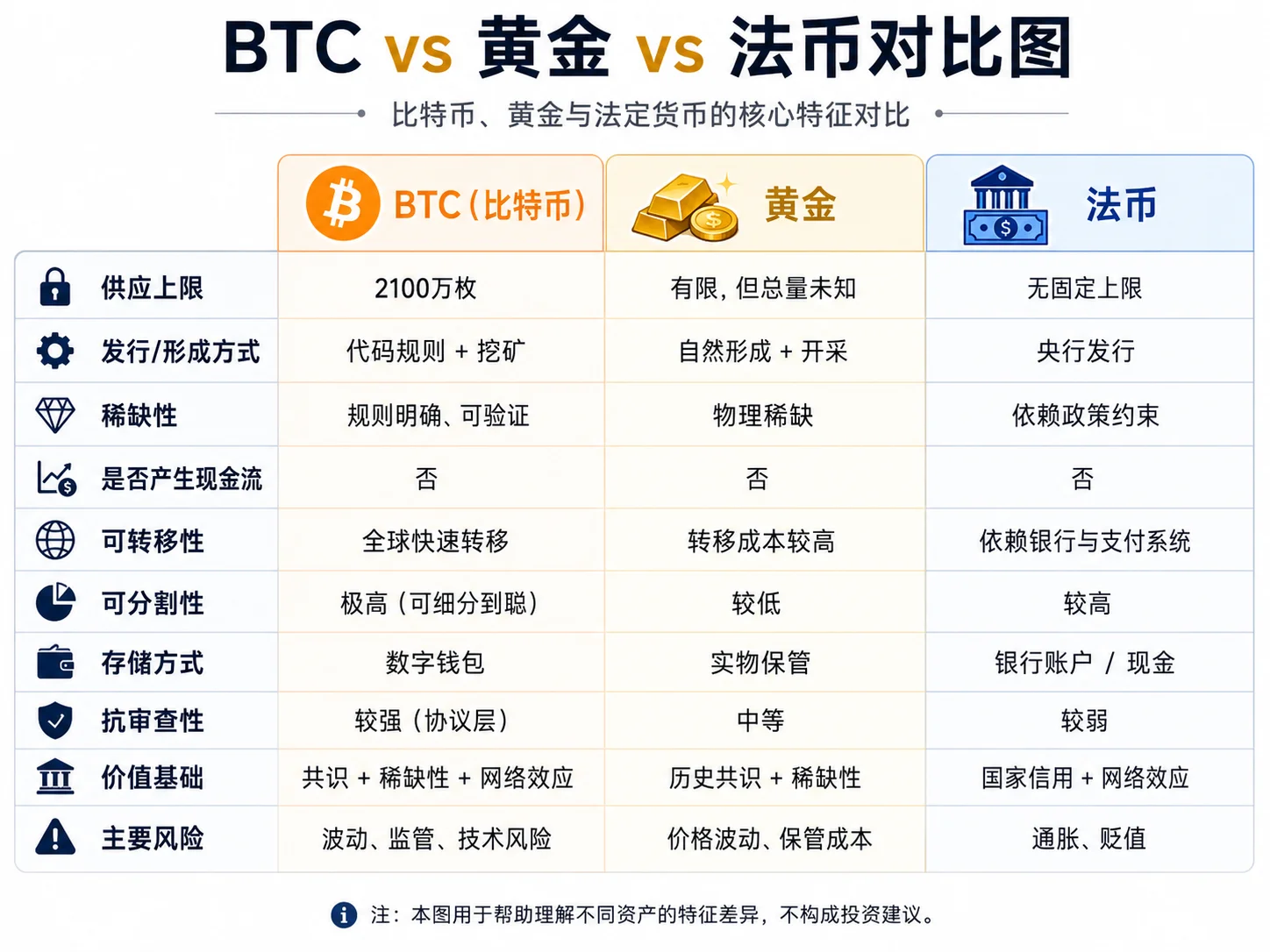
Where does money's value come from?
Going further, even the fiat currencies we use every day (the U.S. dollar, the euro, etc.) don't get their value from "intrinsic value" — but from:
- Scarcity (central banks control the issuance)
- Network effects (everyone accepts it)
- Legal tender status (you must use it to pay taxes)
- Trust (faith that the government won't let it collapse)
Bitcoin lacks the "legal tender" element, but in terms of transparency of supply rules, Bitcoin differs markedly from the traditional monetary system — the 21-million cap is maintained by code rules and network-wide consensus, whereas fiat issuance depends on central-bank decisions.
For Bitcoin's fundamentals, see Why Bitcoin Doesn't Need Banks: UTXO, Nodes, PoW.
Why is Bitcoin scarcer than ordinary digital assets? The 21-million cap explained
Why "scarce" doesn't equal "valuable"
Scarcity is a necessary condition for value, but not a sufficient one. The fingerprint on my left hand is unique in the world, but it's worthless — because nobody needs it.
For scarcity to create value, two conditions must hold at once: people want it (demand) and supply can't be easily increased (supply rigidity).
Bitcoin's scarcity is meaningful because:
- The 21-million cap is maintained by public code rules and network consensus, not by a single institution's promise.
- Hundreds of millions of people already want it.
- The only way to increase supply is to change the consensus rules — requiring the agreement of the vast majority of nodes network-wide.
Just how hard is Bitcoin's scarcity
Bitcoin's 21-million total cap is not a "promise" written in the whitepaper — it's a mathematical rule hard-coded into the software:
- Every 210,000 blocks (about 4 years), the block reward halves
- Initial reward: 50 BTC per block
- After the 2024 halving: 3.125 BTC per block
- Around the year 2140: the last satoshi (1 sat = 0.00000001 BTC) is mined
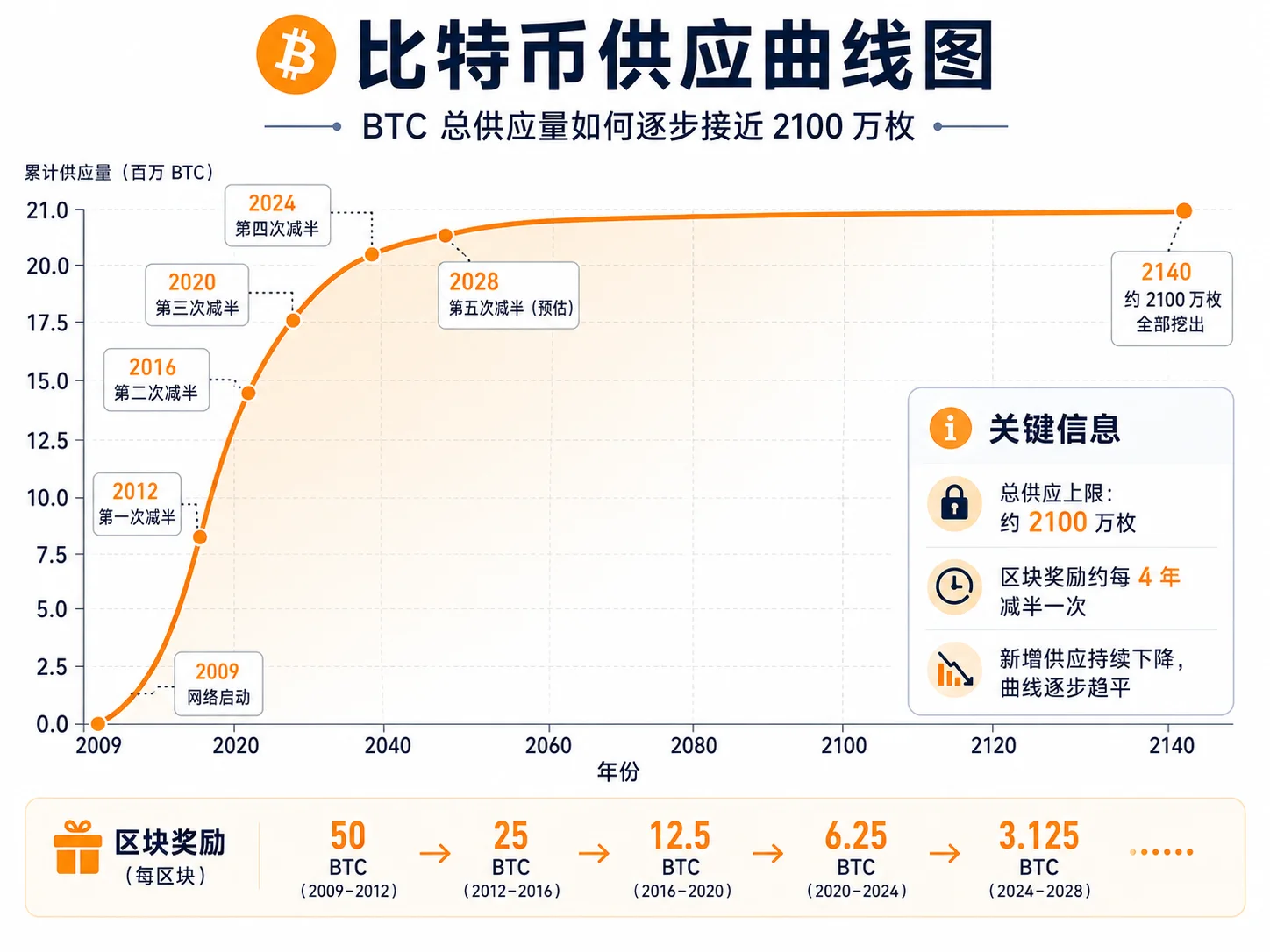
This means that, under current consensus rules, no single entity can unilaterally "print" more Bitcoin. The Federal Reserve can print more dollars, the European Central Bank can print more euros, and the People's Bank of China can adjust the money supply — but Bitcoin's supply rules are enforced jointly by network-wide nodes, and changing them requires a large number of participants to accept new consensus rules; otherwise the modified rules cannot become the mainstream network rules. This has never happened in more than 17 years.
Even if 51% of the hash rate united to change the rules, all they could do is reorganize recent blocks (a double-spend attack) — they cannot create more than 21 million Bitcoin, because full nodes reject non-compliant blocks.
Scarcity compared with gold and fiat
| Asset | Source of scarcity | Supply cap | Supply predictability | Can be unilaterally inflated |
|---|---|---|---|---|
| Bitcoin | Code + consensus | 21 million | Precisely predictable | No |
| Gold | Crust abundance + mining cost | Unknown (about 200,000 tonnes mined so far) | Depends on exploration and mining tech | Theoretically (asteroid mining) |
| U.S. dollar | Federal Reserve decisions | No cap | Depends on FOMC votes | Yes |
| Euro | ECB decisions | No cap | Depends on monetary policy | Yes |
A key distinction: Bitcoin's scarcity is digital scarcity with clear rules and a verifiable supply cap — you know exactly what the total is, how much has been mined, how much remains, and the future daily output. Gold's remaining reserves are estimates, and fiat's future issuance is entirely unpredictable.
The Stock-to-Flow model and its controversies
Stock-to-Flow (S2F) is a common metric for measuring scarcity:
S2F = existing stock / annual new production
- Gold's S2F: about 60 (it takes 60 years of production to double the existing stock)
- Silver's S2F: about 22
- Bitcoin's current estimated S2F (2026): about 120 (different calculation methods may differ)
- Bitcoin's estimated S2F after the 2028 halving: about 240
From an S2F standpoint, Bitcoin is already one of the scarcest major commodities on Earth.
But a caveat: the S2F model is not a price-prediction tool. PlanB's original paper assumes "scarcity directly determines price," but ignores variables like demand shifts, regulatory shocks, and technological substitution. In 2022, BTC's price fell far below the S2F model's predicted value, which already proved this point. S2F is a useful framework for understanding scarcity, not a basis for investment decisions. It's worth adding that many economists and market researchers believe explaining asset prices by supply scarcity alone is insufficient — demand, liquidity, regulation, and the macro environment also affect prices. The value of S2F lies in offering a quantified perspective on scarcity, not a complete pricing model.
What does Bitcoin decentralization mean? Why it's hard for a single force to control it
What "decentralization" actually protects
Many newcomers think "decentralization" means "no leader, everyone votes equally" — that's a misunderstanding.
Bitcoin's decentralization actually protects three things:
- No single point of failure: there is no single server, data center, or country that, if shut down, would cripple the network.
- No single point of control: no single person, company, or government can unilaterally change the rules.
- Permissionless: anyone can run a node, verify transactions, and participate in the network without approval.
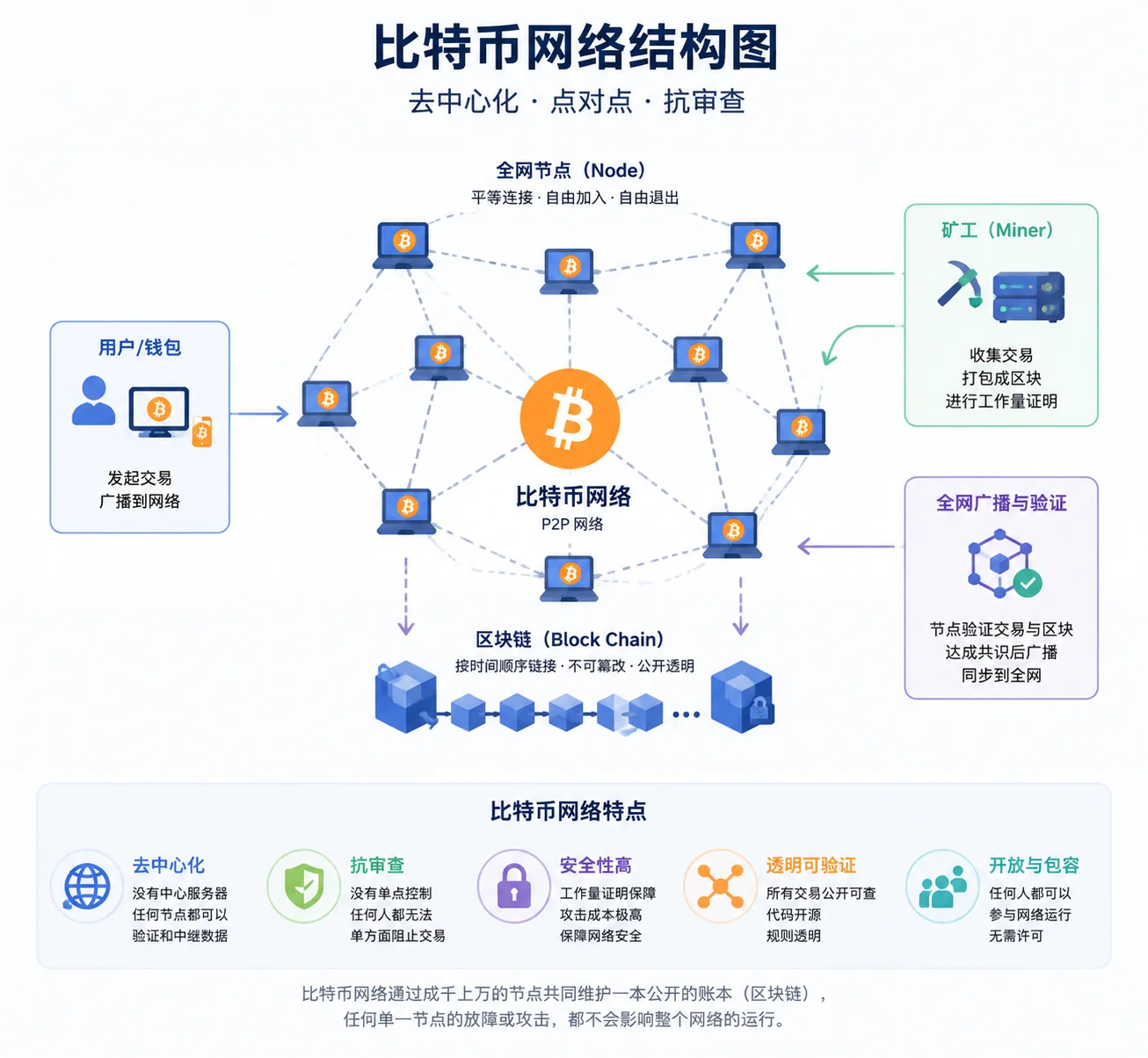
Together, these three attributes make Bitcoin a global value-transfer network that is, by design, extremely difficult for a single entity to shut down or control — it doesn't depend on a single server, a single institution, or a single jurisdiction to keep running.
The four layers of decentralization
Many discussions conflate "decentralization," but it actually occurs at four different layers:
1. Node decentralization. A large number of publicly visible Bitcoin full nodes exist worldwide (see Bitnodes live data), with the count varying by measurement method and network state, distributed across more than a hundred countries and regions. Every full node independently verifies every transaction and every block. If all of one country's nodes were shut down, nodes in other countries would keep running and the network would be unaffected.
2. Hash-rate decentralization. Bitcoin mining is distributed around the globe. Although hash rate has a geographic concentration trend (some regions have cheaper electricity), no single entity controls more than 51% of the hash rate. And even with 51% of the hash rate, one could only reorganize the most recent few blocks (a double-spend attack) — not change consensus rules or mint coins out of thin air.
3. Development decentralization. Bitcoin Core is the main implementation of the Bitcoin protocol, but it's maintained by hundreds of volunteer developers, with no CEO and no controlling company. Anyone who is unsatisfied can fork the code and create their own version — but that only affects those who follow the fork, not the mainnet.
4. Governance decentralization. Bitcoin's governance is not a voting system, but an "exit" system — if a group is unhappy with a rule change, they can keep running the original rules (a hard fork), and the market decides which chain is more valuable. This is not democracy; it's market selection.
For the underlying technical principles of blockchain, see How Does Blockchain Record Transactions? Blocks, Hashing, Proof of Work (2026).
The 2017 SegWit war: a real test of power
In 2017, the Bitcoin community erupted into a fierce conflict over "how to scale" — known in history as the "Blocksize War" or the "SegWit war."
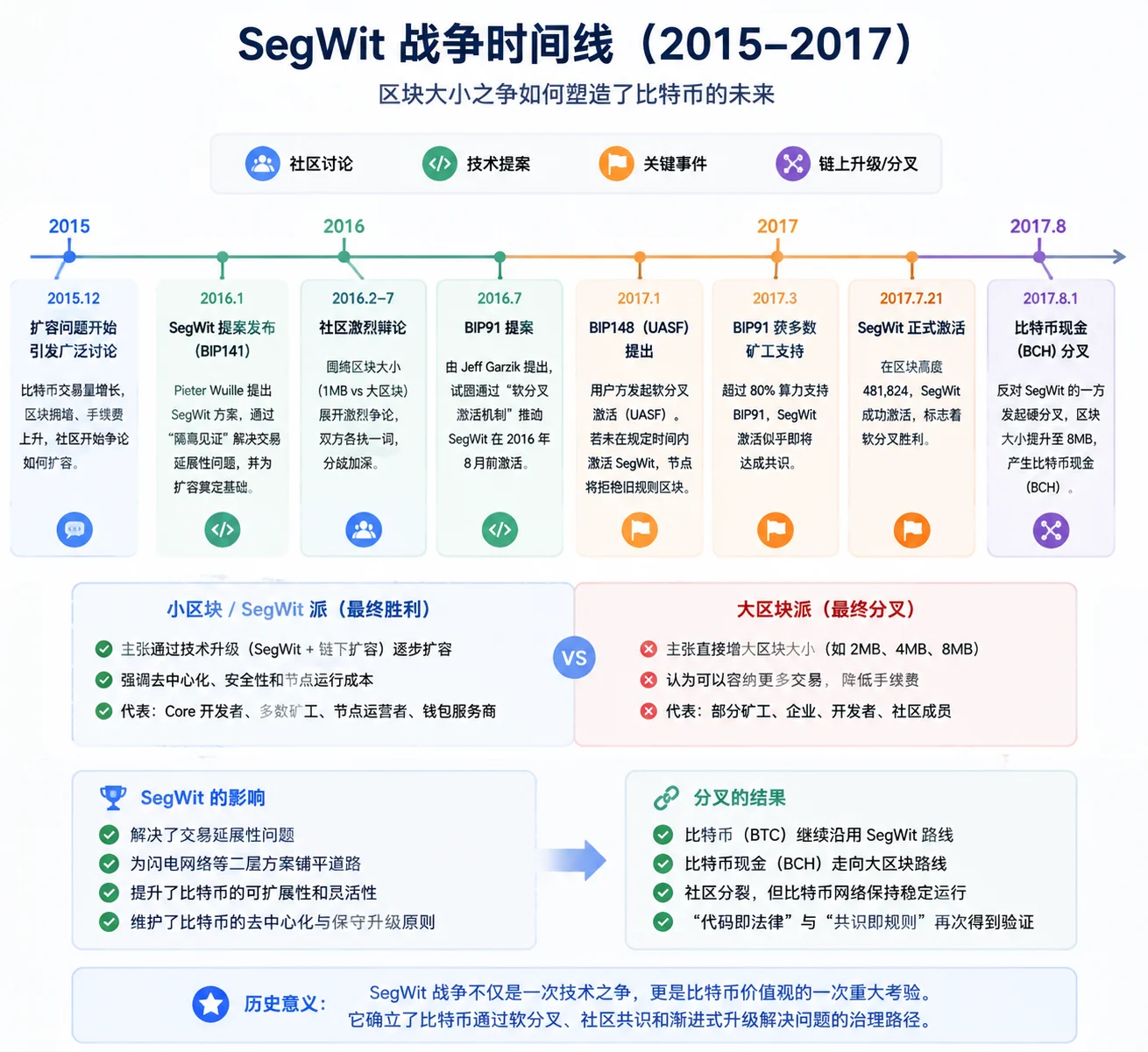
Background: Bitcoin's transaction volume was growing, the 1 MB block capacity was no longer enough, and transaction confirmations slowed while fees surged.
The two camps:
- Big-blockers: directly raise the block-size limit from 1 MB to 8 MB (or even larger) — simple and crude.
- SegWit camp: use Segregated Witness (see BIP 141) to move signature data out of the block body, effectively scaling about 2x while paving the way for layer-2 networks (the Lightning Network). Later, the community also passed BIP 148 (a user-activated soft fork) to push SegWit's final activation.
The key event: at the time, the vast majority of large mining pools and major exchanges supported the big-block solution (the New York Agreement). If Bitcoin were "miners call the shots," the scaling proposal would have passed long ago. But full-node operators and users refused to upgrade to big-block-supporting clients — the blocks miners produced were accepted by no one; hash rate alone was useless.
The outcome: SegWit was activated, and the big-block camp forked off Bitcoin Cash (BCH). BCH continues to exist as an independent crypto asset, but its market size and influence have long been clearly below BTC.
The SegWit war proved three things:
- Miners provide the security service, but the final say on rules lies with full nodes and users.
- Decentralized governance is inefficient (the debate lasted over two years), but it prevents a single interest group from hijacking the protocol.
- What's truly scarce is consensus — code is easy to copy, consensus is impossible to copy.
Censorship resistance: anyone can send and receive BTC
Why "censorship resistance" is Bitcoin's core value
In the traditional financial system, your money sits in a bank account. That account can be:
- Frozen (court orders, regulatory requirements)
- Capped (daily transfer limits, cross-border remittance restrictions)
- Denied service (banks can refuse to open an account for you)
- Monitored (every transaction is recorded and analyzed)
For most people, these limits aren't a problem — you don't need censorship-resistant money, just as a healthy person doesn't need emergency medicine. But for some people — those living in countries with runaway inflation, those excluded from the banking system, those who need to move assets across borders — censorship-resistant payments are not a theoretical need, but a real, practical necessity.
How Bitcoin's censorship resistance works technically
There is no centralized "approver." The Bitcoin network doesn't distinguish between "good" and "bad" transactions, and doesn't check the identities of sender and receiver. As long as you have a valid UTXO and the corresponding private-key signature, the transaction is accepted by the network.
Specifically:
- Full nodes verify only whether the transaction format is valid (signature correct, UTXO unspent, input/output amounts balanced), not who you are or why you're transferring.
- Miners order transactions by fee, not by the sender's identity.
- There is no "blacklist address" that the whole network can forcibly reject — an individual miner may choose not to include certain transactions, but other miners will.
This is not a bug; it's a deliberately designed feature.
It's worth noting that censorship resistance mainly means the protocol layer doesn't depend on a single approval authority — it does not mean every transaction gateway (such as exchanges or bank conversion channels) is unregulated. In practice, converting BTC to fiat or goods may still be subject to the laws of your jurisdiction.
Real use cases: why some people genuinely need it
Case one: high-inflation countries. Argentina's inflation rate exceeded 200% in 2023, with the local peso continuously devaluing. Ordinary people can't easily open dollar bank accounts, but they can buy Bitcoin to protect purchasing power. For them, Bitcoin isn't an "investment" — it's a lifeboat.
Case two: cross-border remittances. Around 200 million migrant workers worldwide send home over $600 billion each year. Traditional remittances (Western Union, SWIFT) charge 5-10% in fees and take 3-5 business days. A Bitcoin cross-border transfer can cost as little as a few dollars (on-chain) or a few cents (Lightning Network), confirming in 10 minutes to 1 hour.
Case three: the unbanked. About 1.4 billion people worldwide have no bank account, but many of them have smartphones. Bitcoin + the Lightning Network let them participate in the global economy without needing a bank's permission.
Network effects: the more people use it, the higher the value
Metcalfe's law and Bitcoin
Metcalfe's law states: a network's value is proportional to the square of the number of users. In real markets, network value doesn't grow strictly quadratically, but the theory helps explain the synergies that come with network scale — the more users, the greater the utility each user derives from the network.
Network value ∝ n² (n = number of users)
Intuitively this makes sense: if only two people have telephones, the telephone network's value is low. If a billion people have them, the value is enormous — because you can reach anyone.
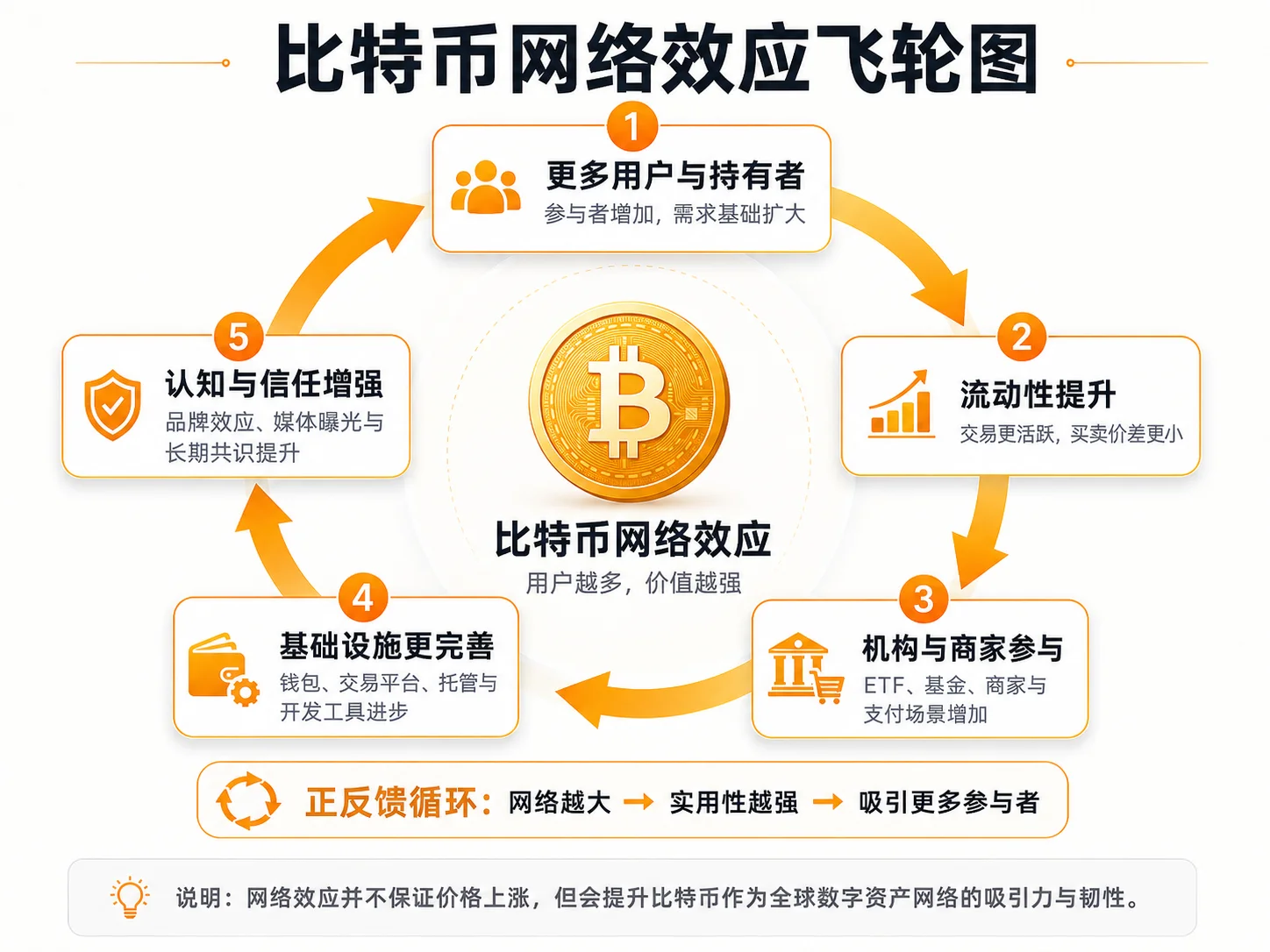
Bitcoin's network effects show up at multiple levels:
- More holders → better liquidity → more people willing to hold.
- More merchants accepting Bitcoin → Bitcoin is more useful → more merchants willing to accept it.
- More developers → better infrastructure → more use cases → more developers join.
- More media coverage → higher public awareness → more people understand → more media coverage.
This is a positive-feedback loop.
The Lindy Effect: the longer it lives, the longer it lives
The Lindy Effect states: for non-perishable things (like technologies, ideas, institutions), the remaining expected lifespan is proportional to how long they've already existed.
Simply put: a book that's been in print for 100 years is likely to stay in print for another 100. A technology that has existed for more than 17 years without dying is likely to keep existing for many more years.
The Bitcoin network launched in 2009 and, as of 2026, has run for more than 17 years, through multiple market cycles, regulatory changes, and technological evolution:
- Multiple 80%+ crashes
- "Bans" in multiple countries
- Countless "Bitcoin is dead" obituaries (over 470 of them)
- The Mt.Gox collapse (2014)
- China's total mining ban (2021)
- The FTX collapse (2022)
After every crisis, Bitcoin didn't disappear — it got stronger: hash rate recovered, users grew, infrastructure kept building. This isn't luck; it's the Lindy Effect at work.
Holder counts and the adoption curve
According to on-chain data platforms such as CoinMetrics, Bitcoin's count of holding addresses keeps growing:
- 2016: about 5 million non-zero addresses
- 2020: about 30 million
- 2024: over 50 million
- 2026: still growing
More importantly, the 2024 approval of U.S. spot Bitcoin ETFs allowed traditional financial institutions to allocate to Bitcoin through compliant channels. According to analyses by institutions such as Binance Research, this means Bitcoin's holder base expanded from "crypto natives" to "institutional investors" — a new source of demand has opened up.
For more on ETFs, see How to Buy a Bitcoin ETF? IBIT vs FBTC Comparison and Fees (2026).
Liquidity network effect: Bitcoin's moat
One of Bitcoin's biggest network effects comes from liquidity. The more traders and market makers, the tighter the bid-ask spread and the smaller the impact of large trades on market price. This forms a self-reinforcing loop:
- Better liquidity → easier for institutions to enter. When large funds allocate to Bitcoin, they need enough market depth to absorb orders without slippage. Bitcoin's average daily trading volume is far higher than other cryptocurrencies, making it the first choice for institutional allocation.
- Institutions enter → liquidity improves further. After the spot ETF approval in 2024, Bitcoin's trading depth and market-maker participation increased markedly, which in turn lowered trading costs for all participants.
- High liquidity → stronger price discovery. Bitcoin's global 24/7 trading mechanism gives it continuous price-discovery capability, though price is still affected jointly by liquidity, the macro environment, regulation, and market sentiment — this around-the-clock market structure is relatively rare among traditional assets.
This is also why "better technology" finds it hard to replace Bitcoin: a new chain can copy the code, but it can't copy the liquidity depth and global trading infrastructure Bitcoin has accumulated over 17+ years.
What's the difference between Bitcoin and gold?
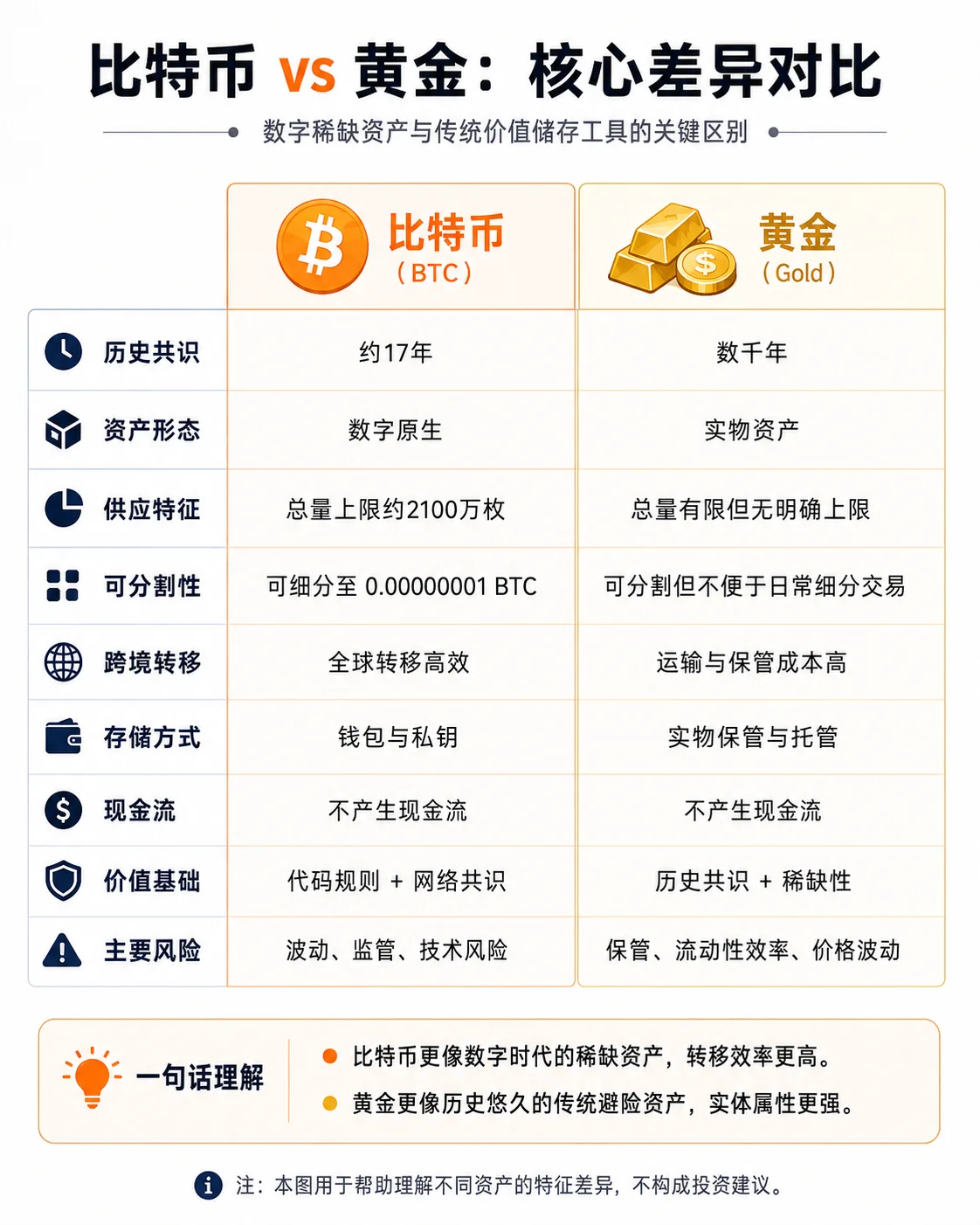
Does gold have "intrinsic value"?
A Picasso painting — the canvas and paint are worth about $100. But it sold at auction for $100 million.
Where did the other $99.99 million come from? Consensus. Enough people believe it's worth that price, and are willing to trade at that price, so it's worth that price.
The core difference between Bitcoin and gold
Gold's industrial uses (electronics, dental materials) account for only a small fraction of its total demand. Most of gold's value comes from thousands of years of human consensus around it as a "store of value." Gold itself produces no cash flow and won't "give birth" to more gold — just like Bitcoin.
But the differences are equally significant: gold has thousands of years of historical consensus and physical tangibility, and can be held and transferred without depending on any technological infrastructure; Bitcoin is a digital-native store of value, programmable, infinitely divisible, with near-zero cross-border transfer costs. The two aren't in a "who replaces whom" relationship — they're more likely to coexist long-term, each serving different scenarios and populations.
"Value" itself is human consensus
What is money? A $100 bill costs about 14 cents to print. Where does the other $99.86 come from? From everyone collectively believing that this piece of paper can be exchanged for $100 worth of goods and services.
All value — stocks, bonds, real estate, art, gold, fiat currency — at its foundation, rests on human consensus. The only differences are:
- How many years this consensus has accumulated
- How many people participate in this consensus
- How robust the institutions supporting this consensus are
Bitcoin attracted massive global attention in a relatively short time, becoming one of the fastest-growing digital assets in history. This doesn't mean it will go up forever — it means that the criticism "it has no intrinsic value," if applied with the same logic to gold and fiat, reaches the same conclusion.
What are Bitcoin's biggest risks? Three uncertainties you must face
Discussing Bitcoin's value means not just talking about the upside and ignoring the risks. Here are the three most core uncertainties:
Risk one: regulatory uncertainty
In 2024, the U.S. approved spot Bitcoin ETFs, marking a major shift in regulatory attitude. But regulatory stances differ greatly around the world:
- U.S.: moving toward normalization (ETF approval, regulatory framework under discussion)
- EU: MiCA regulation passed, providing a clear framework
- China: total ban on trading and mining
- India: repeated flip-flopping, multiple ban rumors
Regulation is not a binary "good" or "bad" question. Appropriate regulation can open an entry channel for institutional capital (a positive), while over-regulation can restrict Bitcoin's use cases (a negative). The future global regulatory direction is one of the biggest uncertainties facing Bitcoin.
Risk two: price volatility
Bitcoin's price volatility is far higher than traditional assets:
- It fell from $69,000 in 2021 to $16,000 in 2022, a 77% decline
- Single-day drops over 10% are not rare
- Bull and bear markets alternate, with clear cycles
High volatility means: Bitcoin is not suitable for money you need in the short term, nor for money you can't afford to lose. Only invest what you're willing to see go to zero — this isn't a joke, it's the most practical advice there is.
Risk three: technical risk
Although the Bitcoin protocol has been battle-tested for over 17 years, technical risks remain:
- Quantum computing threat: theoretically, a sufficiently powerful quantum computer could break Bitcoin's elliptic-curve signature algorithm (ECDSA). A practical quantum computer doesn't exist yet, but once one appears, the community would need to upgrade to quantum-resistant signatures — technically feasible, but coordinating tens of thousands of nodes to upgrade simultaneously is a huge challenge.
- Protocol vulnerabilities: although the probability is extremely low, Bitcoin's code may still contain undiscovered bugs.
- User security: most Bitcoin "thefts" don't happen because the protocol was broken, but because of poor private-key management, exchange hacks, and phishing attacks. The security of the Bitcoin protocol is not the same as your personal security.
A thinking framework: risk vs uncertainty
- Risk: you know what could happen, and you know the probability distribution. For example, "what's the probability Bitcoin drops 50% next year" — you can reference historical data.
- Uncertainty: you don't even know what could happen. For example, "what will global regulation look like in five years" — you can't assign a probability to that question.
Bitcoin faces both at once. If you only see its strengths and ignore the risks, you'll buy high and sell low. If you only see the risks and ignore its value logic, you'll miss a monetary experiment that is happening right now.
Why won't Bitcoin easily disappear?
Many people worry: will Bitcoin someday suddenly go to zero? The worry is understandable, but from a historical and technical standpoint, the probability of Bitcoin "going to zero" has been declining over time.
It has survived multiple "death tests" and is still alive
In more than 17 years since its birth, Bitcoin has gone through many moments of being declared "dead":
- 2014 Mt.Gox collapse: the world's largest exchange at the time crashed, and 850,000 BTC were stolen. Many said "Bitcoin is finished." The network kept running.
- 2017 BCH fork: the community split, hash rate took sides, and the market feared a "civil war" would destroy consensus. Bitcoin kept running.
- 2021 China's total mining ban: about 50% of the network's hash rate left China within a month. Bitcoin never stopped producing blocks, and hash rate recovered quickly.
- 2022 FTX collapse: the world's second-largest exchange collapsed in fraud, and the market crashed. Bitcoin's protocol layer was unaffected.
After every crisis, Bitcoin not only didn't die — it kept growing in hash rate, user count, and infrastructure. This isn't luck — it's the decentralized architecture leaving the system with no single fatal point.
Technically hard to "shut down"
The Bitcoin network has no central server, no headquarters, no CEO. Tens of thousands of full nodes around the world are distributed across more than a hundred countries; shutting them all down simultaneously is nearly impossible. Even if a country completely cut off the internet, as long as one node still runs in another country, Bitcoin's historical state is fully preserved.
But "not going to zero" doesn't mean "won't sharply depreciate"
We need to distinguish two concepts: "going to zero" (the network fully dying) and "sharp depreciation" (price falling 80-90%). The former has an extremely low probability; the latter has already happened many times in Bitcoin's history. Bitcoin's future is more likely to lie between "going to zero" and "inevitable success" — a high-risk, high-volatility, still-evolving global asset.
For the technical details of how the node network makes Bitcoin "impossible to shut down," see What Are Bitcoin Nodes? Full Nodes, Light Nodes, and Miner Nodes Explained.
FAQ
Bitcoin has no physical backing — why is it worth anything?
Fiat currency also has no physical backing — the U.S. dollar has been off the gold standard since 1971. The essence of value is not "what physical thing is behind it," but "how many people are willing to accept it as a means of payment or a store of value." Bitcoin's 21-million cap, its decentralized security model, and its global network effects form the basis of its role as a digital-era store of value. If the logic "no physical backing means no value" held, then the balances in PayPal and Venmo (all just numbers in a database) shouldn't have value either — but no one thinks that.
Could a government ban Bitcoin and make it go to zero?
A single country can ban Bitcoin trading (like China's total ban in 2021), but the Bitcoin network itself runs on tens of thousands of nodes worldwide — no country can "shut off the Bitcoin protocol." History shows that bans often just shift trading activity from one region to another. The more likely scenario isn't "going to zero," but different jurisdictions adopting different degrees of regulatory frameworks — just as the internet has different access rules in different countries, but the internet itself hasn't disappeared.
Is Bitcoin a Ponzi scheme?
No. The core feature of a Ponzi scheme is: using new investors' money to pay old investors' "returns," with no real value creation, inevitably collapsing in the end. Bitcoin's differences are: (1) it promises no returns — no one guarantees you "an annualized yield of X%"; (2) its value comes from network utility — a real utility, even if not a cash-flow one (store of value, cross-border transfers, censorship-resistant payments); (3) it has survived multiple 80%+ crashes over 17+ years — a Ponzi scheme collapses once and ends forever.
If a better cryptocurrency appears, will Bitcoin go to zero?
"Better technology" doesn't equal "greater value." Bitcoin's moat isn't its code (code can be copied), but: hash rate (the largest PoW network), time (17+ years of history), consensus (the broadest holder base), liquidity (the best trading depth), and a security record (a core protocol verified over long-term operation). A new technology can be faster, cheaper, and smarter than Bitcoin, but it can't copy 17+ years of security history and global consensus. The more likely result is different cryptocurrencies serving different scenarios — not winner-take-all, but a division of labor.
Bitcoin mining uses so much electricity — isn't that immoral?
This is a contested question. According to research from the Cambridge Bitcoin Electricity Consumption Index (CBECI): (1) energy consumption is a deliberate design of the PoW security model — energy cost = the threshold for attack cost; (2) the mining industry uses a large share of renewable energy (hydro, wind, solar), because miners chase the cheapest electricity — and the cheapest electricity often comes from surplus renewables; (3) what's special about PoW is that it pays a continuous cost directly for security, which itself can be seen as a model of investing energy in exchange for the security of a global value network. There's no simple answer, but energy consumption ≠ waste.
Bitcoin's price is so high now — is it still worth buying?
This article doesn't provide investment advice. But from the angle of value logic, what you should think about isn't "is the price too high," but "do you understand and accept Bitcoin's long-term value logic." If you accept these value logics, your next step should be studying risk tolerance, position sizing, and asset allocation — not simply judging whether the price is high or low. Dollar-cost averaging (DCA) is a common method for beginners to reduce timing risk. If you don't accept its value logic, then even $1 is too expensive.
Does Bitcoin really only have 21 million coins? Could someone secretly mint more?
Bitcoin's supply rules are publicly verifiable — anyone can run a full node and independently audit the origin of every BTC. The 21-million cap is maintained by code and network-wide consensus; the more full nodes participate in maintaining the rules, the harder it is to change them unilaterally. But to be objective: if, hypothetically, the vast majority of participants someday agreed to change the supply rules (for example, to pay for network security), it is theoretically possible — but this scenario would require tens of thousands of independent operators to agree collectively, which has never happened in 17+ years and is extremely improbable. For actual investors, what matters more is understanding that the maintainers of this cap are globally distributed nodes, not any single company or government.
Which is more valuable, Bitcoin or gold?
Both are "no-cash-flow" store-of-value assets, but each has strengths and weaknesses. Gold's advantage is 5,000 years of historical consensus and physical tangibility — you hold a piece of metal in your hand, with no dependence on technological infrastructure. Bitcoin's advantage is the programmability, divisibility, and efficient cross-border transfer that come from being digital-native — technically, Bitcoin allows value to move globally at speed, without the multi-layer clearing processes of the traditional financial system. The two aren't a "who replaces whom" relationship; they're more likely to coexist long-term, each serving different scenarios and populations. For a more detailed comparison, see Bitcoin vs Gold: A Full Comparison.
Bitcoin has no government backing — why does it still exist?
Because it doesn't need government backing. Bitcoin relies on cryptography to verify ownership, a distributed network to propagate transactions, and economic incentives to drive participants to maintain the system — these three mechanisms jointly replace the role of a "centralized trust party" in traditional finance. Bitcoin doesn't depend on trust in any institution, but on trust in public rules and self-interested incentives. This is similar to how the internet works — the internet has no "internet CEO," yet billions of people use it every day. For Bitcoin, government support isn't a necessity, but a reasonable regulatory framework can lower the barrier for ordinary people to participate — and that's the direction the industry is evolving.
Why can't Bitcoin generate returns like a stock?
A stock represents ownership in a company; the company generates profits through operations, and part of those profits return to shareholders as dividends or buybacks — that's the source of a stock's returns. Bitcoin is closer to a store-of-value asset (like gold): it doesn't operate a business or produce cash flow, and its price changes come mainly from shifts in market supply and demand. Understanding this distinction is important: buying a stock is investing in a company's profitability; buying Bitcoin is holding a scarce digital asset — the two value logics are completely different. For investors seeking regular cash flow, stocks and bonds are more suitable; for investors seeking long-term value storage and asset diversification, Bitcoin offers a different choice.
Why does Bitcoin's price rise? A brief look at price drivers
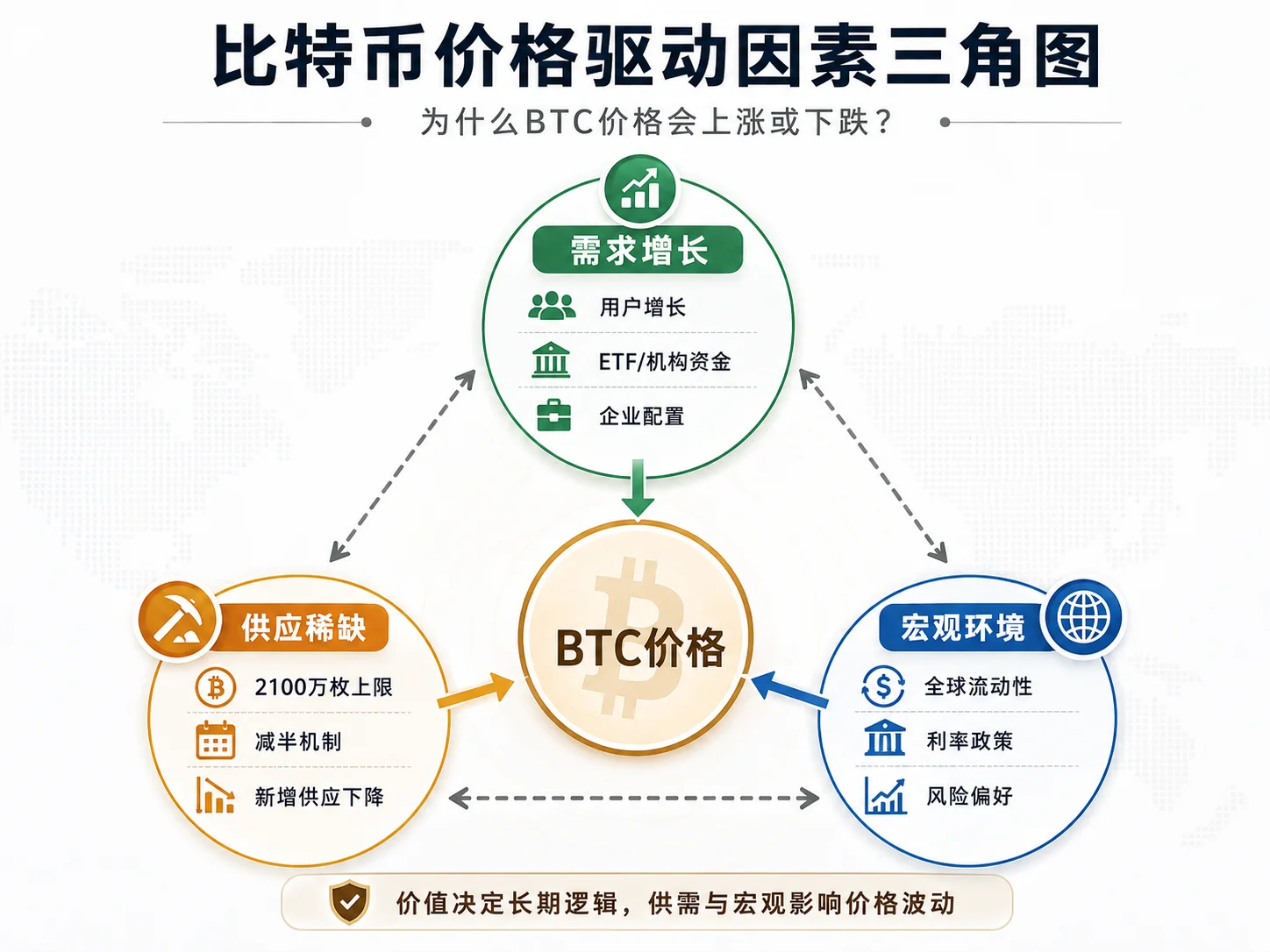
Bitcoin's price movements are the result of many factors acting together. Here are the three most core drivers:
1. Demand growth. When more individuals, institutions, or businesses are willing to hold BTC, buying power strengthens. The 2024 spot ETF approval is a textbook case — it opened a compliant entry channel for traditional capital, bringing a new source of demand.
2. Fixed supply. Bitcoin's new supply is strictly constrained by the halving mechanism. The block reward halves every four years, meaning that, holding demand constant, reduced new supply supports the price. But note: scarce supply doesn't mean the price must rise — if demand falls at the same time, the price can still drop.
3. The global macro environment. As a high-risk asset, Bitcoin's price is also affected by global liquidity, interest-rate policy, and market risk appetite. In loose monetary conditions, capital tends to flow into risk assets; in tightening cycles, Bitcoin usually faces greater selling pressure.
The value of understanding these drivers isn't in "predicting the price," but in building a rational understanding of market volatility — knowing why it rises and why it falls is what lets you stay calm during extreme market conditions.
For more on price volatility, see the section above What are Bitcoin's biggest risks?.
Summary
Bitcoin's value doesn't come from cash flow, but from a complete system of rules — mathematics guaranteeing scarcity, economic incentives guaranteeing security, decentralization guaranteeing censorship resistance, and network effects guaranteeing it can't be replicated.
Reviewing this article's four analytical dimensions:
Scarcity: the 21-million cap is maintained by code and network-wide consensus, with precisely predictable supply. This is extremely rare among major global assets — you know exactly the total, the amount already mined, and the future daily release, a transparency that traditional assets can hardly provide.
Decentralization: tens of thousands of nodes worldwide maintain the network, with no single point of failure and no single point of control. The 2017 SegWit war proved — even when large mining pools jointly pushed a change, if full nodes and users didn't buy in, the change couldn't be forced through.
Censorship resistance: anyone can send and receive BTC without a bank's approval. For people living in inflationary countries, excluded from the banking system, or needing to move assets across borders, this isn't a theoretical advantage, but a real, practical necessity.
Network effects: Metcalfe's law and the Lindy Effect work together — the more people use it, the higher the value; the longer it exists, the harder it is to kill. More than 17 years, hundreds of "Bitcoin is dead" predictions, countless crashes — Bitcoin's resilience has been repeatedly verified.
Traditional finance uses DCF to value cash-flow assets. Bitcoin, like gold, is a "no-cash-flow store-of-value asset" — it needs a different framework. Not all value can be measured by discounted profits — if that logic held, gold, art, and fiat currency would all "have no intrinsic value" too.
Once you recognize one fact, your thinking clears up: Bitcoin is neither a "certain revolution" destined to reach $1 million, nor a "Ponzi bubble" destined for zero. It is an evolving global digital-asset experiment, and humanity's first attempt to use cryptography and distributed networks to create a non-sovereign digital scarce asset — with real innovation, real value logic, and also real, enormous risk.
Related reading
- What Is Bitcoin (BTC)? How It Works, Value, and Risks (2026) — your first BTC lesson
- Why Bitcoin Doesn't Need Banks: UTXO, Nodes, PoW — a deep dive into UTXO, nodes, and PoW
- How Does Blockchain Record Transactions? Blocks, Hashing, Proof of Work (2026) — the technical details of blocks and chains
- What Are Bitcoin Nodes? Full Nodes, Light Nodes, and Miner Nodes Explained — how the node network secures decentralization
- How to Buy a Bitcoin ETF? IBIT vs FBTC Comparison and Fees (2026) — how institutional capital is changing the BTC market
- How to Dollar-Cost Average Crypto? A Hassle-Free DCA Method for BTC/ETH (2026) — a way to reduce timing risk
Disclaimer
This article is for educational purposes on the logic of Bitcoin's value and does not constitute investment advice, financial advice, or trading advice.
Crypto asset prices are volatile, and related services may carry platform risk, market risk, cybersecurity risk, and operational risk. Users should make careful judgments based on their own risk tolerance and the laws and regulations of their location.
Any action involving private-key management, transfers, and asset custody should be fully understood for its risks before testing with a small amount.
- Bitcoin.orgBitcoin's official resource and foundational documentation
See ourEditorial Policy and the correction process in ourCorrections Policy.
The CoinTrailHub editorial team focuses on crypto education for beginners, exchange security and P2P trading risk. This article is compiled from official sources and public data, reviewed by humans, and strives for accuracy but is not investment advice.
Last updated:2026-08-08 · Content reviewed by humans · Learn more
© 2026 CoinTrailHub · Original content. Reproduction or rewriting without permission is prohibited.