
Can You Still Buy BTC in 2026? Yes, But First Answer These Four Questions

Table of contents

Binance new user rewards
20% trading fee rebate
Official Binance registration. Complete identity verification (KYC) to trade and withdraw.
In August 2026, if you're searching "can I still buy BTC," you're probably not asking what Bitcoin is — you have a more specific question in mind: if I buy now, will I end up buying at the top and losing money right away?
The answer isn't in the price action; it lies in first answering four questions:
- Is this your first BTC purchase, or do you already hold some?
- If BTC drops 40% after you buy, what's your plan?
- Do you plan to hold for a few months, or for more than three years?
- After you buy BTC, where do you plan to keep it?
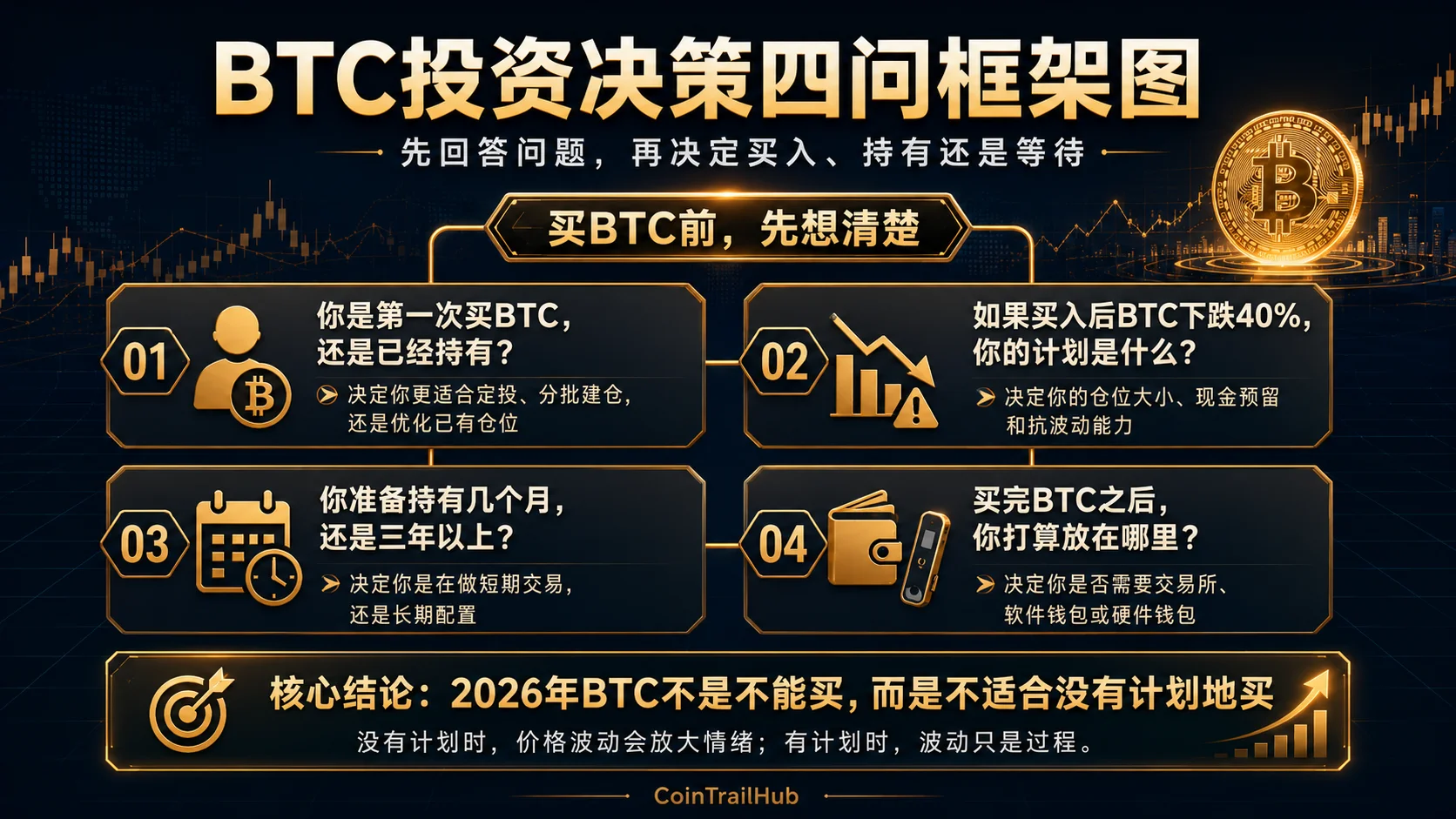
The answers to these four questions matter more than anyone's price prediction. Bitcoin has repeatedly seen 30%-50% pullbacks in its history, even during long-term uptrends — if you haven't thought through these four questions, even buying at a seemingly good price can lead you to make the wrong decision under later volatility; if you have a plan in advance, the impact of short-term price swings drops sharply.
Simply put: BTC in 2026 isn't "don't buy" — it's "don't buy without a plan."
About a 14-minute read. Remember two things first: putting all your money in at once makes you most likely to sell at the bottom when a 40% drawdown hits; and decide where you'll store it and when you'll sell before you place the order.
This article is compiled from public market data and historical patterns and does not constitute investment advice. Crypto assets are extremely volatile; always act according to your own risk tolerance.
The Three Biggest Risks of Buying BTC Now
Before discussing how to buy, first understand where you could lose money. Many people who fail at buying BTC aren't wrong about the direction — they simply never designed their execution plan in advance.
Risk 1: A deep drawdown after you buy
This is the most realistic fear.
BTC has repeatedly pulled back 30-50% during bull markets. In April 2021 BTC hit $64,000, then fell to $30,000 in May — a 50% cut. But by November that same year it rallied to a new all-time high of $69,000.[1]
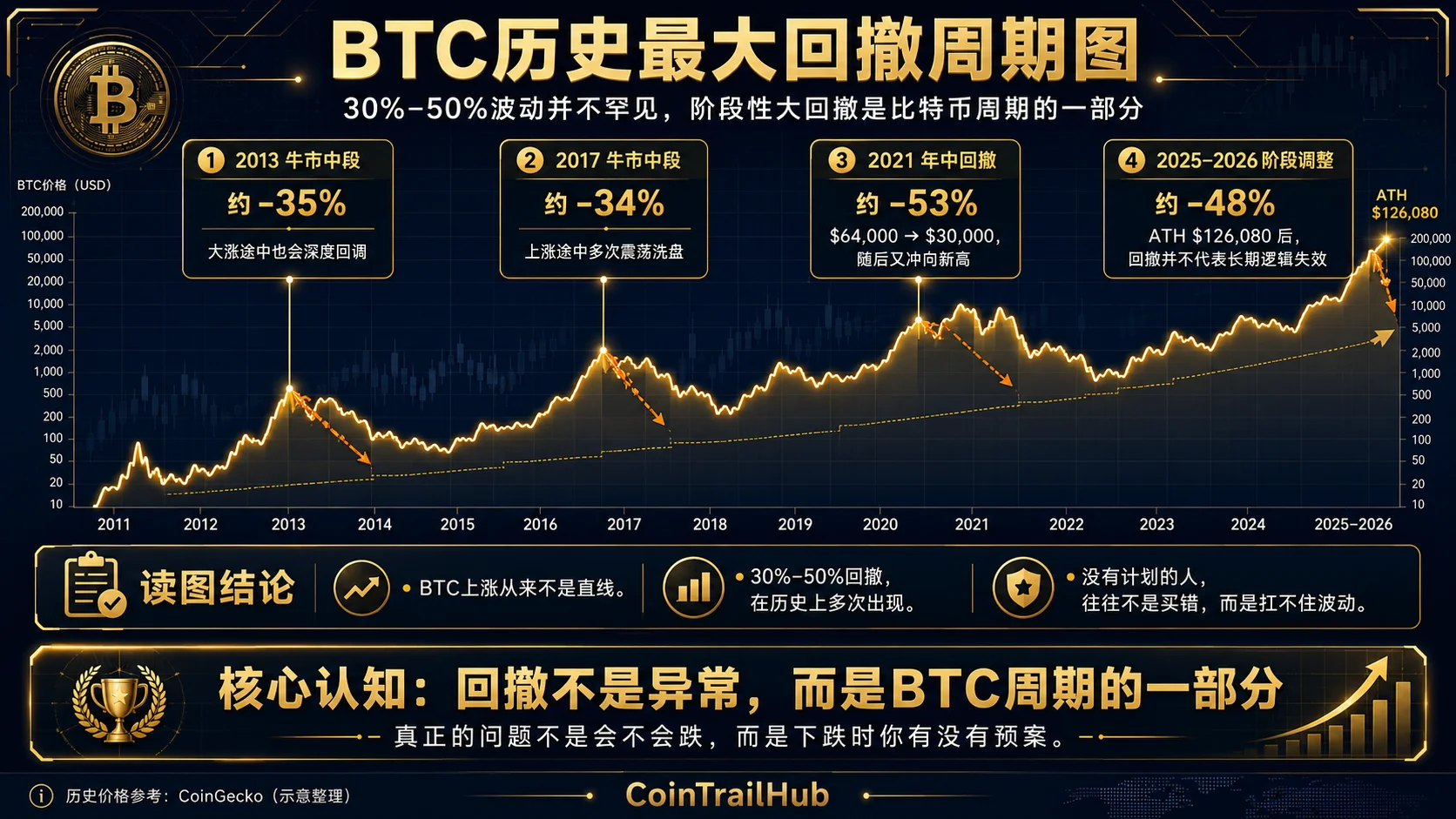
If you put all your money in at once and hit a 40% drawdown:
- The unrealized loss keeps you up at night
- You may end up selling at the exact bottom
- Even if it recovers later, you're already gone
How to handle it:
- Don't put in your entire capital at once
- Always keep some cash on hand
- Accept in advance that "it will drop after you buy" — this isn't a question of whether it happens, but when
Risk 2: FOMO-chasing after a rally
Too scared to buy on the way down, chasing desperately on the way up — this is the most common path to losing money.
Many people don't lose money on BTC itself, but on their buying method: buying heavily into rallies and panic-selling into dips.
The psychological process usually goes like this:
BTC up 20% → "Let me wait, it might be a fake breakout"
BTC up 50% → "It's already risen too much, wait for a pullback"
BTC up 100% → "If I don't buy now it'll be too late" → chase in
BTC pulls back 30% → sell at a loss
How to handle it:
- Use staged accumulation instead of a one-shot judgment call
- Once you set your buying cadence, execute it regardless of whether the price is up or down
- Tell yourself: it's normal not to buy at the absolute bottom; getting a reasonable range is enough
Risk 3: Earning a profit but never selling, then giving it all back
In the 2021 bull market, many people's accounts went from +300% to -50%.
The reason wasn't buying wrong — it's that they never thought about "when to sell."
BTC's cycle pattern is very clear: it rises slowly (12-18 months) and falls fast (losing most of its gains in 2-3 months). Watching your profit vanish to zero while believing "it can still go up" — that's the holder's greatest source of pain.
How to handle it:
- Write your take-profit rules when you buy, not later
- Don't try to predict the top — use staged selling instead of guessing the peak
- Selling too early isn't scary (profit locked in); the scary thing is never selling a single coin from start to finish
Four Ways to Buy BTC in 2026
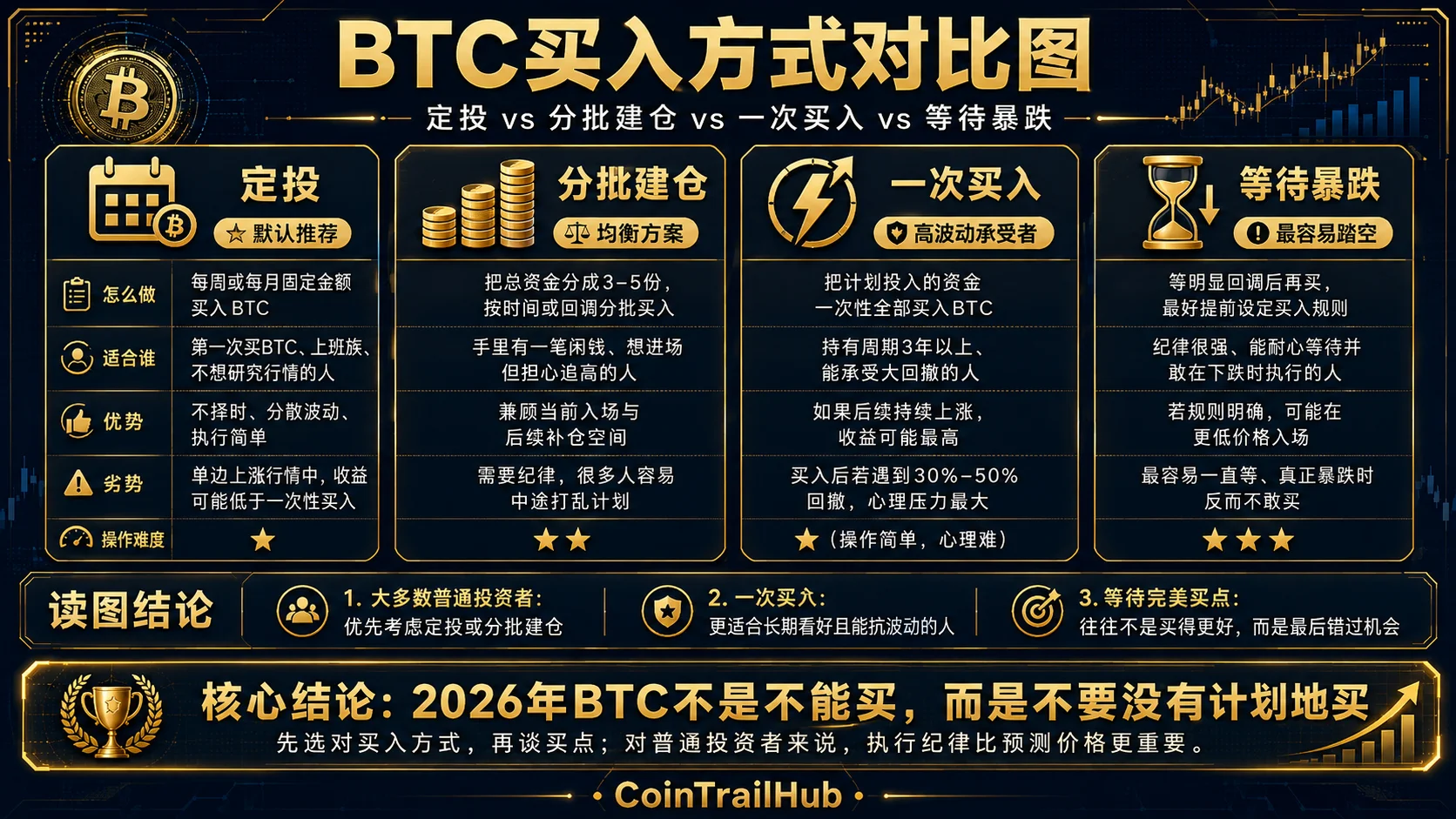
Plan A: Weekly DCA
| Dimension | Description |
|---|---|
| How it works | Buy a fixed amount every week without timing the market. For example, buy $500 of BTC each week |
| Who it's for | First-time BTC buyers, people with a monthly salary, people who don't want to study charts |
| Pros | Automatically buys more when the market panics and less when it's euphoric; no judgment required |
| Cons | If BTC keeps rising without pulling back, returns are lower than lump-sum buying |
| Difficulty | 1/5 |
Mainstream platforms (like Binance and OKX) all offer a DCA feature: App → Earn → DCA → search BTC → set amount and frequency. For step-by-step operations, see Buying BTC for the First Time in 2026: Don't Rush the Order — First Figure Out What Happens After You Buy.
Plan B: Staged accumulation
| Dimension | Description |
|---|---|
| How it works | Split your total capital into 3-5 portions and buy one every 1-2 months. For example, split $10,000 into 4 portions — buy one now, then one every 6 weeks |
| Who it's for | People with a lump sum of idle cash who want to enter now but worry about chasing the top |
| Pros | If it drops later, you have follow-up capital to average down; if it rises, at least you already have some exposure |
| Cons | Requires discipline — many people buy two portions and then can't resist going all in |
| Difficulty | 2/5 |
Plan C: Lump-sum buying
| Dimension | Description |
|---|---|
| How it works | Buy all your planned capital into BTC right now |
| Who it's for | People holding for 3+ years who can calmly accept a 50% paper loss |
| Pros | If BTC keeps rising from here, returns are maximized |
| Cons | If a 40% drawdown hits after you buy, the psychological pressure is huge and you may easily sell at the bottom |
| Difficulty | 1/5 (simple to execute, hard psychologically) |
Historical reference: if you bought BTC lump-sum at the December 2017 cycle top (~$20,000), you'd have had to wait until December 2020 to break even — a full three years.[2] With lump-sum buying, getting the timing right gives the highest returns; getting it wrong costs the most.
Plan D: Waiting for the perfect entry — why most people end up missing the opportunity
"Wait for it to drop 50% and I'll buy" — everyone in crypto has said this.
The problem is:
BTC rises from 50,000 to 100,000 → "Too expensive, wait for a pullback"
BTC pulls back to 80,000 → "It'll drop more, wait a bit longer"
BTC rises to 150,000 → "If I don't buy now it'll be too late" → chase in
Most people who wait for a crash are actually too scared to buy when the crash finally comes — because during a crash the entire internet is shouting "it'll drop even more." Then, after it recovers, they chase in at an even higher level.
If you really want to wait, at least set a clear rule: for example, "when BTC pulls back 30% from its recent high, buy 1/3 of your planned capital." A rule beats empty waiting.
Example: A Capital-Allocation Framework to Avoid One-Shot Bets
This isn't investment advice — it's an example of a risk-management framework to help you understand how to allocate capital and reduce the risk of a single bet.

Suppose a user plans to put a certain amount of capital into BTC. One reference approach:
One part → build an initial position, buy now
One part → deploy in stages later, smoothing out volatility
One part → keep as reserve for buying dips when the market pulls back significantly
One part → keep as cash/stablecoin as a safety reserve for extreme situations
The core logic of this framework:
- Build a base position first: if BTC keeps rising, you're already in
- Deploy in stages: smooths short-term volatility, so you don't obsess over the exact entry
- Keep a dip reserve: gives you the psychological safety of "even if it drops, I still have ammo"
- Hold cash: the crypto market always has surprises — always keep a bit of flexibility on hand
Whatever your final allocation ratios, the key principle is: never go all-in, always keep a reserve.
After You Buy BTC, Where Do You Store It?
Buying BTC isn't the end — security management is the next step
Many beginners put all their attention on "when to buy," then casually leave their BTC on the exchange and call it done.

But one of the biggest differences between BTC and ordinary stocks is that after buying, you still need to think about asset custody. Stocks held in a brokerage account have regulatory protection and insurance backstops. BTC held on an exchange — if the exchange gets hacked, freezes withdrawals, or collapses, your BTC could go to zero.
If you've just bought BTC, first understand the difference between exchange storage, software wallets, and hardware wallets before deciding on a long-term storage method — see How to Choose a Bitcoin Wallet? Cold, Hot, and Hardware Wallets Compared (2026).
Asset security matters far more than entry timing. With BTC, buying is only the first step — how you store and manage your private keys determines whether that asset truly belongs to you in the end.
| Amount | Recommended storage | Note |
|---|---|---|
| Small (within a few hundred dollars) | Exchange | Convenient for trading, but don't keep large amounts there long-term |
| Moderate (a few thousand dollars) | Software wallet + spread across exchanges | Don't put all your eggs in one basket |
| Larger (tens of thousands of dollars or more) | Hardware wallet | Private keys stored offline — a qualitative leap in security |
| Large assets | Hardware wallet + steel backup of seed phrase | Fire-, water-, and loss-resistant |
Three basic security principles:
- An exchange is not a bank — only keep the BTC you plan to trade or DCA with there
- Don't store your seed phrase on your phone — no screenshots, no cloud notes, no messaging it to yourself
- Test with a small amount before a large transfer — the first time you send BTC, send a small test amount first to confirm the address is correct
For a complete operational guide on wallet and seed-phrase security, see Bitcoin Private Key Security: 6 Decisions That Decide Whether You Lose Your BTC (2026).
When Should You Consider Selling?
This is the hardest question in the entire investing process — and the most easily overlooked one.
Don't try to predict the exact top. No one can. But you can set exit rules for yourself.
Three sell signals
Signal 1: BTC is too large a share of your personal assets
Say you started with a 5% position, and BTC went up 5x so it's now 25% of your assets. Selling part of it isn't because you're "bearish" — it's because your allocation has become unbalanced.
Signal 2: The market is in extreme euphoria
When friends who never cared about crypto are all asking you how to buy BTC, when the fear & greed index sits in extreme greed for a long stretch, when "this time is different" becomes the dominant narrative — historically, this tends to correspond to a stage-top zone.
Signal 3: You've hit your preset financial goal
Decide before you buy: "when BTC rises X%, sell Y%." — then execute. A simple staged take-profit framework:
Rather than guessing where BTC's highest point is, a more practical approach is to set staged take-profit rules in advance. Here's one common phased-exit approach:
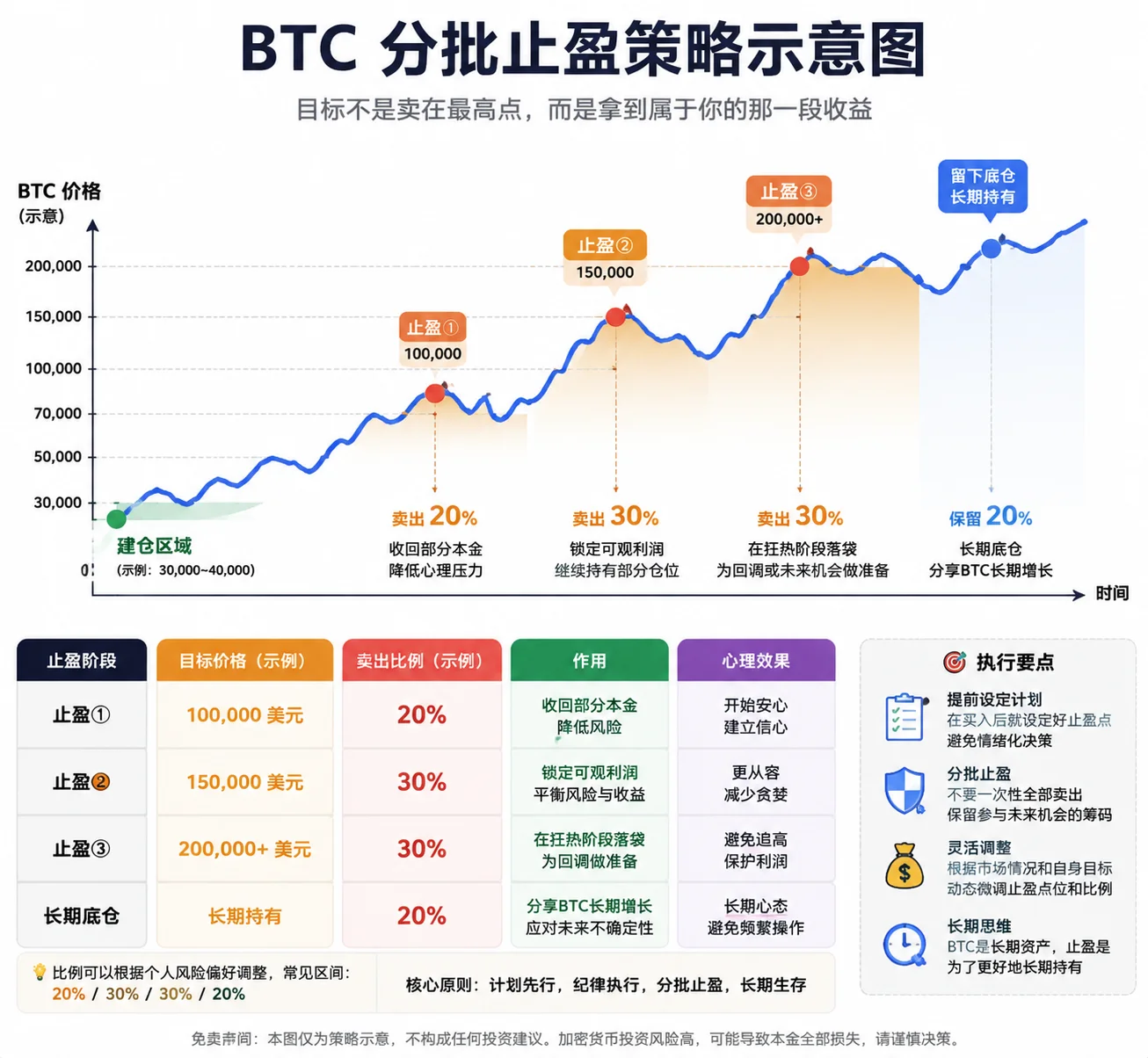
| BTC rise from your cost basis | Action |
|---|---|
| +50% | Sell 1/4 (recover part of your principal) |
| +100% | Sell another 1/4 (recover all principal + some profit) |
| +200% | Sell another 1/4 |
| Remaining 1/4 | Hold it, no take-profit price set |
Core principle: selling too early isn't scary; never selling a single coin from start to finish is what's scary.
Can You Still Rely on the Halving Cycle?
If you only care about "what to do," you can skip this section and go straight to the FAQ. This section is for people who want to understand the "why."
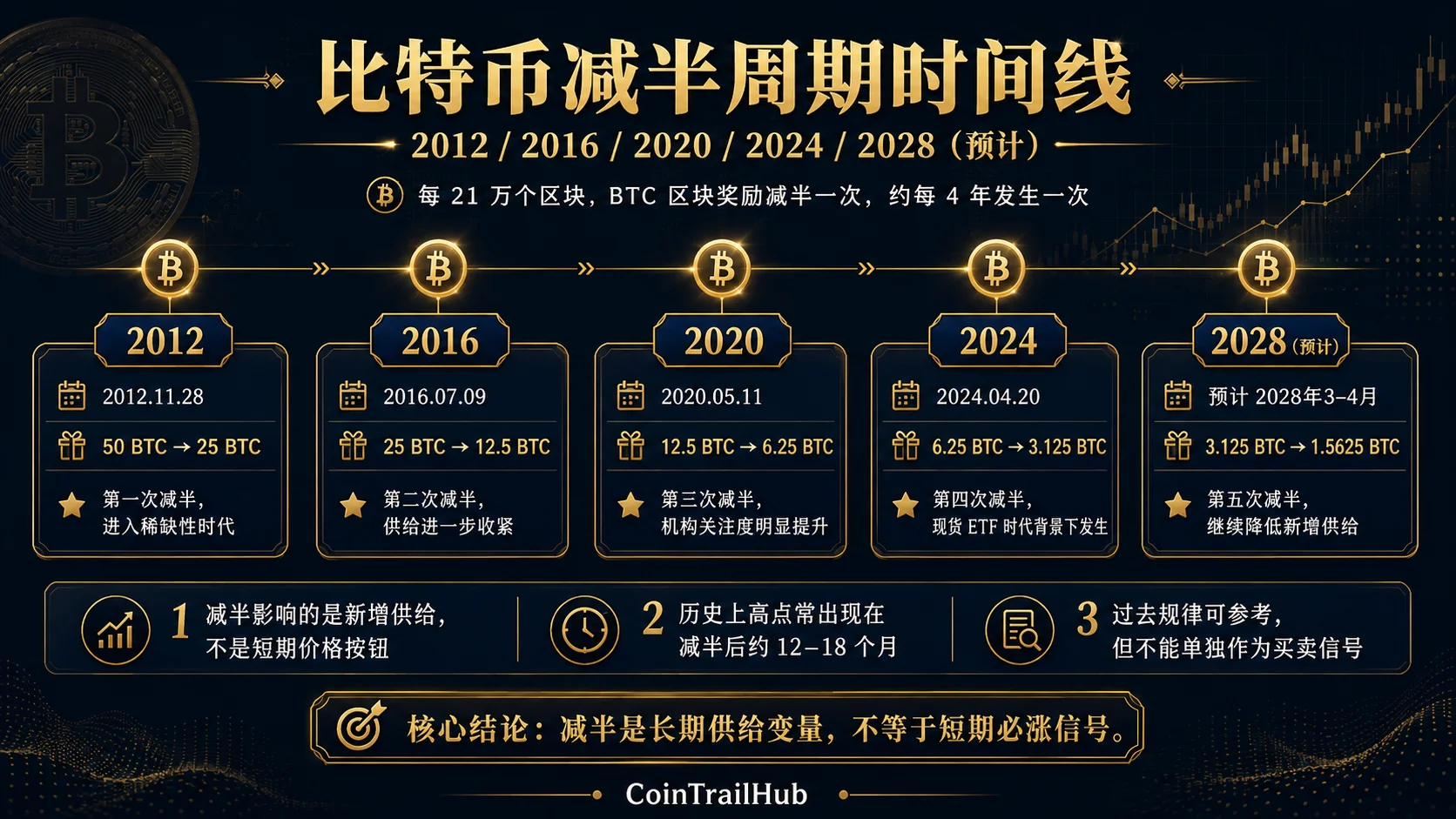
Bitcoin's halving happens every 210,000 blocks (about 4 years), automatically cutting the block reward in half and slowing the release of new coins. Four halvings have happened so far (2012/2016/2020/2024), with the next expected around March-April 2028.[3]
Historical pattern: how does BTC usually behave after a halving?
| Halving date | Price on halving day (approx.) | Cycle high | High reached | Gain from halving day |
|---|---|---|---|---|
| 2012.11.28 | ~$12 | ~$1,100 | ~12 months later | ~90x |
| 2016.07.09 | ~$650 | ~$20,000 | ~17 months later | ~30x |
| 2020.05.11 | ~$8,600 | ~$69,000 | ~18 months later | ~8x |
| 2024.04.20 | ~$44,000 | ? | ? | ? |
Historical price data source: CoinGecko and public Bitcoin blockchain data.
Three patterns worth noting:
- The halving day never pumps — every halving is followed by 2-6 months of sideways movement or pullback
- The high comes 12-18 months after the halving — the halving is a slow variable, not a fast-forward button
- Each cycle's gain is shrinking — 90x → 30x → 8x; as the base grows, percentage returns narrow
To check the latest on-chain data for the current halving cycle yourself (indicators like MVRV, NUPL, miner outflows), you can view the basic free version on Glassnode or CryptoQuant.
What's different about this halving?
The biggest variable: U.S. spot BTC ETFs. After approval in January 2024, ETFs from BlackRock, Fidelity, and others have seen continued inflows.[4] Traditional-finance capital now has a compliant on-ramp — a variable that none of the previous three halvings had.
This means this cycle could be extended, or could end early. ETF capital can flow in fast — and flow out fast too.
For a comparison between ETFs and buying coins directly, see Buy a Bitcoin ETF or BTC Directly? Choose by Amount and Holding Period (2026).
Can the halving be used as a buy/sell signal?
Not on its own. The halving reduces new supply — but if the market's capital is flowing out overall (like the Fed's aggressive rate hikes in 2022), tightening supply doesn't help. The halving is a background variable, not a trading signal.
Think of the halving as "long-term favorable to BTC's scarcity," not "it will definitely rise in the short term." Use it to help understand the big picture, not to time entries.
For more on the fifth halving in 2028 and BTC's supply cap, see Can Bitcoin's 21 Million Cap Be Changed? Source Code and Forks Explained.
Security Risk Reminders
- Beware of "guaranteed profit," "insider info," and "signal groups" — there is no guaranteed return in the crypto market. Anything promising "guaranteed profit" is 100% a scam
- Don't add leverage out of FOMO — a 30-50% BTC pullback is common in cycles, but with leverage a single pullback can wipe you out
- Move large BTC to a personal wallet — an exchange is not a bank; don't keep all your assets on an exchange. See Bitcoin Wallet Types Explained
- Don't publicly disclose your position size and strategy online — it makes you a target for targeted attacks
FAQ
Q1: Is it already too late to buy BTC in 2026?
It depends on your holding period. If you plan to hold for 3+ years, "too late or not" matters less. If you plan to make a quick buck within a few months, no one can predict the short-term direction at this moment. The key isn't "is it expensive now," but "how long do you plan to hold."
Q2: BTC has risen so much — will I be the bag-holder if I buy now?
If you put all your capital in at once, there is indeed that risk. But if you enter via staged accumulation or DCA, you can average down even if a pullback comes. The biggest reason people end up as bag-holders isn't "buying too expensive" — it's "buying too much at once + not being able to hold through the pullback and selling at a loss."
Q3: How much should I put into BTC the first time?
A conservative reference: no more than 10% of your monthly income, and only money you can afford to lose entirely. Don't borrow, and don't use rent/tuition/living expenses. Start small and experience BTC's volatility — many people think they can handle a 50% drawdown, then find out a 30% drop is already too much.
Q4: What if BTC drops 50% after I buy?
If you entered via staged buying or DCA, a 50% drop means every subsequent buy is "on discount." If you went all-in at once, a 50% drop is a massive psychological test — which is why this article stressed "don't put it all in at once." Also, BTC has historically recovered to new highs from every 50%+ drawdown, but recovery can take 1-3 years. The key is: do you have enough cash flow and patience to wait that long.
Q5: Should I DCA or lump-sum buy BTC?
For most people, DCA. DCA doesn't require timing the market and won't let one wrong decision destroy your entire return. Lump-sum buying only beats DCA when you "perfectly time the bottom" — but no one can consistently time the bottom. If you must buy lump-sum, make sure you can calmly accept the possibility of "dropping 30% after buying."
Q6: Should I sell the BTC I already hold?
You shouldn't sell based on "someone else says sell." Sell based on your own rules: ① Is your position too heavy? ② Is the market in extreme euphoria? ③ Have you hit your preset return target? If all three answers are "no," keep holding. If any one is "yes," consider selling part of it in stages.
Q7: Can the halving cycle really be trusted?
Use it as a reference, not a religion. BTC made new highs 12-18 months after each of the three historical halvings, but each rally came with demand-side catalysts beyond the halving (2017's ICOs, 2021's central-bank money printing, 2024's ETFs). The halving reduces new supply — a real supply-side variable — but it can't decide prices on its own. Treat it as a big-picture reference, not a buy/sell signal.
Q8: BTC dropped 30% — should I keep DCA-ing?
This is exactly when DCA earns its keep. DCA's logic is: when prices are high you buy less, when prices are low you buy more. If you stop DCA-ing after a 30% drop, you'd only be buying "when it's expensive" and stopping "when it's cheap" — the exact opposite of DCA's design. Of course, the premise is that your DCA amount doesn't affect your normal life, so a drop won't force you to sell.
Q9: Should I keep BTC on an exchange or in a wallet?
It depends on the amount and your purpose. Keeping a few hundred dollars of "experience money" on an exchange is fine — it's convenient for trading. For long-term positions of several thousand dollars or more, move it to a personal wallet — an exchange is not a bank, and there have been multiple exchange collapses in history (like FTX). For which wallet to choose, see How to Choose a Bitcoin Wallet? Cold, Hot, and Hardware Wallets Compared (2026).
Q10: If the market enters a correction in 2026, should I keep holding?
It depends on whether your holding period or buying thesis has changed. If your original reason for buying BTC was long-term optimism (supply scarcity, adoption growth, institutional entry) and those underlying fundamentals haven't changed, a short-term correction shouldn't change your holding decision. But if your position has become so heavy it's affecting your normal life, or your original reason for buying no longer holds — then a correction may be a time to re-examine your allocation, not a reason to panic-sell everything.
Data verification notes
The key facts in this article were verified against public market, on-chain, and regulatory-disclosure data on 2026-08-09, as follows:
- Historical drawdowns: BTC was about $64,000 in April 2021, pulled back to about $30,000 in May, and hit a new high of about $69,000 in November of the same year; 30%-50% drawdowns have occurred repeatedly across cycles. Source: CoinGecko.
- Break-even period for lump-sum buying: BTC was about $20,000 in December 2017 and didn't return to that level until December 2020 — about three years. Source: CoinGecko.
- Halving schedule: Bitcoin halves every 210,000 blocks (about 4 years); halvings happened in 2012, 2016, 2020, and 2024, with the next expected in March-April 2028. Source: Glassnode.
- U.S. spot ETF: Spot Bitcoin ETFs were approved in January 2024, with BlackRock, Fidelity, and others as issuers; holdings and flows are visible in their SEC filings. Source: SEC EDGAR.
Related reading
Will MicroStrategy Blow Up? MSTR's Real Risk After BTC Drops to $62,500 (2026)
Buying BTC for the First Time in 2026: Don't Rush the Order — First Figure Out What Happens After You Buy — decided to buy? Read this to learn every step (with Binance/OKX signup tutorial)
How to Choose a Bitcoin Wallet? Cold, Hot, and Hardware Wallets Compared (2026) — where to store BTC after buying? A wallet-selection decision guide
Buy a Bitcoin ETF or BTC Directly? Choose by Amount and Holding Period (2026) — unsure whether to buy the ETF or coins directly
Bitcoin Private Key Security: 6 Decisions That Decide Whether You Lose Your BTC (2026) — an asset-security operations manual
What Is Bitcoin (BTC)? How It Works, Its Value, and Its Risks (2026) — still don't understand BTC? Start here
How Does Binance KYC Work? Review Time, Failure Reasons, and Fixes (2026) — choosing Binance as your platform? Read this to avoid detours
Is Bitcoin Mining Still Profitable? Do These Four Calculations First (2026) — want to understand mining and how halving affects miners
Disclaimer
This article is for crypto-market education and strategy-framework sharing only and does not constitute investment advice, financial advice, or trading advice.
Crypto asset prices are extremely volatile; past price performance and historical patterns do not represent future results. Any investment decision should be made based on your own independent research, financial situation, and risk tolerance. Mentioning any platform, product, or service in this article does not constitute a recommendation or endorsement.
Do not borrow money to invest in crypto. Do not put in money you cannot afford to lose entirely.
- CoinGeckoBTC historical price and cycle data
- GlassnodeOn-chain indicators and halving-related data
- CryptoQuantOn-chain data and miner indicators
- SEC EDGARSpot ETF issuer disclosure filings
- 2026-10-17UpdateAdded evidence-chain superscripts and data verification notes.
See ourEditorial Policy and the correction process in ourCorrections Policy.
The CoinTrailHub editorial team focuses on crypto education for beginners, exchange security and P2P trading risk. This article is compiled from official sources and public data, reviewed by humans, and strives for accuracy but is not investment advice.
Last updated:2026-08-09 · Content reviewed by humans · Learn more
© 2026 CoinTrailHub · Original content. Reproduction or rewriting without permission is prohibited.