
Will MicroStrategy collapse? The real risks of MSTR after BTC drops to $62,500 (2026)
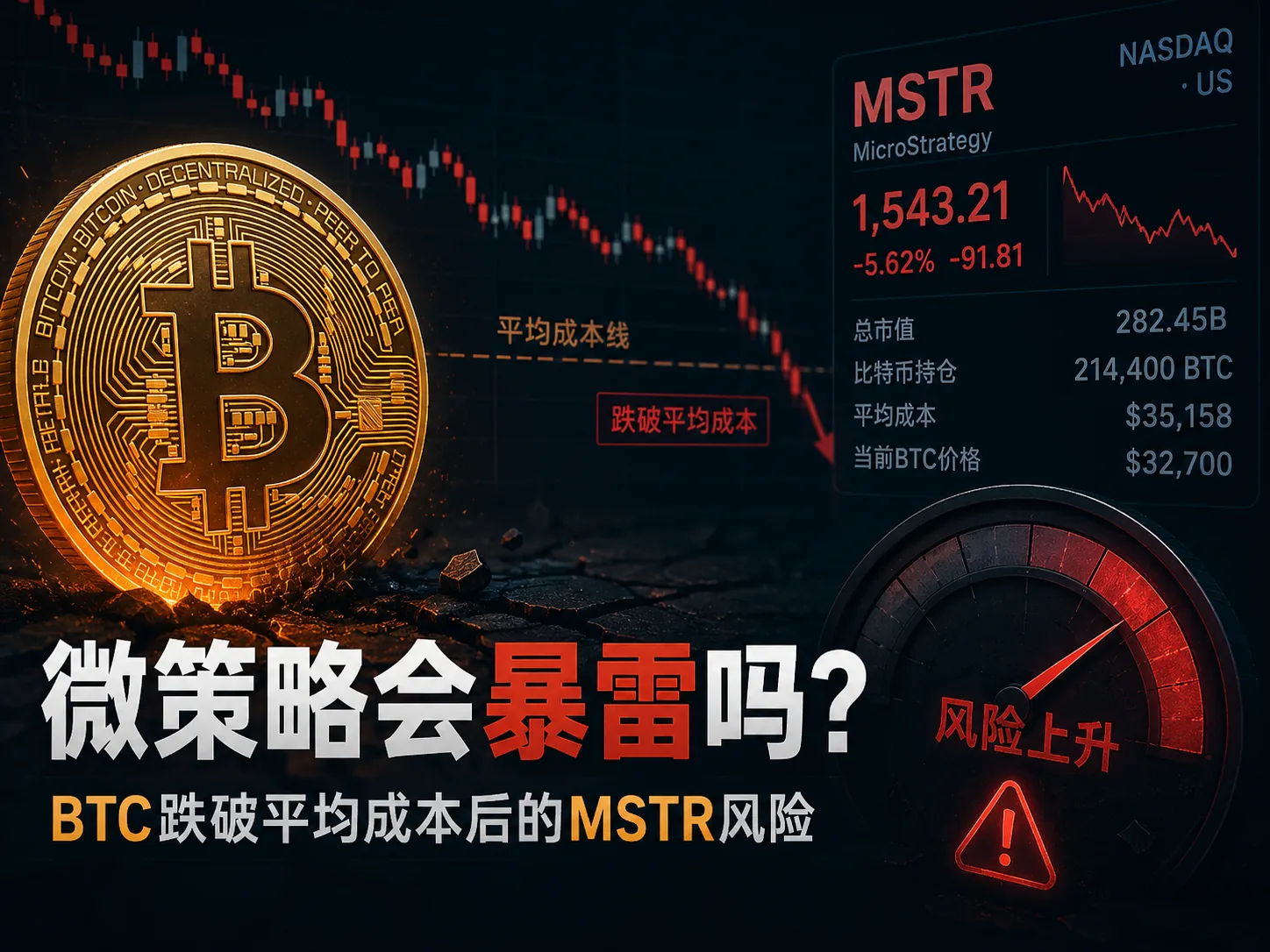
Table of contents

Binance new user rewards
20% trading fee rebate
Official Binance registration. Complete identity verification (KYC) to trade and withdraw.
After Bitcoin dropped to around $62,467, many people started to worry:
Will MicroStrategy collapse?
This question can't be answered with a simple "yes" or "no."
Because MicroStrategy's risk is not the exchange-futures kind of "one drop and you're liquidated."
Its real risk lies in:
Once BTC falls below the average cost, the market will reassess MSTR's financing ability, share valuation and the cushion protecting common shares.
In other words, MicroStrategy doesn't look like it will fall over tomorrow.
But it has already entered a more sensitive position.
For beginners, the most important thing isn't guessing whether it collapses tomorrow, but first understanding:
MSTR is not BTC. MSTR is not a Bitcoin ETF either. It is a US stock that is highly tied to BTC while carrying a corporate financing structure.
If you're not familiar with BTC itself, you can first read: What is Bitcoin (BTC)?, then come back to MSTR's risk structure.
This article is not investment advice and makes no short-term predictions — it only helps you understand where MicroStrategy's real risk lies.
Reading time: about 8 minutes. Remember one thing first: MSTR is not BTC and not a Bitcoin ETF — it is a company stock with a financing structure.
Table of contents
- Conclusion in 30 seconds
- 1. Why is the market watching MicroStrategy now?
- 2. Why isn't MicroStrategy an ordinary Bitcoin holder?
- 3. What's the real difference between BTC, Bitcoin ETFs and MSTR?
- 4. What actually changes when BTC falls below the average cost?
- 5. Will MicroStrategy get liquidated like a futures position?
- 6. Which indicators matter most right now?
- 7. How to think about risk at different BTC price levels?
- 8. Why do common shareholders face bigger risk?
- 9. Will MicroStrategy sell its BTC?
- 10. How does this affect the BTC market?
- 11. Three mistakes beginners make most often
- 12. Final judgment: will MicroStrategy collapse?
- FAQ: common questions about a MicroStrategy collapse
Conclusion in 30 seconds
- MicroStrategy doesn't look like an imminent debt collapse in the short term.
- But with BTC near $62,500, it has already fallen below its roughly $75,600 average cost.
- This means MicroStrategy's BTC holdings now show clear unrealized losses on paper.
- MSTR's biggest risk isn't "instant liquidation" — it's that the market starts doubting whether it can keep smoothly raising money to buy BTC.
- Buying MSTR is not the same as buying BTC, nor the same as buying a Bitcoin ETF.
- For common shareholders, what really matters is: a falling share price, more expensive financing, dilution from new issuance and declining market confidence.
In one sentence:
MicroStrategy isn't about to collapse immediately, but after BTC fell below its average cost, MSTR has shifted from a "high-beta BTC stock" to a "BTC-related asset whose financing risk needs to be reassessed."
1. Why is the market watching MicroStrategy now?
MicroStrategy was originally a software company.
Later it pivoted its corporate strategy toward Bitcoin, continuously buying BTC and treating BTC as its main reserve asset.
According to the Strategy official BTC purchase records and related public disclosures, Strategy / MicroStrategy currently holds about 847,000 BTC at an average purchase cost of about $75,600.[1]
Now BTC has come to around $62,500, already below its average cost.
What does this mean?
For beginners, think of it this way:
If a person keeps buying BTC at an average price of $75,600, and the market price is now only $62,500, then their holdings have entered an unrealized loss.
MicroStrategy follows a similar logic.
It's just that the amount of BTC it holds is very large, so the scale of the unrealized loss is also magnified.
But note:
An unrealized loss is not the same as an imminent collapse.
As long as it doesn't sell BTC, these losses exist only on paper.
The real problem is:
The market will start reassessing whether its old "raise money, buy BTC" model can keep running.
2. Why isn't MicroStrategy an ordinary Bitcoin holder?
Ordinary people buying BTC mostly face one core question:
Did BTC go up or down?
But MicroStrategy is different.
It doesn't buy BTC simply with spare cash.
Part of the money it has used to buy BTC came from capital-market financing, including common stock, convertible bonds, preferred stock and other methods.
So its risk isn't just BTC price volatility.
It also includes:
- A falling MSTR share price
- Harder access to further financing
- Dilution of common shareholders
- Preferred-stock dividend pressure
- Declining market confidence in the company
For beginners, this means:
MicroStrategy is not a "wallet address" — it is a company.
A company has stock, debt, financing plans and investor sentiment.
So judging MicroStrategy's risk can't be done by only looking at how much BTC it holds.
You also have to look at whether it can keep raising money at a reasonable cost going forward.
If you want to understand the difference between "holding BTC yourself" and "buying BTC-related financial products," start with: What is a crypto wallet?.
3. What's the real difference between BTC, Bitcoin ETFs and MSTR?
Many people treat MSTR as "BTC inside the US stock market."
That understanding isn't quite accurate.
The three are very different.

| Item | Spot BTC | Bitcoin ETF | MSTR |
|---|---|---|---|
| Essence | The Bitcoin asset itself | A fund product that tracks BTC | A listed company stock holding large amounts of BTC |
| Main risk | BTC price volatility, wallet security | BTC price volatility, fund rules | BTC price, share price, financing, debt, management decisions |
| Corporate operating risk | None | Low | Yes |
| Shareholder dilution risk | None | Usually none | Yes |
| Equals directly holding BTC | Yes | Close, but not on-chain holding | No |
| Volatility potential | High | High | Potentially higher |
This table is the key to understanding MicroStrategy.
If you buy BTC, you mainly bear BTC's own price volatility.
If you buy a Bitcoin ETF, you're buying BTC exposure inside the traditional financial market.
Even when gaining crypto-asset exposure through ETPs or ETFs, SEC investor-education materials remind investors to pay attention to crypto-asset price volatility, speculative risks and product-structure differences — see: SEC Investor Education: Crypto asset ETP risk bulletin.[2]
But if you buy MSTR, what you're buying is more than just BTC.
You're also buying:
- The company's financing ability
- Its stock-market valuation
- Management decisions
- Common-share dilution risk
- Market confidence in the MicroStrategy narrative
So MSTR is not a "lower-risk version of BTC."
It's more like:
A high-volatility BTC asset with a corporate structure attached.
If you choose to hold BTC yourself, you also need to understand on-chain transfers, network selection and wallet-address risks — read: Withdrawal networks and wallet addresses.
4. What actually changes when BTC falls below the average cost?
When BTC falls below MicroStrategy's average cost, the most important change isn't "the company is about to fail."
It's that market psychology has shifted.
When BTC was above cost, the market could easily believe:
MicroStrategy's BTC buying is a success. It's reasonable for the company to keep financing to buy BTC. MSTR should enjoy higher valuation elasticity than BTC.
But once BTC falls below the average cost, the market starts asking:
Will continuing to buy BTC still add shareholder value? Will continued share issuance dilute common shares? Will preferred-stock dividends become a long-term burden? Can MSTR's valuation premium be maintained?
For beginners, this means:
MicroStrategy's risk has shifted from "the BTC price fell" to "the market is re-examining its financing model."
That is the key.
5. Will MicroStrategy get liquidated like a futures position?
In the short term, don't treat MicroStrategy like an exchange futures position.
It hasn't opened a high-leverage BTC futures account.
BTC falling to a certain price doesn't mean it will be automatically liquidated by the system.
So the claim floating around online that "when BTC drops to X, MicroStrategy will be instantly liquidated" is often imprecise.
But that doesn't mean it has no risk.
Its risk is more like something that accumulates gradually:
BTC stays depressed for a long time MSTR's share price weakens Financing costs rise Common-share dilution pressure increases Market confidence declines
For beginners, think of it this way:
A futures liquidation is triggered by price.
MicroStrategy's risk is more like one triggered by confidence and the financing environment.
That's why it may not collapse in the short term, but still warrants caution over the medium and long term.
6. Which indicators matter most right now?
To judge MicroStrategy's risk, don't just look at social-media sentiment.

Focusing on the following 4 indicators is enough.
| Indicator | Why it matters | How beginners should read it |
|---|---|---|
| Whether BTC reclaims the average cost | Determines market confidence in the holding quality | The lower BTC goes, the more pressure on MSTR |
| Whether MSTR's share price keeps weakening | Affects the company's ability to raise money by selling shares | A low share price means financing dilutes shareholders more |
| Whether preferred-stock or financing costs get more expensive | Affects long-term funding pressure | The more expensive financing gets, the more pressure on the company |
| Whether the company starts selling BTC more often | Affects the "long-term buyer" narrative | Once it flips from buyer to seller, market psychology shifts |
This table suits beginners better than complex models.
Because MicroStrategy's problem can ultimately be simplified to one sentence:
BTC price, MSTR share price, financing cost and market confidence cannot all deteriorate at once.
If all four indicators worsen together, the risk rises.
For specific financing, preferred stock, debt and the latest disclosures, refer to the Strategy official SEC documents.[3]
7. How to think about risk at different BTC price levels?
The following isn't a prediction — it only helps beginners understand the risk layering.
| BTC price level | MicroStrategy status | How beginners should read it |
|---|---|---|
| Above the average cost | Relatively low pressure | The market finds it easier to believe in the buying strategy |
| Around $60k–$70k | Already in the sensitive zone | Unrealized losses appear; share price and financing draw more attention |
| Around $40k–$50k | Pressure clearly rises | The market worries about financing and dilution |
| Around $30k | High-risk zone | The common-share cushion clearly thins |
| Below $20k for a long time | Extreme pressure zone | Debt, dividends, financing and confidence may all come under pressure at once |
Don't misread this.
It doesn't mean that when BTC hits a certain number, MicroStrategy will definitely collapse.
What really matters is:
How long does BTC stay low? Has MSTR's share price held up? Are the company's financing channels still smooth? Is the market still willing to believe in its BTC strategy?
For beginners, the point isn't memorizing some precise liquidation line.
It's understanding that:
MicroStrategy's risk rises in ranges, not suddenly at a single price point.
8. Why do common shareholders face bigger risk?
Many people see MicroStrategy holding lots of BTC and assume it's safe.
But common shareholders can't just look at the total BTC value.
Because inside the corporate structure there are also debt, preferred stock, financing arrangements and other, more complex things.
Common shares usually rank further back.
This means:
When BTC rises, common shares may enjoy greater upside elasticity.
But when BTC falls, common shares are also more likely to bear valuation compression and dilution pressure.
For beginners, a simple analogy:
MicroStrategy is like a building full of BTC.
BTC is the core asset in the building.
But this building isn't owned only by common shareholders.
Inside there are also creditors, preferred-stock investors, financing instruments and potentially new shareholders in the future.
So what common shareholders really care about isn't just "how much BTC is in the building."
They also have to look at:
How much cushion is left for common shares after the more senior funding arrangements are subtracted.
This doesn't need complex modeling, but it matters.
It's similar to the logic in Exchange vs wallet: holding the same crypto assets in different places and through different structures carries different risk.
9. Will MicroStrategy sell its BTC?
In the short term, the probability of MicroStrategy selling BTC on a large scale is low.
Because its biggest market label has been long-term buying and holding of BTC.
If it suddenly sold a large amount, it would hurt its own core narrative.
But if the financing environment deteriorates in the future, whether it might sell part of its BTC for cash reserves, dividend arrangements or capital-structure management remains worth watching.
The key here isn't how much it sells.
It's whether the market comes to believe:
MicroStrategy has gone from a "long-term buyer" to a "capital manager that will also sell when necessary."
For the crypto market, narrative changes matter a lot.
Sometimes what really moves the price isn't that selling has already appeared, but that the market starts pricing in "selling that might appear."
10. How does this affect the BTC market?
MicroStrategy holds such a large amount of BTC that it isn't an ordinary market participant.
If the market believes it's still a long-term buyer, that supports BTC sentiment.
But if the market starts worrying that it might sell BTC in the future, panic sentiment increases.
This doesn't mean MicroStrategy will definitely dump on the market.
It means:
It has already become part of BTC market sentiment.
For beginners, the significance of this goes beyond just watching MSTR.
It also reminds us:
When an institution's position is too large, it becomes a market variable in itself.
11. Three mistakes beginners make most often
Myth 1: MSTR equals BTC
It doesn't.
MSTR and BTC are highly correlated, but MSTR is not BTC.
It is a listed company's stock.
Behind a stock there are financing, management, valuation, dilution and market sentiment.
Myth 2: MicroStrategy holds a lot of BTC, so it must be safe
Holding a lot of BTC is an advantage, but it can also be a source of pressure.
In a bull market, a large BTC holding amplifies the upside narrative.
In a bear market, a large BTC holding also amplifies market worry.
The bigger the asset, the more the market cares about whether it becomes potential selling pressure.
Myth 3: As long as it doesn't get liquidated, there's no risk
Not being liquidated doesn't mean there's no risk.
MSTR's risk may not be sudden liquidation, but rather slowly showing up as:
- A continuously falling share price
- Dilution of common shares
- Higher financing costs
- The disappearance of the market valuation premium
- Declining investor confidence
For common-stock investors, these are real risks all the same.
12. Final judgment: will MicroStrategy collapse?
My judgment is:
MicroStrategy doesn't look like it will collapse immediately, but it has clearly entered a pressure zone.
Right now BTC is around $62,500, below MicroStrategy's roughly $75,600 average cost.
This means the market will pay more attention to:
- Can BTC get back above its average cost?
- Can MSTR's share price hold up?
- Can the company still raise money cheaply?
- Will common shareholders keep being diluted?
- Will preferred-stock and dividend pressure keep rising?
- Will MicroStrategy change its "only buy, never sell" market image?
So the more accurate conclusion isn't "MicroStrategy will definitely collapse" or "MicroStrategy is absolutely safe."
The more accurate way to put it is:
MicroStrategy's risk has escalated from pure BTC price volatility to a combined risk involving the BTC price, share financing, common-share dilution and market confidence.
For beginners, the most important thing is to understand the structure.
BTC is BTC.
A Bitcoin ETF is an ETF.
MSTR is a company stock.
They are all related to Bitcoin, but their risks are completely different.
If you're interested in the difference between US stocks, tokenized stocks and on-chain stocks, you can also read: What's the difference between tokenized US stocks and traditional stocks.
Data verification notes
All key facts in this article were verified on 2026-10-17, item by item:
- Strategy BTC holdings: Strategy's official purchase records continuously disclose the company's BTC holdings and average purchase cost; the exact figures update with each disclosure, and this article uses the data as of the time of writing. Source: Strategy official BTC purchase records.
- Crypto asset ETP risk: SEC investor-education materials note that crypto asset ETPs carry price volatility, speculative nature and product-structure differences. Source: SEC Investor Education — Crypto asset ETP risk bulletin.
- Strategy's SEC disclosures: Strategy (CIK 1050446, Nasdaq ticker MSTR) discloses financing, preferred stock and debt arrangements through 8-K, 10-Q and 10-K filings. Source: SEC EDGAR — Strategy, Inc. (CIK 1050446).
Related reading
- Should you still buy BTC? Yes, but think through these four questions first (2026)
- Is Bitcoin a scam? 10 doubts broken down one by one (2026)
FAQ: common questions about a MicroStrategy collapse
1. Will MicroStrategy go bankrupt right now?
You can't simply say it will go bankrupt right now.
Its risk is not exchange-futures-style liquidation, but that after BTC stays depressed for a long time, the share price, financing and market confidence all come under pressure together.
2. Does BTC falling below MicroStrategy's average cost mean the company is in trouble?
No.
Falling below the average cost means more on-paper pressure, but it isn't an automatic collapse signal.
What's really dangerous is BTC staying below cost for a long time while MSTR's share price keeps weakening, financing gets harder and market confidence declines.
3. Why might MSTR be riskier than BTC?
Because MSTR is more than just BTC.
It also layers on corporate financing, stock valuation, common-share dilution, preferred stock and management-decision risk.
So in a bull market MSTR may rise harder, and in a bear market it may fall deeper.
4. Will MicroStrategy sell its BTC?
The probability of a large short-term sale is low.
But if the financing environment keeps deteriorating, it's not entirely impossible for the company to make partial sales in the future for cash reserves, dividends or capital-structure management.
What really needs watching is whether it flips from a "long-term buyer" to a capital manager that "will also sell when necessary."
5. Should beginners treat MSTR as a BTC substitute?
It's not recommended.
MSTR is a BTC-related asset, but not BTC itself.
If you want to learn about BTC, first understand spot BTC.
If you want BTC exposure through a traditional account, learn about Bitcoin ETFs.
If you study MSTR, you must additionally understand listed-company financing, share valuation and shareholder-dilution risk.
Risk disclosure
This article is for crypto-market awareness and risk education only, and does not constitute investment, financial or trading advice.
The BTC price of $62,467 is used as a writing reference, and Strategy's holdings and average cost are based on public disclosures; actual figures will change with market prices and the company's subsequent disclosures.
BTC, MSTR and related assets are highly volatile. Beginners should not make a buy or sell decision based on a single article, and should not use leverage to participate in highly volatile assets.
- Strategy official BTC purchase recordsOfficial disclosure of the company's BTC holdings and average purchase cost
- SEC EDGAR — Strategy, Inc. (CIK 1050446)8-K, 10-Q, 10-K and other financing, preferred stock and debt disclosures
- Strategy official financial documentsSummary of financing structure, preferred stock and debt documents
- SEC Investor Education — Crypto asset ETP risk bulletinPrice volatility, speculative nature and product-structure risks of crypto asset ETPs/ETFs
- 2026-10-17UpdateAdded evidence-chain superscripts and "Data verification notes"; refreshed key fact verification date.
See ourEditorial Policy and the correction process in ourCorrections Policy.
The CoinTrailHub editorial team focuses on crypto education for beginners, exchange security and P2P trading risk. This article is compiled from official sources and public data, reviewed by humans, and strives for accuracy but is not investment advice.
Last updated:2026-07-03 · Content reviewed by humans · Learn more
© 2026 CoinTrailHub · Original content. Reproduction or rewriting without permission is prohibited.