
Bitcoin ETF or Buy BTC Directly? Choose by Amount and Holding Period (2026)
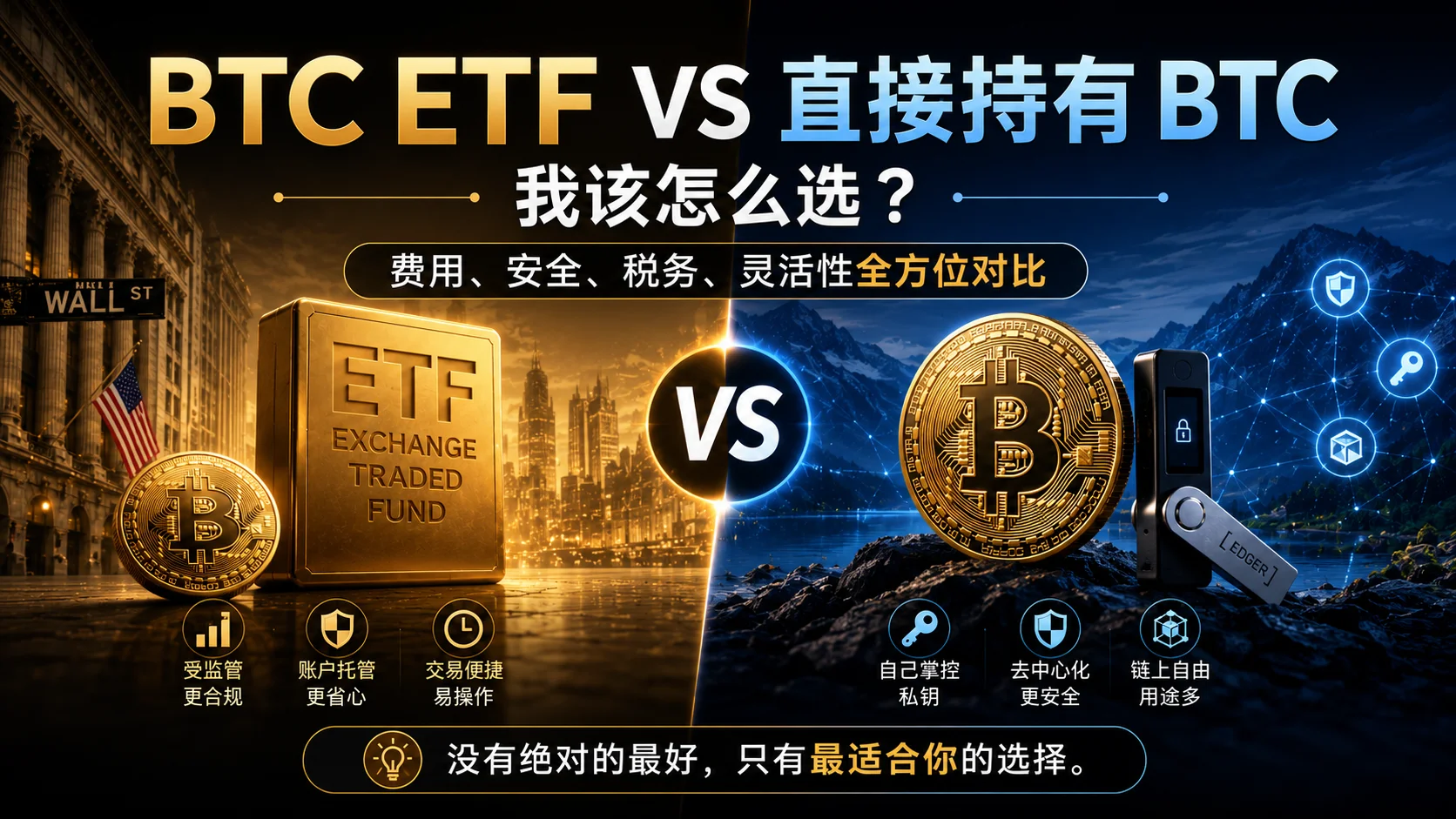
Table of contents

Binance new user rewards
20% trading fee rebate
Official Binance registration. Complete identity verification (KYC) to trade and withdraw.
I bought IBIT on the first day the spot Bitcoin ETF listed in January 2024, and I've also held BTC in a hardware wallet the whole time. Two years of actually using both sides taught me the deepest lesson: this is not a "which is better" question — they are fundamentally two different things.
A simple but useful analogy: buying a BTC ETF is like buying a gold ETF (GLD), while buying real BTC is like buying physical gold bars. A gold ETF lets you conveniently track gold's price, but you can't melt the ETF shares into a ring. A BTC ETF is the same — you're buying price exposure, not the asset itself.
After reading this article, you'll learn:
- Whether to choose an ETF or buy BTC directly based on your amount ($500–$500,000)
- The optimal strategy under three tax identities (US / Hong Kong / Singapore)
- How much the ETF management fee really eats over five years
- The three moments when self-custodied BTC is most likely to go wrong (ones I've hit)
- A compromise plan that holds both, so you don't have to choose
Note: This article shares my personal experience using both ETFs and self-custodied BTC, and does not constitute investment advice. Both ETFs and BTC are high-risk assets with sharp price swings. For tax matters, please consult a local professional.
If you're still unsure what a Bitcoin ETF actually is, read this first: How to Buy a Bitcoin ETF? IBIT vs FBTC Comparison & Fees (2026), then come back for the comparison.
About 10 minutes to read. Remember two things up front: an ETF buys price exposure, self-custody buys control — they're not the same thing; and the cost of switching midway (tax, fees, bid-ask spread) is usually higher than you think, so deciding early saves money.
The Gist: A 30-Second Way to Decide
| If you are | Consider first |
|---|---|
| A US retirement-account investor (Roth IRA / 401k) | BTC ETF — the tax advantage is decisive |
| Just want to track BTC's price without the hassle | BTC ETF — shortest path |
| $50,000+ and planning to hold 5+ years | Buy BTC directly — the management fee starts compounding |
| $1,000–$10,000 just sitting around | Not much difference — pick by convenience |
| Want to transfer / Lightning payments / use on-chain | Buy BTC directly — an ETF is paper exposure |
| Don't want to learn wallets and seed phrases at all | BTC ETF — don't force yourself |
In one sentence: an ETF buys Bitcoin price exposure; BTC buys asset control. The bigger your amount, the longer you hold, and the more you want to use the on-chain ecosystem, the more direct holding wins.
Who Needs an ETF? Who Needs to Buy BTC Directly?
The 30-second table above probably gave you a rough direction. Here's a fuller picture of who each choice suits:
An ETF suits you if:
- You have a US retirement account (IRA/401k). This is the ETF's most undisputed advantage — in a Roth IRA, BTC that goes 10x can be withdrawn tax-free. That advantage crushes the 0.2% annual management fee.
- You're completely uncomfortable with technical operations. Honestly, not everyone is suited to managing private keys. If you can't even be bothered to back up your phone, forcing yourself to learn self-custody is digging a hole for yourself.
- You need to sell and cash out at any time. An ETF is a tap on your phone, settled T+2. Self-custodied BTC requires "hardware wallet → exchange → place order → withdraw", and when you urgently need cash you'll be cursing.
- You want to manage all your assets in one place. The ETF sits alongside your stocks and bonds in one account, which makes statements and taxes easier.
Buying BTC directly suits you if:
- You hold $50,000+ and plan to hold long-term. At 0.2% a year, five years of management fees is $500+ — that money is better in your pocket than handed to the fund company.
- You're in Hong Kong or Singapore. With no capital-gains tax, the ETF's tax advantage doesn't exist, and holding directly saves the management fee.
- You want to use the on-chain ecosystem. Lightning payments, Ordinals, DeFi — all of these need real on-chain BTC. ETF shares can do none of it.
- You value the feeling of "truly owning." This isn't mysticism — moving BTC from an exchange to your own hardware wallet and seeing that UTXO appear at your address on a block explorer gives you a sense of "this asset depends on no one" that's completely different from looking at a brokerage statement.[1]
In the following cases, reconsider:
| Your situation | Why forcing it isn't worth it | Alternative |
|---|---|---|
| Holding < $1,000 but want a hardware wallet | A hardware wallet is $80+ plus 2 hours of learning — too high a share of the cost | Keep it on a top exchange first; withdraw when the amount grows |
| US IRA account but fully self-custodied BTC | You give up Roth IRA tax-free growth — the biggest hidden cost | Buy the ETF in the IRA; self-custody money outside the IRA |
| First BTC purchase, want to withdraw it all to a wallet | Mistakes are most likely when you're unfamiliar | Send $10 as a test first; confirm the flow, then send the rest |
Two Years Holding Both: The 5 Biggest Differences I Felt
A comparison table can list data, but some differences you only notice from actually using both. Here's what I've felt since January 2024:
1. The psychological feel is completely different
Buying IBIT feels like adding another stock to your US brokerage account — no different from buying Apple or Tesla. I'm "investing in an asset."
The moment I moved BTC from Binance to my Ledger hardware wallet and confirmed that UTXO appeared at my address on Blockstream's block explorer: I was owning an asset that depends on no one.
There's no right or wrong between the two — but you should know which you value more: "investment convenience" or "true ownership."
2. The ETF management fee is a slowly boiling pot
Honestly, a 0.2% annual fee is completely imperceptible in an account. No deduction notice, no line item on the statement. I deliberately dug through my Roth IRA IBIT records — the fee is deducted daily from the NAV, and you genuinely never notice.
But do the math: $100k held for ten years is $2,000 gone. Not a fortune, but enough for a top-tier hardware wallet plus several nice dinners with friends.
I'll break down the numbers in the fee section below.
3. Self-custody anxiety is real, and it doesn't go away
The first time I withdrew 0.05 BTC (about $2,000 at the time) from Binance to my hardware wallet as a test, I checked the address five times. After copying the seed phrase onto paper, I checked it three more times, then started worrying: is the paper fireproof? Did someone see it? Should I buy a steel plate?
That nervousness has eased a lot now, but it comes back every time I make a large transfer.
This isn't fear-mongering — if you're completely unconfident with technical operations, afraid of mistyping an address, or afraid of your seed phrase being seen, then "handing it to a professional custodian" may be far more rational than "losing it yourself."
For how to store a seed phrase, I wrote a separate guide: What Is a Cold Wallet? The Safest Ways to Store a Seed Phrase (2026, 5 Methods Compared).
4. Customer-service experience is night and day
ETF problem — say you can't log into Fidelity one day, or your holdings show incorrectly — one phone call to support, and someone follows up.
On-chain BTC problem — say a withdrawal is stuck in pending, or the gas is set too low so the transaction never gets confirmed — you have to check congestion on mempool.space yourself, ask around in community groups, or just wait.[2] This is the "hidden friction cost" that almost no comparison article mentions.
5. The selling path is on a totally different scale
A real story: last month I needed cash quickly, so I tried both sides to compare speed.
- ETF: tap "sell" on my phone, settle T+2 to the brokerage account, another day to the bank. About 3 business days total.
- Self-custodied BTC: hardware wallet → connect to computer → sign and broadcast → wait for on-chain confirmation (that time, luckily ~30 minutes) → exchange receives → place a limit order → fill → withdraw fiat → wait for the bank. About 3 business days in total, but if the chain is congested, getting stuck for half a day or a day isn't surprising.
If you're someone who needs to cash out on short notice, the ETF's liquidity path is far shorter.
Real Fee Test: I Dug Through My Statements — What Each Side Actually Cost
The actual cost of a Bitcoin ETF
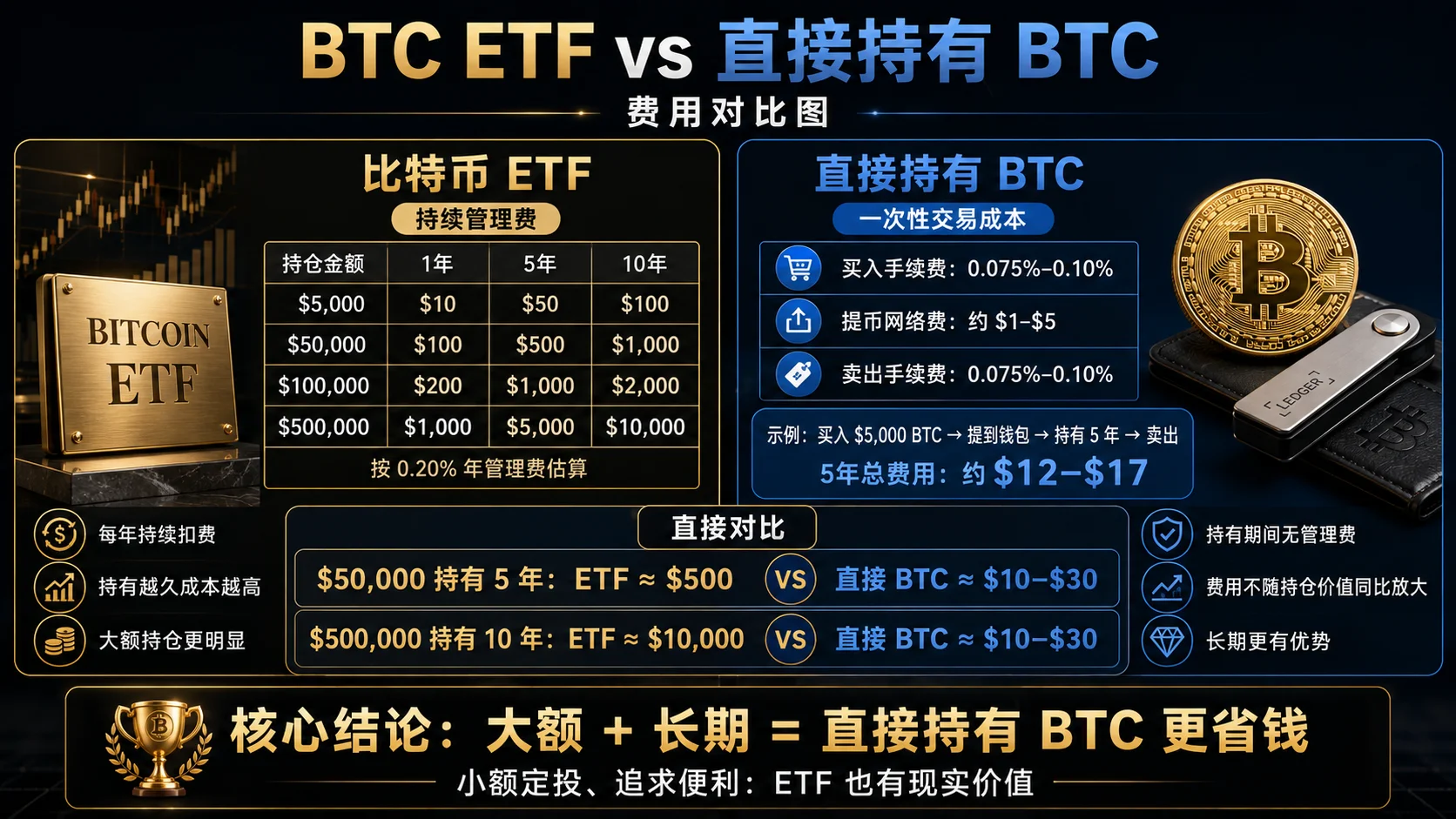
Mainstream spot Bitcoin ETFs charge an annual management fee of 0.15%–0.25%. My IBIT is currently in a 0.12% promotional period (later reverting to 0.25%, per BlackRock's official announcement); FBTC is 0.25%.
I dug through my Roth IRA's holdings over the past 12 months — the fee is deducted daily from the NAV, and you never get a deduction notice. Here's how it accumulates at different amounts:
| Holding amount | One year (at 0.20%) | Five years | Ten years |
|---|---|---|---|
| $5,000 | $10 | $50 | $100 |
| $50,000 | $100 | $500 | $1,000 |
| $100,000 | $200 | $1,000 | $2,000 |
| $500,000 | $1,000 | $5,000 | $10,000 |
$5,000 held ten years costs $100 — honestly not much. But $100k held ten years costs $2,000 — that's more than enough for three top-tier hardware wallets.
The actual cost of holding BTC directly
Fees only occur when buying, selling, and withdrawing. While holding, nothing is deducted:
- Exchange trading fee: 0.075%–0.1%. Paying fees with BNB lowers it further — see How to Save on Binance Fees: BNB Discount + Referral Code BN522 Rebate Stacking (2026)
- Withdrawal on-chain gas fee: BTC mainnet is generally $1–$5, and the Lightning Network can go down to a few cents[3]
- Hardware wallet: a one-time $50–$150, amortized over 5+ years to $10–$30 a year
Take one of my own operations as an example: buying $5,000 of BTC → withdrawing to a Ledger wallet → holding since. The actual fees:
| Fee item | Amount |
|---|---|
| Purchase fee (0.075%, paid with BNB) | $3.75 |
| Withdrawal gas fee (mempool wasn't congested) | $2.30 |
| Total fees while holding to date | $6.05 |
If it were an ETF, the same $5,000 held two years at 0.20% would have already deducted about $20.
Fee comparison, five-year view
| Item | Bitcoin ETF (0.20%) | Holding BTC directly |
|---|---|---|
| Initial purchase cost | Broker commission (mostly zero) | Exchange fee 0.075%–0.1% |
| Fees while holding | 0.15%–0.25% a year (ongoing) | $0 |
| Hardware cost | $0 | One-time $50–$150 |
| $50k held 5 years, total | ~ $500 | ~ $10–$30 |
| $500k held 10 years, total | ~ $10,000 | ~ $10–$30 |
Core conclusion: the bigger the amount and the longer you hold, the more direct holding saves. On-chain fees are fixed and don't scale with your position value — that's the fundamental cost advantage of direct holding.
But if you're dollar-cost-averaging just $200 a month, the ETF's zero-commission convenience may outweigh the management fee. For how to do a DCA strategy, see: How to DCA Crypto: A Low-Stress Way to Accumulate BTC/ETH (2026).
Security: The Risk I Worry About Isn't the Risk You Worry About
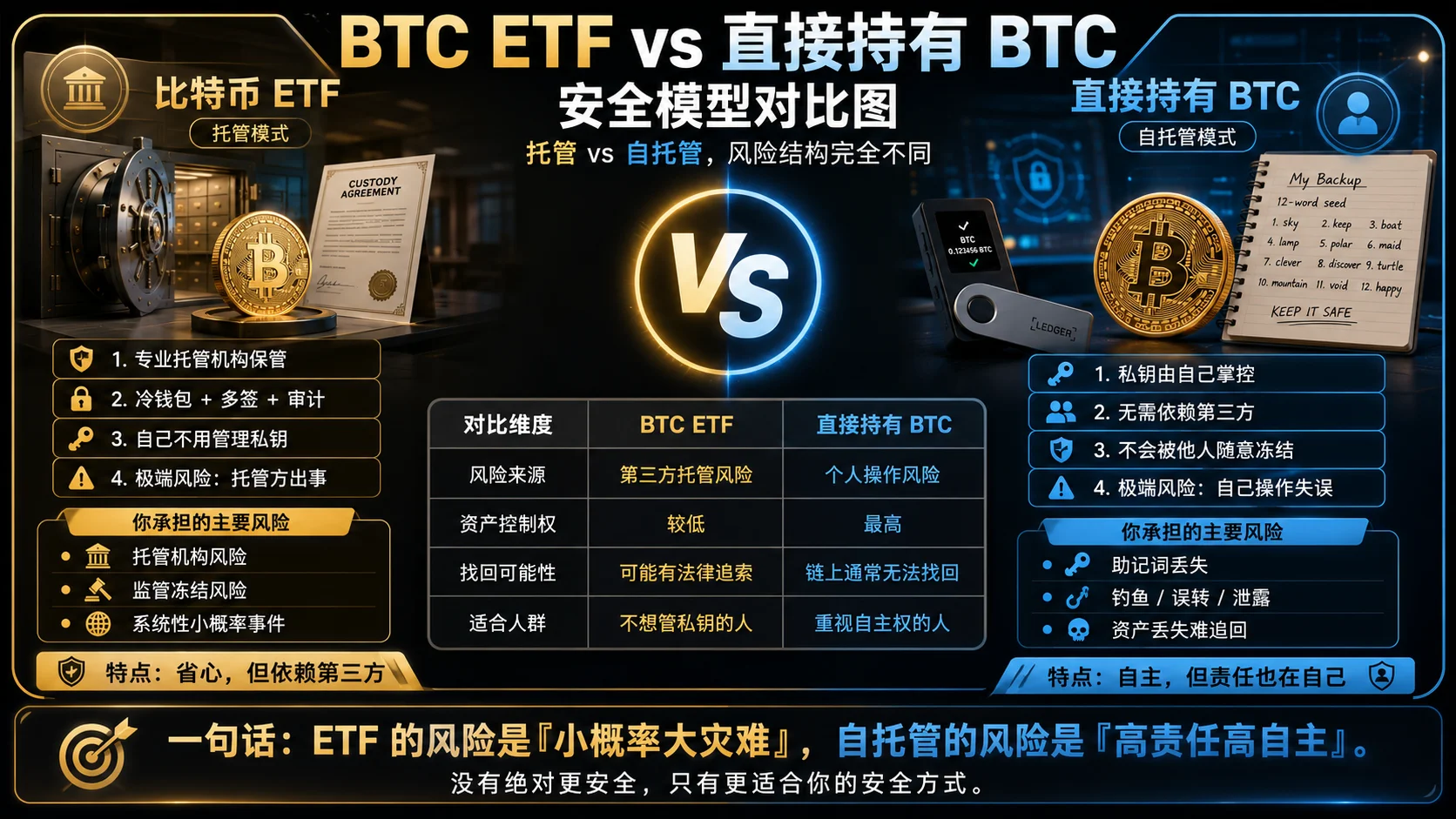
The ETF and direct-holding security models are mirror images. You're not choosing "which is safer" — you're choosing "which risk you fear more."
The Bitcoin ETF security model
BTC is held by a professional custodian (the underlying BTC of both IBIT and FBTC is custodied by Coinbase Custody), with cold wallets + multi-signature, commercial insurance coverage, and regular compliance audits.
The risk you bear: the custodian fails. Insider malfeasance, a system breach, regulatory freeze — all very low probability, but Mt.Gox and FTX in history show that "custody risk" is not theoretical.
Honestly, I personally judge the probability of a custodian of BlackRock's or Fidelity's scale failing to be extremely low — but "extremely low" isn't zero. That's the essence of the ETF security model: low probability, big disaster.
The direct-holding BTC security model
Security is entirely on you. Hardware wallet + a properly stored seed phrase = no need to trust any third party, and no one can freeze your BTC.
The risk you bear: yourself. Lost seed phrase = BTC permanently gone. Stolen seed phrase = BTC moved and unrecoverable.
Compared to the ETF's "low probability, big disaster," self-custody's risk structure is the reverse: high probability, small disaster. Every year, large numbers of individuals lose assets to poorly stored seed phrases, phishing, and operational mistakes — but any single loss is usually small (because beginners generally don't buy hundreds of thousands of dollars of BTC at once).
Security comparison
| Dimension | Bitcoin ETF (custody) | Direct BTC (self-custody) |
|---|---|---|
| Main asset-loss risk | Custodian fails (very low, non-zero) | Your own mistake (not low, really happens) |
| Can assets be recovered? | Possibly through legal channels | Not recoverable on-chain |
| Can assets be frozen? | Regulatory freeze risk in theory | No (private keys in your hands) |
| Technical requirement | Zero, just a brokerage account | Must learn seed-phrase storage and hardware-wallet use |
| Suits whom | Those who don't want the "I lost it myself" risk | Those who don't want the "third party failed" risk |
In one sentence: are you more afraid of losing coins by your own slip, or of BlackRock collapsing? My fear of those two is completely different.
For wallets and security plans, see: Bitcoin Wallets Compared: Cold, Hot, and Hardware Wallets (2026) and Bitcoin Private-Key Security: 6 Decisions That Determine Whether You Lose BTC (2026).
Taxes: My Biggest Regret — Not Using a Roth IRA Sooner
Tax differences are the dimension most comparison articles gloss over, yet their actual impact can far exceed the management fee. A real regret of mine:
When the ETF first listed in early 2024, I bought IBIT only in a regular brokerage account and didn't put it in a Roth IRA. I only realized the mistake after doing the math —
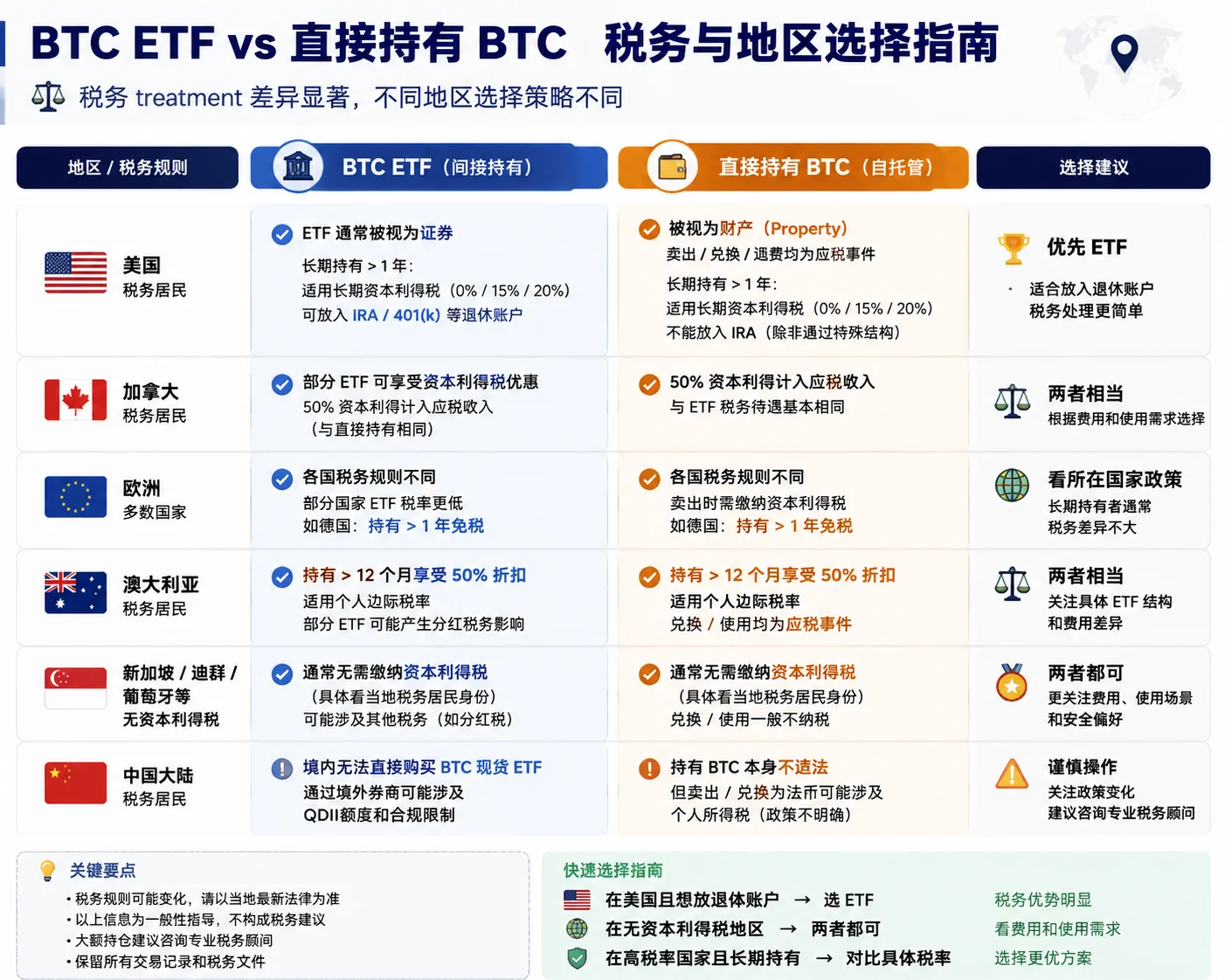
US: the ETF has a decisive advantage in retirement accounts
A spot Bitcoin ETF can go into an IRA (Individual Retirement Account) and a 401k:
- Traditional IRA: no tax when buying; taxed as ordinary income when withdrawing in retirement (tax-deferred)
- Roth IRA: taxed when buying; at retirement you can withdraw tax-free — including all of BTC's gains (see IRS Publication 590-B for the rules)
Take $10,000 as an example: buy a BTC ETF in a Roth IRA and suppose it grows to $500,000 in 20 years. That $490,000 profit, if in a regular account at 15%–20% long-term capital-gains tax, would owe roughly $73,500–$98,000. In a Roth IRA, the entire $500,000 can be withdrawn tax-free.
A 0.2% annual management fee vs saving $73,500+ in tax — these two numbers aren't even on the same scale.
This is also why my earlier point that "US retirement-account users should prioritize the ETF" isn't casual — it's calculated.
Meanwhile, holding BTC directly means every sale, swap to USDT, DeFi yield, and staking reward triggers a taxable event. If you have a lot of on-chain activity, the tax-filing complexity far exceeds the ETF.
Non-US Markets
- Hong Kong, Singapore: no capital-gains tax → the ETF's tax advantage doesn't exist → direct holding's fee advantage stands out more
- Other regions: rules vary widely; consult a local tax or legal professional
One-line decisions by tax identity
| Your tax identity | ETF vs direct holding |
|---|---|
| US + has IRA/401k | The ETF's tax advantage wins over everything — don't agonize |
| US + no retirement account available | Tax difference is small; go by fee and security preference |
| Hong Kong / Singapore | Direct holding is more cost-effective (saves fees + no capital-gains tax) |
| Other regions | Consult a local tax professional |
This article does not provide tax advice. Tax laws vary by country and change over time; please consult a licensed local tax or legal professional.
My Decision Framework: Match Amount and Region
After the five dimensions above, you might feel "each has its merits, still don't know which to pick." Here's the decision path I use when advising friends:
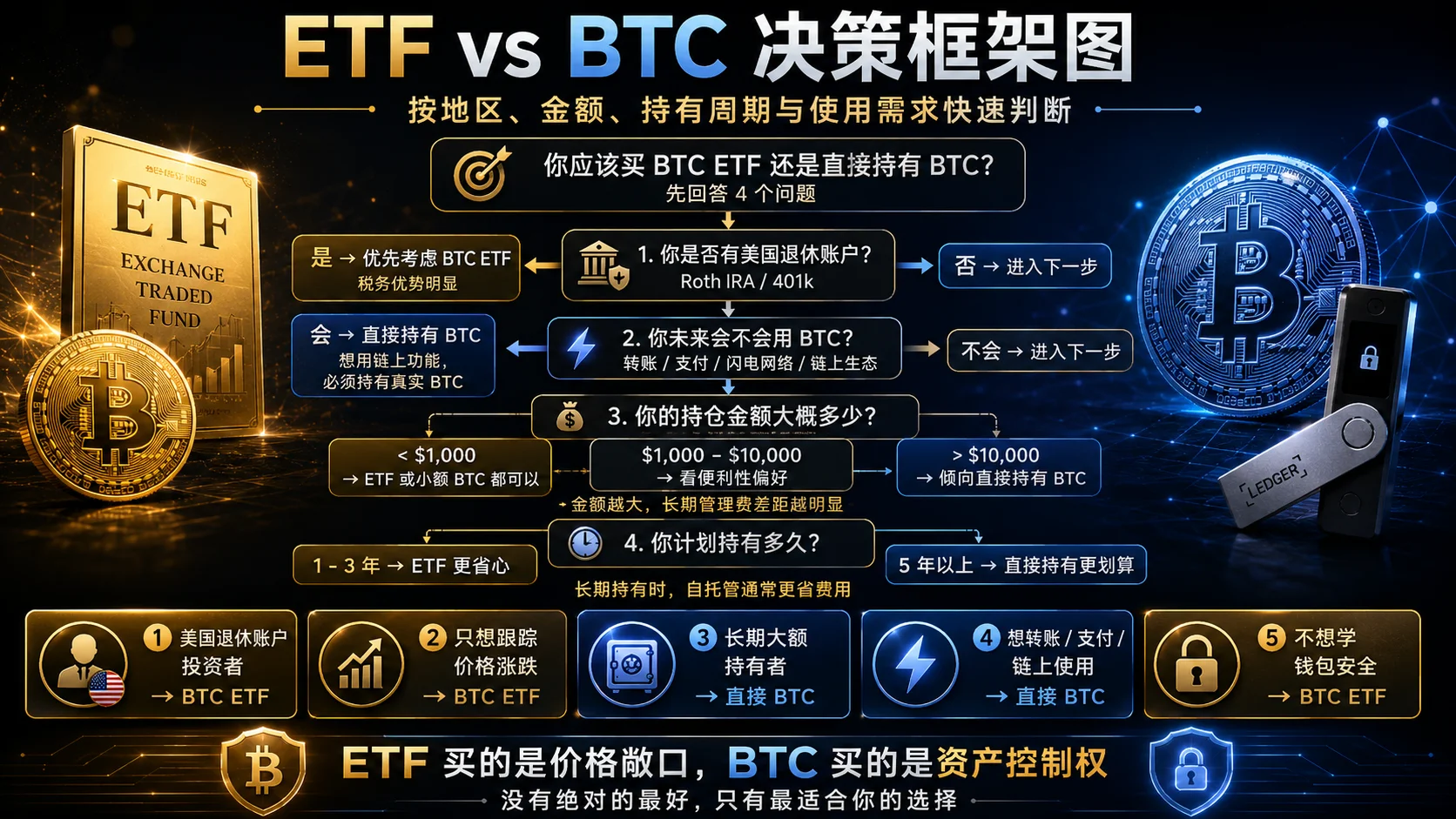
Three steps to decide
Step 1: Check your tax identity
- You can use a US Roth IRA / 401k → ETF. The tax advantage is decisive; stop agonizing.
- You're in Hong Kong / Singapore → keep reading.
Step 2: Check your amount and horizon
- Holding $50k+ and planning 5+ years → buy BTC directly
- Holding under $1k and might sell anytime → ETF is more convenient
Step 3: Check your technical willingness
- Willing to spend 2 hours learning seed phrases and hardware wallets → buy BTC directly; learn once, benefit for life
- Don't want to touch the tech at all → ETF, don't force yourself
Recommendations by amount tier
| Your amount | Holding period | Recommendation | Why in one sentence |
|---|---|---|---|
| < $1,000 | Might sell anytime | ETF (recommended) | Operating cost is too high a share; not worth learning self-custody |
| $1,000–$10,000 | 1–3 years | Little difference | Pick by convenience |
| $10,000–$50,000 | 3–5 years | Buy BTC directly (recommended) | The fee starts compounding; worth learning |
| > $50,000 | 5+ years | Buy BTC directly (recommended) | Save $500–$10,000+ over five years |
| Retirement account (any amount) | Long-term | ETF (recommended) | Tax advantage crushes the fee gap |
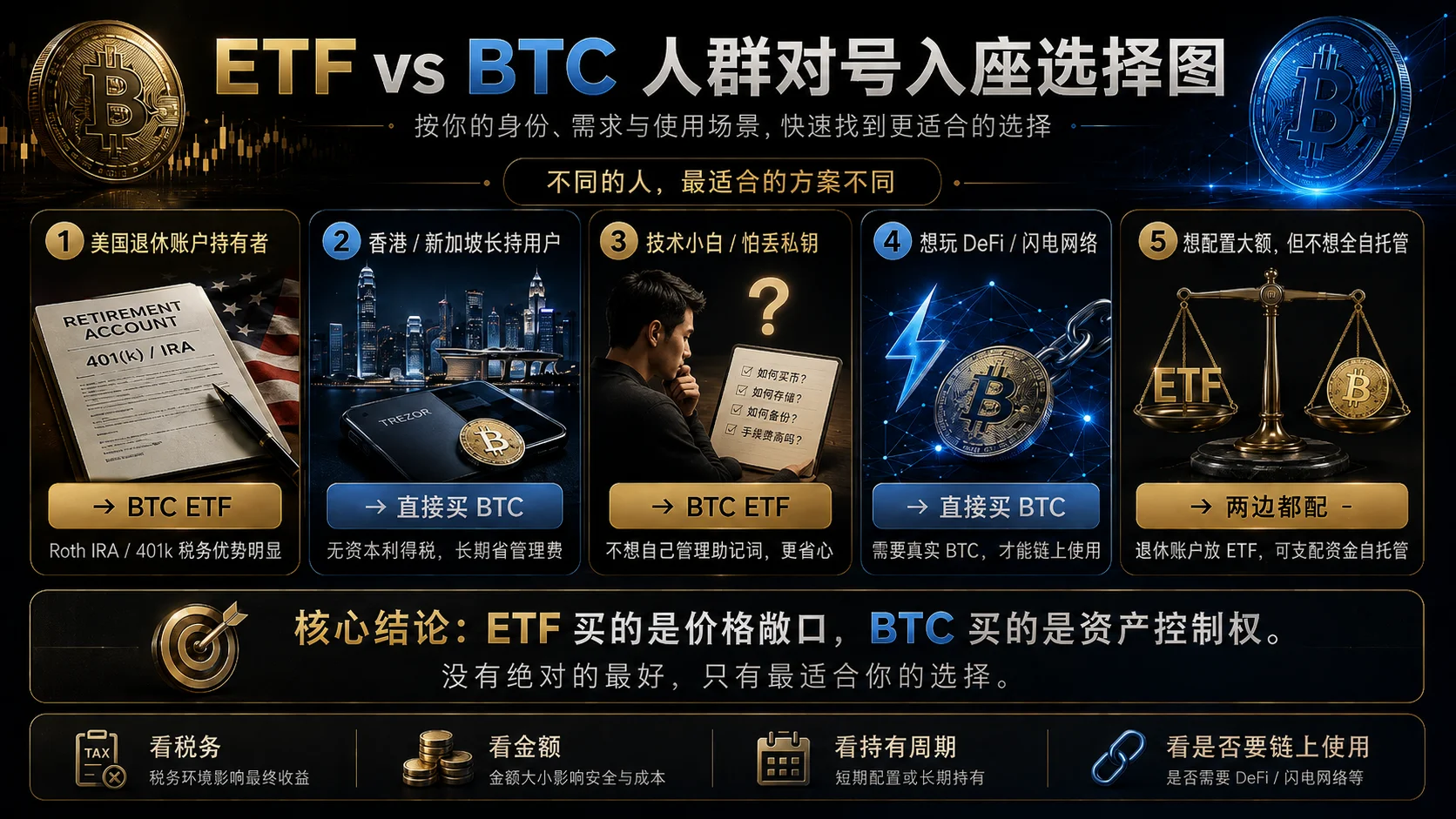
The 5-person selection table
| Your situation | Recommendation | Why |
|---|---|---|
| US retirement-account holder | ETF | Roth IRA tax-free withdrawal; tax savings far exceed the fee |
| Hong Kong/Singapore long-term holder | Buy BTC directly | No capital-gains tax; saves the annual fee |
| Tech novice / afraid of losing keys | ETF | Self-custody mistake risk is real; ETF custody risk is at the institutional level |
| Wants DeFi / Lightning | Buy BTC directly | An ETF is paper exposure; can't do any on-chain activity |
| Wants a large allocation without full self-custody | Hold both | ETF in retirement account + self-custody with disposable cash |
Holding Both: What I Actually Do Now
Many people treat ETF and direct holding as an either/or, but they're not mutually exclusive at all. Here's my actual allocation logic:
My approach: money in the Roth IRA buys IBIT for tax-free growth; disposable cash outside the IRA buys BTC and moves to a Ledger hardware wallet for self-custody.
This way I simultaneously get:
- The ETF's tax advantage (Roth IRA tax-free growth)
- Direct holding's fee advantage (no management fee on the self-custodied part)
- The sovereignty of on-chain BTC (an asset that truly depends on no one)
- The ETF's liquidity convenience (for urgent cash, the ETF is far faster than self-custody)
How to split the ratio? Honestly there's no "optimal answer." My approach: max out the ETF in the retirement account first (because of the tax ceiling), then decide with spare cash whether to buy the ETF or real BTC — depending on whether you feel like touching on-chain things during that period.
If you want to go the "hold both" route, the next step is learning exchange purchasing, withdrawals, and wallet security:
- Buying BTC for the First Time in 2026: Think Before You Order
- Bitcoin Wallets Compared: Cold, Hot, and Hardware Wallets (2026)
- What Is a Cold Wallet? The Safest Ways to Store a Seed Phrase (2026, 5 Methods Compared)
Three Pitfalls I Hit
This part is, to me, the most valuable content in the article. Comparison data is everywhere online, but these are lessons bought with real money:
Pitfall 1: Thinking "a 0.2% ETF fee is nothing" — I miscalculated one variable
Scenario: when IBIT first listed in early 2024, I thought a 0.2% management fee was negligible, so I bought a decent chunk of IBIT in a regular brokerage account. My logic at the time: "it's only 0.2% a year, 2% over ten years, nothing."
Cause: my mistake was — I only calculated the percentage, not the absolute amount, and not the opportunity cost. 0.2% is charged every year; compounding in reverse is reverse compounding. $100k over ten years costs $2,000, and that's not just money — if that $2,000 had also been in BTC exposure, it would have grown with BTC too. The ETF's fee doesn't just lose you $2,000; it loses you the future value of $2,000.
Lesson: if the amount is large ($50k+) and the horizon is long (5+ years), the fee isn't worth ignoring. Either switch to self-custody to save the fee, or at least put it in a Roth IRA and use the tax advantage to offset the fee.
Pitfall 2: Wanting to sell the ETF to save the fee — which triggered a tax event
Scenario: after realizing the fee problem, I once wanted to sell all the IBIT in my regular account, withdraw the money, and buy real BTC on an exchange. Halfway through I realized: selling the ETF in the US is a taxable event, and my IBIT was already in profit, so selling would incur capital-gains tax.
Cause: I was only thinking about saving the fee and ignored the switching cost. Selling the ETF → transferring to the bank → depositing to an exchange → buying BTC → withdrawing, every step can generate cost and friction, and the key one is that selling triggers tax.
Lesson: decide upfront. The total switching cost (tax + fees + bid-ask spread) is likely higher than the fee of continuing to hold the ETF. If you already hold an ETF with unrealized gains, don't force a switch to save the fee — buy real BTC with future incremental money instead.
Pitfall 3: First self-custody, almost lost a $50 test — thankfully only $50
Scenario: my first BTC withdrawal from Binance to Ledger, the tutorials said "send a small test amount first." I sent $50 as a test, and nearly sent it to a wrong address because I didn't carefully check the last few digits when pasting (the Ledger screen is too small). Luckily I caught it on Binance's withdrawal-confirmation page.
Cause: tutorials teach you the steps but not "where you're most likely to slip." For me, the biggest risk point wasn't the seed-phrase backup (I'd check that repeatedly) — it was copy-pasting the address. The address shown on the computer and the address shown on the Ledger can be tampered with by malware during copy-paste.
Lesson:
- The first transfer amount must be something you can afford to lose (I suggest $10–$50; no need for more)
- Don't only check the first 4 and last 4 digits of the address — check at least the middle 8
- The address on the Ledger screen and the one on the computer must be compared character by character — never trust copy-paste
The combined lesson of these three pitfalls: the switching cost between ETF and self-custody is far higher than most people imagine. Once you've chosen a path, don't casually switch just because "I did the math and the other one seems cheaper."
Security Risk Reminders
Whether you choose the ETF or self-custody, keep these risks in mind:
If you choose the ETF:
Custody concentration risk — currently most BTC ETFs have their underlying BTC custodied by Coinbase Custody. If Coinbase fails, it affects not one ETF but a large batch. This isn't saying Coinbase is unsafe, but concentration itself is a risk dimension.
Premium/discount risk — the ETF's market price may not exactly equal the BTC NAV. In extreme conditions you may see a discount (ETF cheaper than NAV) or premium (more expensive). Glance at the premium/discount rate before buying.
Trading-hours limit — ETFs can only be bought and sold during US market hours. BTC trades 24/7. If something big happens over the weekend, you can only watch BTC's price move and wait until Monday's open to act on the ETF.
If you choose self-custody:
The seed phrase is the only recovery method — lost or seen seed phrase = BTC gone. No customer service, no "reset password," no remedy. The responsibility is entirely yours.
Phishing is more real than you think — fake Ledger Live apps, fake wallet websites, fake support DMs — these happen every day. The first principle of self-custody: never enter your seed phrase on any website, and never give it to anyone.
Inheritance needs advance planning — if something happens to you, how does your family access your BTC? This isn't a taboo topic; it's something you must consider. Write a clear note (that does NOT contain the seed phrase itself) telling a trusted person how to find your assets.
FAQ
Q1: I have $5,000 of spare cash I plan to leave for 3 years. Which do I pick?
$5,000 for 3 years: the ETF fee is about $30, while direct holding's buy/sell + withdrawal costs about $15. The fee gap is tiny. At this amount and horizon, I'd decide by technical willingness — if you'll spend 1–2 hours learning wallet operations, buy real BTC; if not, buy the ETF. There's no wrong choice here.
Q2: I'm afraid of losing my seed phrase, but I don't want to pay the annual fee. Is there a middle ground?
Yes. You can buy BTC on Binance or OKX and leave it in the exchange balance. It's not as sovereign as a hardware wallet, but it's closer to "holding real BTC" than an ETF, and you don't have to manage private keys yourself. The risk is the exchange itself — so pick only top-tier platforms, not small exchanges. Withdraw to a hardware wallet once you're ready.
I used this approach myself for about 3 months, and by the time I withdrew to a hardware wallet I was already very familiar with the flow.
Q3: I'm in Hong Kong and don't pay capital-gains tax. Does an ETF still make sense for me?
The tax advantage is gone, but the ETF still has two values: ① you can buy it directly with a US brokerage account without registering an exchange or doing KYC; ② it's simple to operate, buyable and sellable on your phone. If neither matters to you, buying BTC directly is more cost-effective — you save the fee and truly own the asset.
Q4: BlackRock IBIT or Fidelity FBTC — how do I choose?
Their fees are close (IBIT is currently in a 0.12% promotional period, later 0.25%; FBTC 0.25%), and the underlying BTC of both is custodied by Coinbase Custody. The core differences: IBIT has a larger AUM (better liquidity), while FBTC uses Fidelity's own custody system (not reliant on a third party). My logic: if liquidity matters most, pick IBIT; if custodian diversification matters, pick FBTC. But honestly the gap is small — don't spend too much energy on this question.
Q5: How do I switch from ETF to real BTC, and how much tax do I pay?
See the second pitfall above — sell the ETF → withdraw to bank → deposit to exchange → buy BTC → withdraw. In the US, selling the ETF is a taxable event, and the profit is subject to capital-gains tax. There's also bid-ask spread and transfer-fee drag. So I suggest deciding upfront — the mid-way switching cost isn't low.
Q6: $50,000 all in the ETF vs all self-custodied — how big is the real difference?
Over five years: the ETF fee is about $500, self-custody total cost about $20 — a $480 gap. But the bigger difference is the feel — an ETF can be sold anytime on your phone, while self-custody requires "hardware wallet → exchange → sell → withdraw." If you won't touch it for five years, self-custody saves money; if you might need cash anytime, the ETF's liquidity has value.
Q7: Can I buy the ETF first and switch to real BTC later?
Technically yes, but weigh several costs: ① selling the ETF may trigger a taxable event; ② re-buying BTC incurs trading fees and bid-ask spread; ③ you may miss price moves during the switch. Again — deciding upfront is far better than switching midway.
Q8: Does the ETF pay dividends? Can I use ETF shares for BTC staking or DeFi?
BTC ETFs don't pay dividends — Bitcoin itself produces no cash flow, and the ETF only tracks the price, so there's no dividend source. ETF shares also can't participate in any on-chain activity — no staking, no DeFi, no Lightning payments. You're buying price exposure, not functional exposure.
If you want on-chain activity + buy-and-hold + fee savings, real BTC is the only choice.
Q9: Dollar-cost-averaging $200 a month — ETF or direct BTC?
At this amount, the ETF's advantage is zero-commission automated investing, the least hassle. Direct BTC's advantage is that after accumulating for a while you can withdraw to a wallet and truly own it. My advice: if it's pure DCA and you don't want the hassle, the ETF is completely sufficient. If you want to "invest and own at the same time," withdraw to a wallet every time you accumulate $1,000–$2,000 — but the withdrawal gas fee eats a small slice of your returns.
Q10: Can non-US investors buy BTC ETFs, or should they buy BTC directly?
Different investors have very different account situations and compliance paths. Investors outside the US should judge based on local regulations and account conditions; this article doesn't provide legal advice, so consult a local professional.
Data Verification
Key facts in this article were checked on 2026-10-16 against public block-explorer data, item by item:
- On-chain holdings are verifiable: self-custodied BTC addresses and UTXOs can be checked publicly on a block explorer, without relying on a platform statement. Source: Blockstream Explorer.
- Transfers need block confirmation: an on-chain transaction must be included in a block before it's confirmed, and during network congestion it can stay unconfirmed for a long time. Source: Blockstream Explorer.
- Withdrawal on-chain fees: BTC mainnet transfer fees fluctuate with block-space demand; the reference values here are mainnet $1–$5, and the actual amount depends on on-chain conditions at the time. Source: Blockstream Explorer.
Related Reading
BTC investment decision chain (in reading order):
- How to Buy a Bitcoin ETF? IBIT vs FBTC Comparison & Fees (2026) ← Upstream: learn the ETF basics
- Bitcoin ETF or Buy BTC Directly? 2026 Full Comparison (this article) ← You are here
- Buying BTC for the First Time in 2026: Think Before You Order ← Downstream: once you choose direct holding, start operating here
- Bitcoin Wallets Compared: Cold, Hot, and Hardware Wallets (2026) ← Downstream: pick a suitable wallet
- What Is a Cold Wallet? The Safest Ways to Store a Seed Phrase (2026, 5 Methods Compared) ← Downstream: required security manual for self-custody
- How to Buy USDT on Binance 2026: P2P Process, Choosing a Seller, and Payment ← Hands-on: the first step to buying on an exchange
- Is the Lightning Network Worth It? Fees, Speed, and Common Pitfalls (2026) ← Advanced: use Lightning for daily payments after withdrawing to a wallet
Disclaimer
This article is for comparative education on crypto investment tools and sharing personal experience only, and does not constitute investment, financial, tax, or trading advice.
Crypto asset prices are volatile, and both Bitcoin ETFs and Bitcoin itself are high-risk assets. Tax rules differ greatly across countries and regions and change over time; for tax matters, be sure to consult a licensed local tax professional.
The management fees, gas fees, and tax rates mentioned in this article reflect the market situation as of August 2026 and may change. Beginners are advised not to make buy or sell decisions based on a single article, and not to use leverage on high-volatility assets.
- Blockstream ExplorerPublic on-chain verification of holdings and transactions
- 2026-10-17UpdateAdded evidence-chain superscripts and the data verification section.
See ourEditorial Policy and the correction process in ourCorrections Policy.
The CoinTrailHub editorial team focuses on crypto education for beginners, exchange security and P2P trading risk. This article is compiled from official sources and public data, reviewed by humans, and strives for accuracy but is not investment advice.
Last updated:2026-08-09 · Content reviewed by humans · Learn more
© 2026 CoinTrailHub · Original content. Reproduction or rewriting without permission is prohibited.