
How to Buy a Bitcoin ETF? IBIT vs FBTC Comparison & Fees (2026)

Table of contents

Binance new user rewards
20% trading fee rebate
Official Binance registration. Complete identity verification (KYC) to trade and withdraw.
On January 10, 2024, the US Securities and Exchange Commission (SEC) approved 11 spot Bitcoin ETFs. You no longer need to learn wallet software, manage a seed phrase, or handle on-chain transfers — through a US brokerage account that supports ETF trading, you can buy a Bitcoin ETF just like buying a stock and gain price exposure to Bitcoin.[1]
For the Bitcoin industry, this was a major shift. But for ordinary investors, the more important question is not "does the ETF make BTC more worth buying," but: What problem does the ETF actually solve? How is it different from holding BTC directly? And how should I choose?
Note: This article is educational and does not constitute investment advice. Crypto assets are highly volatile; please judge carefully based on your own risk tolerance.
30-Second Check: ETF or Buy BTC Directly?
Before diving into how ETFs work, quickly locate your own needs:
| If you care more about | Better fit | Why in one sentence |
|---|---|---|
| Buying in a stock account, retirement account allocation | BTC ETF | Simpler tax treatment + shortest path |
| Holding a large amount long-term, wanting full control | Buy BTC directly | No annual management fee |
| Not wanting to manage private keys and seed phrases | BTC ETF | The platform handles custody |
| Wanting to use the Lightning Network or on-chain DeFi | Buy BTC directly | An ETF gives BTC price exposure, not on-chain capability |
| Wanting to trade 7×24 anytime | Buy BTC directly | ETFs only trade during US market hours |
If you're still unsure, read the detailed comparison after this article: Bitcoin ETF or Buy BTC Directly? Choose by Amount and Holding Period (2026).
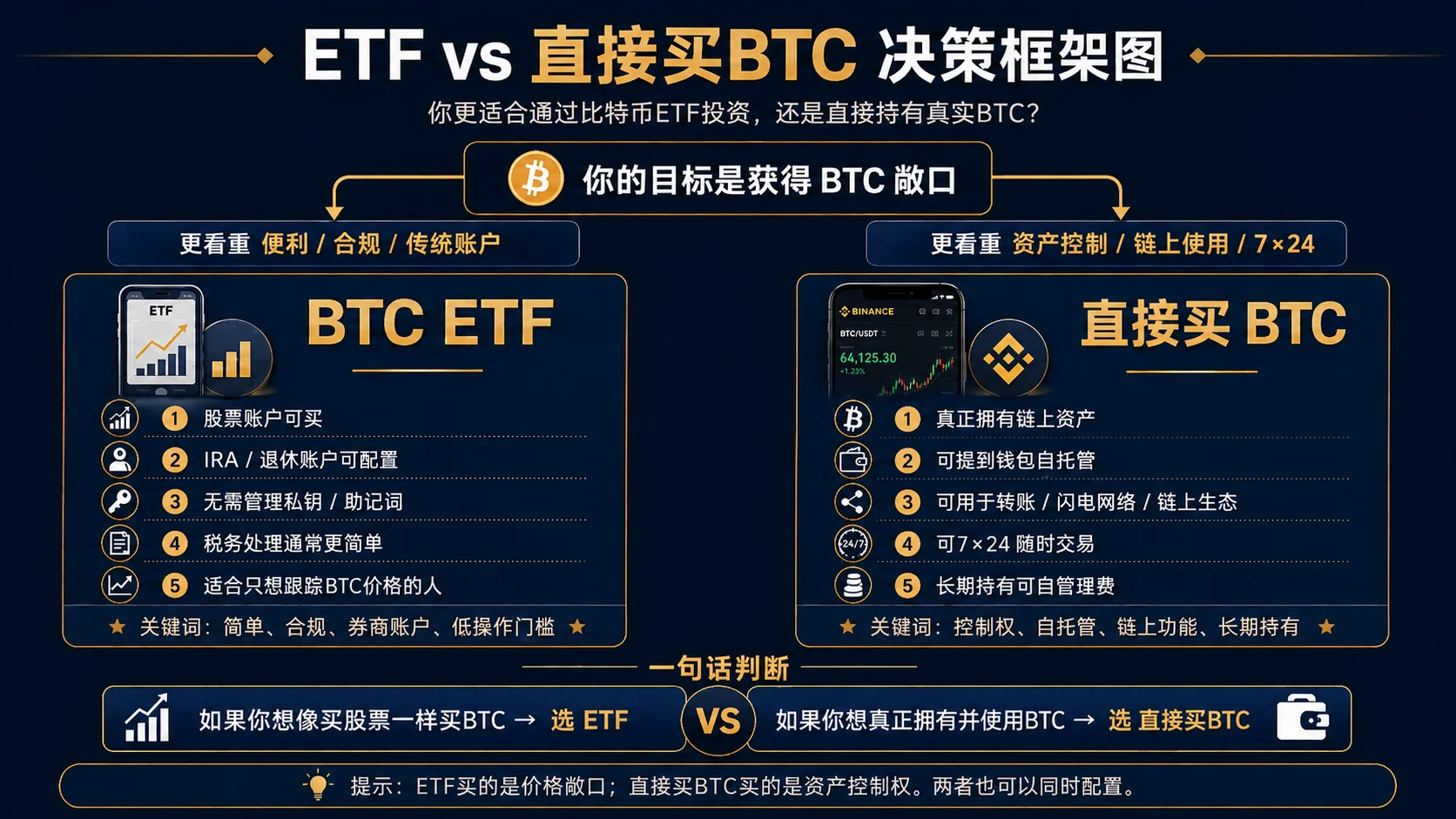
About 9 minutes to read. Remember two things up front: an ETF gives you Bitcoin price exposure, not on-chain BTC — you can't transfer it and can't self-custody; and fee differences get magnified by long-term holding — the gap between GBTC's 1.50% and the 0.20% tier is not small money.
What Is a Bitcoin ETF? Start With the ETF Basics
ETF stands for Exchange-Traded Fund.
Think of it as a "basket of assets." Buying one share of an ETF means proportionally holding the basket of assets inside it.
Example: the S&P 500 ETF (SPY) tracks the 500 stocks in the S&P 500 index. Buying one share of SPY means indirectly owning a tiny slice of Apple, Microsoft, Nvidia, Amazon, and 500 other companies. You don't need to open 500 stock accounts, calculate weights yourself, or rebalance daily — the ETF issuer does all of that for you.
A spot Bitcoin ETF borrows the structural logic of a traditional ETF: investors buy ETF shares, and the fund provides price exposure by holding real BTC. Buying IBIT (BlackRock's spot Bitcoin ETF) means gaining price exposure tied to the BTC the fund holds. The ETF issuer is responsible for buying and safeguarding real BTC, while you simply tap "buy" in your brokerage app.
For traditional investors, this solves several key problems:
- No need to learn crypto wallets: no wallet software, no seed phrase management, no on-chain transfers;
- No need to choose an exchange: no comparing Binance vs OKX, no KYC verification, no worry about a platform collapsing;
- Clearer compliance and tax handling: ETFs trade in a traditional brokerage account and automatically generate a 1099 tax form — you don't have to track the cost basis of every on-chain transaction yourself;
- Unified management with traditional assets: stocks, bonds, ETFs, and Bitcoin ETFs all live in the same account — your asset allocation is clear at a glance.
In short, a spot Bitcoin ETF moves "buying BTC" from the crypto world into the traditional financial world.
Spot ETF vs Futures ETF: What's the Difference?
Before the spot ETFs were approved in January 2024, Bitcoin futures ETFs already existed in the US market.
The two sound similar but affect the market in completely different ways.
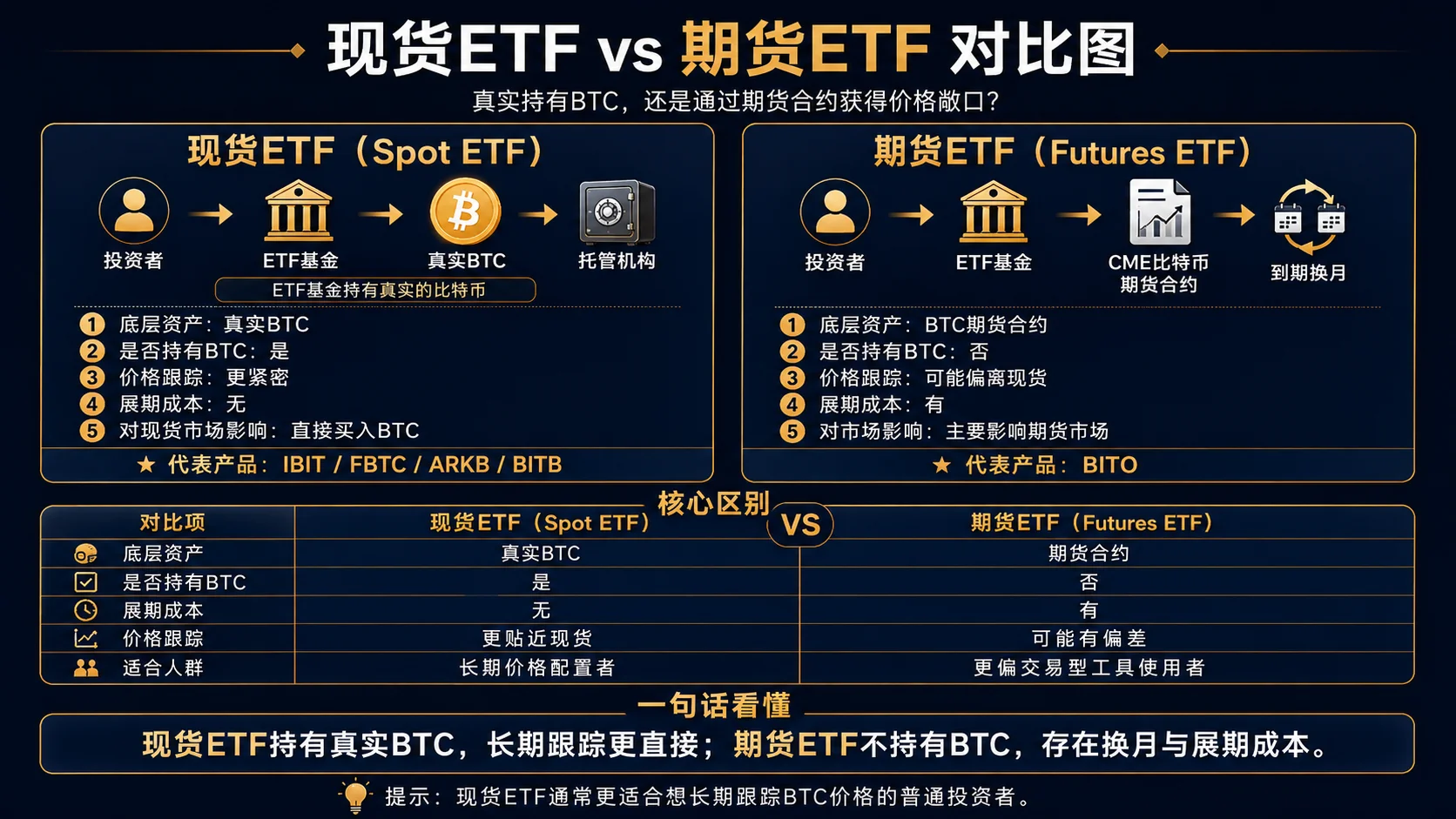
| Dimension | Spot ETF | Futures ETF |
|---|---|---|
| Underlying asset | Real BTC (physically custodied) | BTC futures contracts (CME) |
| Holds BTC? | Yes, held by a custodian | No, only holds contracts |
| Price tracking | Tracks spot price closely | Has futures premium/discount |
| Impact on BTC market | Buys BTC directly, pushes demand | Only affects the futures market |
| Roll cost | None | Yes (rolls contracts monthly) |
| Representative products | IBIT, FBTC, GBTC | BITO (ProShares) |
A futures ETF has one inherent flaw: roll cost.
Futures contracts expire each month. A futures ETF must sell the old contract and buy a new one before expiry. When the market is in "contango" — meaning longer-dated contracts price higher than near-dated ones — each roll incurs a loss. Holding a futures ETF long-term means this cost keeps eroding returns.
By contrast, a spot ETF holds real BTC through a custody arrangement, so it doesn't face the periodic rolling problem that futures ETFs do. Hold it for a year and the ETF custodies your BTC for a year, with more precise price tracking.
This is why the 2024 spot ETF approval was seen as a milestone — for the first time, traditional investors could gain exposure backed by real BTC through an ETF within the US regulatory framework.
The History of Bitcoin ETFs (2013–2026)
The approval of spot Bitcoin ETFs did not happen overnight. It was the result of a decade-long regulatory contest.
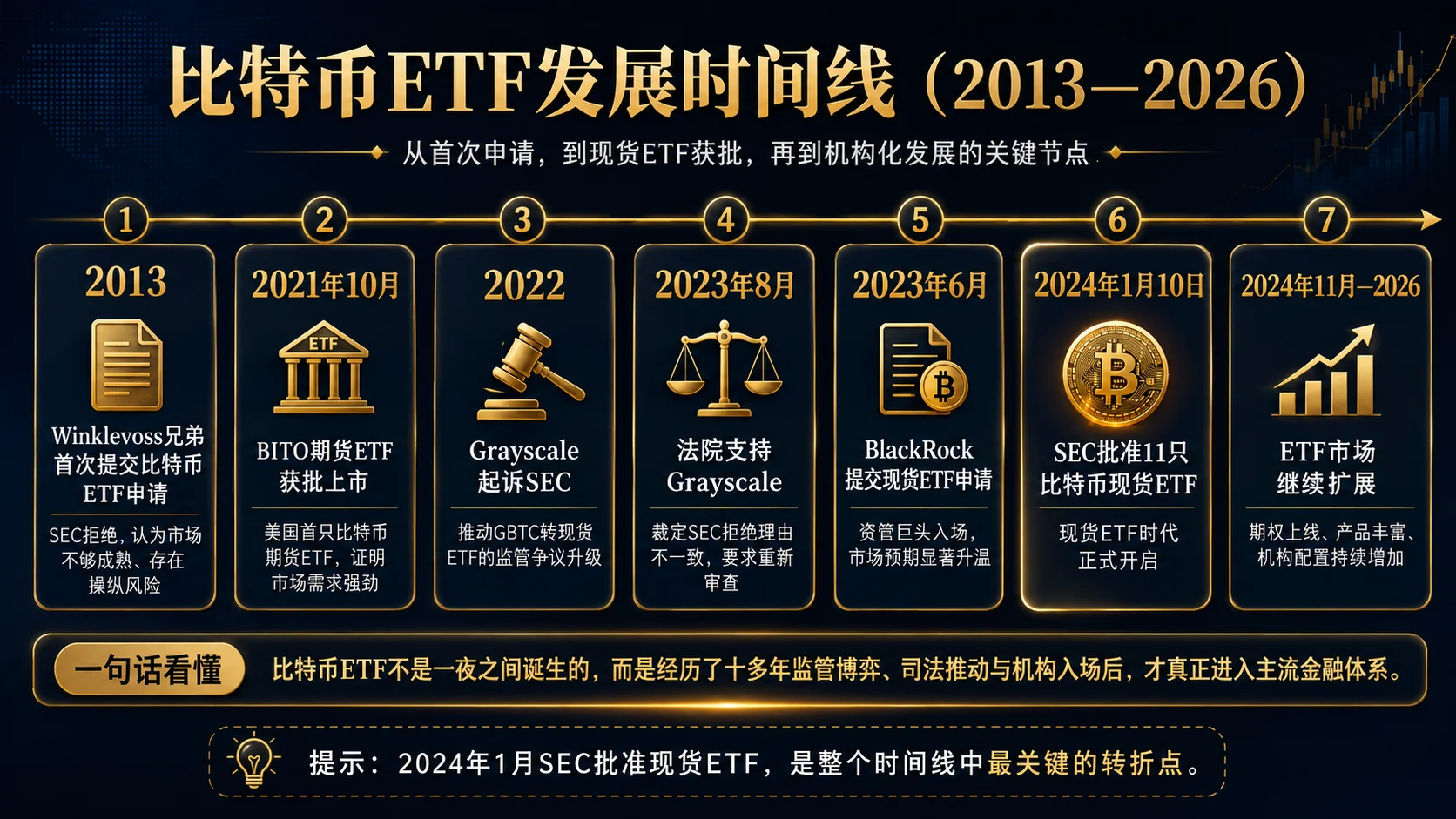
Key timeline:
- 2013: The Winklevoss twins filed the first Bitcoin ETF application, which the SEC rejected, citing an immature market and manipulation risk.
- 2018–2021: Multiple institutions filed applications; all were rejected. The SEC's core concern remained: the Bitcoin spot market lacked effective oversight and was easily manipulated.
- October 2021: The ProShares Bitcoin futures ETF (BITO) was approved and listed. The SEC's logic: the CME futures market is regulated by the CFTC and more orderly than the spot market. BITO's first-day volume exceeded $1 billion, proving the huge demand for Bitcoin ETFs.
- 2022: Grayscale sued the SEC. Grayscale had long wanted to convert its GBTC trust into a spot ETF, but the SEC repeatedly refused. Grayscale's argument: if a futures ETF was approved, why not a spot ETF? Both track the same underlying (BTC price), so the risk logic should be consistent.
- August 2023: A court ruled that the SEC's rejection of Grayscale's conversion was "arbitrary and capricious" and ordered the SEC to reconsider. This is widely seen as the turning point.
- June 2023: Asset-management giant BlackRock filed for a spot Bitcoin ETF. BlackRock's ETF approval rate is near 575:1 — the market widely believed that if even BlackRock couldn't push it through, no one could.
- January 10, 2024: The SEC formally approved 11 spot Bitcoin ETFs. On approval day, Bitcoin traded around $46,000.
- Q1–Q2 2024: Post-listing volumes exceeded market expectations, with first-month trading reaching tens of billions of dollars, and IBIT quickly became one of the largest spot Bitcoin ETFs in the US.
- November 2024: Spot Bitcoin ETF options began trading on Nasdaq, giving institutional investors new risk-management tools.
- 2025 onward: The spot Bitcoin ETF market has continued to develop, with product types and trading tools steadily expanding. ETFs have gradually become a key channel for traditional investors to access BTC, and more mainstream financial institutions and asset-management platforms are adding Bitcoin ETFs to client allocation models.
In short, the ETF's birth was driven by the combined force of judicial pressure (the Grayscale win) + institutional muscle (BlackRock's entry) + market demand (BITO's success). Post-listing performance also shows this was not just a regulatory milestone — it has had a lasting impact on BTC's market structure, liquidity, and investor base.
Comparing the Leading Spot Bitcoin ETFs
As of August 2026, there are multiple spot Bitcoin ETFs available in the US market. Here is a comparison of several leading products:
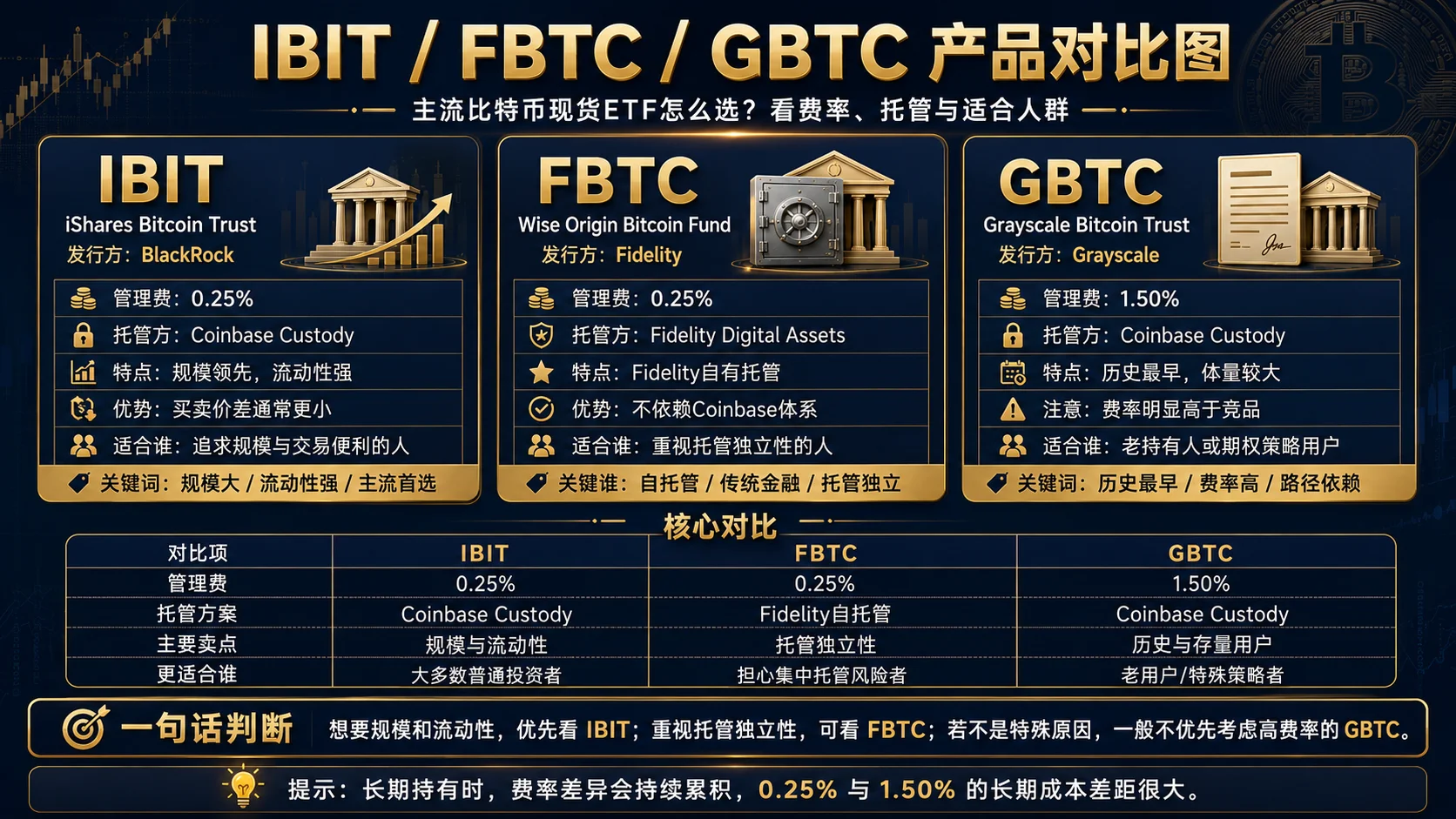
| Product | Issuer | Ticker | Fee | Custodian | Highlight | Best for |
|---|---|---|---|---|---|---|
| iShares Bitcoin Trust | BlackRock | IBIT | 0.25% (promotional period may adjust) | Coinbase Custody | One of the world's largest asset managers, leading size and liquidity | Those seeking maximum size and liquidity |
| Wise Origin Bitcoin Fund | Fidelity | FBTC | 0.25% | Fidelity self-custody | Self-custody, not reliant on a third party | Those concerned about Coinbase single-point risk |
| Grayscale Bitcoin Trust | Grayscale | GBTC | 1.50% | Coinbase Custody | Oldest product, highest fee | Legacy holders locked into positions, or options strategies |
| ARK 21Shares Bitcoin ETF | ARK/21Shares | ARKB | 0.21% | Coinbase Custody | Backed by Cathie Wood | Those valuing low fee + innovative brand |
| Bitwise Bitcoin ETF | Bitwise | BITB | 0.20% | Coinbase Custody | Among the lowest fees, crypto-native team | Those seeking the lowest fee and trusting a crypto-native team |
A few points worth noting:
(1) Fee competition
In the ETF industry, fee is one of the most important competitive dimensions, and Bitcoin ETFs are no exception.
BlackRock's IBIT and Fidelity's FBTC currently charge a 0.25% management fee.[2] Some issuers also launched fee waivers at listing, with the first 6–12 months waived or as low as 0.12%. Bitwise's BITB is one of the lowest at 0.20%.[3]
Grayscale's GBTC, meanwhile, charges 1.50% — six to seven times its competitors. This is mainly because GBTC was converted from an older trust structure and Grayscale is reluctant to cut existing revenue. The high fee has driven sustained outflows from GBTC since its ETF conversion.
For long-term holders, the fee difference compounds. Assume you invest $10,000 with BTC's price unchanged: a 1.50% fee costs roughly $1,400 over 10 years, while a 0.20% fee costs only about $200.
(2) Custody differences
Most ETFs use Coinbase Custody as their custodian (see the next section), but Fidelity is the exception — it uses its own Fidelity Digital Assets custody solution. As a traditional finance giant with decades of asset-custody experience, Fidelity's self-custody means not relying on third-party infrastructure. For investors worried about Coinbase single-point risk, FBTC is a differentiated option.
(3) Liquidity and size
IBIT (BlackRock) quickly became the largest spot Bitcoin ETF after listing, with assets under management (AUM) far exceeding competitors.[4] Large size means better liquidity and tighter bid-ask spreads, which is friendlier for big money.
How ETFs Work: Creation/Redemption, Authorized Participants, Custody
The mechanics behind a spot Bitcoin ETF are "invisible" to most investors. But understanding them helps you judge risk better.
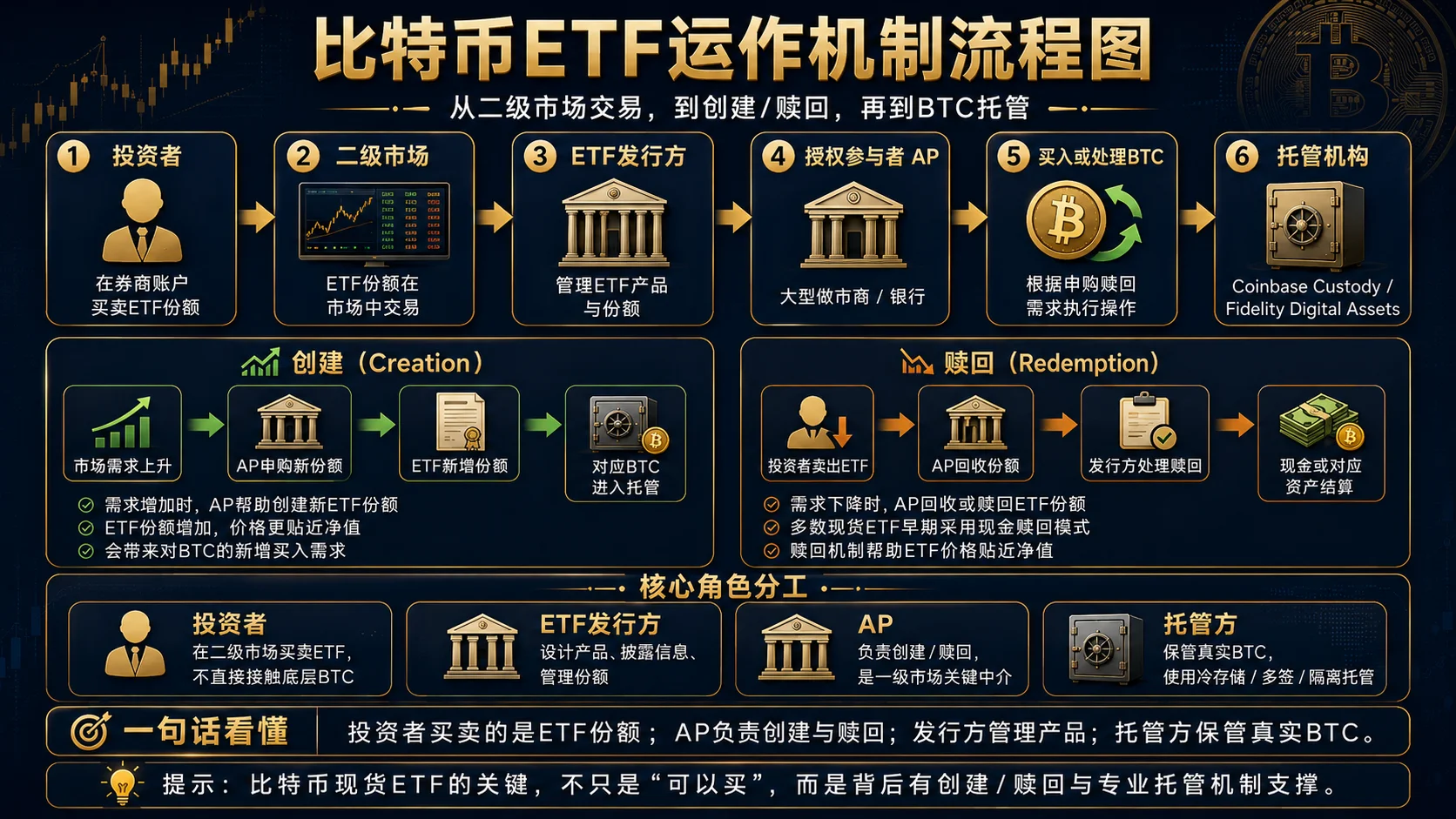
Creation
When market demand rises and the ETF price climbs, authorized participants (APs) — typically large market makers and banks — deliver Bitcoin to the ETF issuer in exchange for newly created ETF shares. These new shares are then sold to investors in the secondary market.
This process pushes up demand for BTC: APs must buy real Bitcoin to create ETF shares.
Redemption
When investors sell and market demand falls, APs reverse the operation: they return ETF shares to the issuer in exchange for Bitcoin. That BTC may then be sold on the market by the AP.
On the primary market, most ETFs currently use cash redemption — the AP receives US dollars, not Bitcoin. This means the redemption step does not directly create BTC selling pressure. But some ETFs also support in-kind redemption.
Custody
Custody is the most important and most sensitive part of the whole system.
The BTC held by a spot Bitcoin ETF is not kept in the issuer's own office — it is entrusted to a professional digital-asset custodian. These custodians typically use cold wallets + multi-signature + geographically distributed storage, a level of security far higher than what any individual investor can achieve.
ETF issuers must establish asset custody, auditing, and disclosure mechanisms per SEC approval documents and regulatory requirements, subject to periodic audits and regulatory inspection.
Are Bitcoin ETFs Safe? Coinbase Custody Mechanics and Risk Analysis
Short answer: a Bitcoin ETF's safety comes mainly from regulatory compliance, professional custody, and traditional financial infrastructure — but it still carries issuer risk, custody-concentration risk, and market risk. It is not a zero-risk product; it shifts risk from "individual operational mistakes" to "institutional systemic risk."
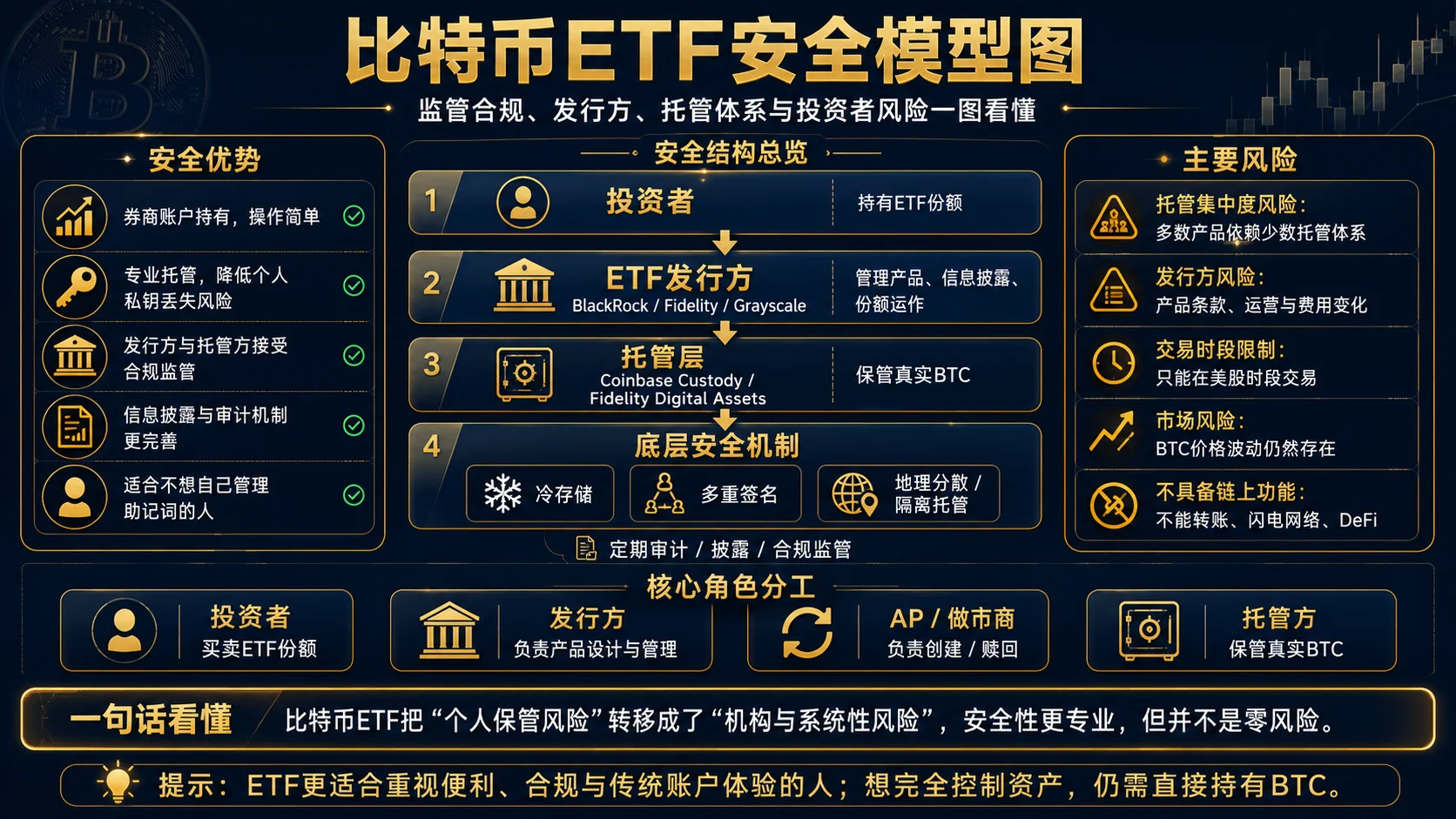
A question worth discussing seriously: most leading US spot Bitcoin ETFs use Coinbase Custody as their custodian, while Fidelity uses its own digital-asset custody system.
This means the majority of BTC held by US spot Bitcoin ETFs is actually concentrated in a single company's infrastructure.[5]
This raises two kinds of considerations:
The upside:
- Coinbase is the largest compliant crypto platform in the US, a public company (NASDAQ: COIN) supervised by the SEC and multiple regulators;
- Its custody solution has been battle-tested over years, using multi-layer physical security, multi-signature mechanisms, and cold/hot wallet segregation;
- Centralized custody reduces operational complexity for ETF issuers, letting them focus on product design and marketing;
- Institutional investors trust a transparent, compliant, regulated custodian more than scattered small custodians.
The risks:
- Single-point-of-failure risk: if Coinbase Custody suffers a security incident, technical failure, or regulatory problem, it affects not one ETF but the entire market;
- Regulatory-concentration risk: if the US government imposes new custody requirements on Bitcoin, Coinbase's compliance status would directly affect the operations of multiple ETFs;
- Key-management concentration risk: although cold-wallet keys are distributed, all operations run through Coinbase's internal systems. Insider malfeasance or process flaws could theoretically cause losses;
- A departure from decentralization: Bitcoin's design philosophy is decentralization, but the ETF custody model reintroduces centralized trust. Some Bitcoin maximalists criticize this as "betraying the original vision."
Why is Fidelity's self-custody special?
Fidelity's FBTC uses its own digital-asset custody solution, Fidelity Digital Assets, and does not rely on Coinbase. Fidelity custodies trillions of dollars in client assets, with security infrastructure and compliance systems verified over decades. For investors concerned about Coinbase's concentrated-custody risk, FBTC offers a meaningful alternative.
Overall, no Coinbase Custody security incident has occurred so far, and the system has operated well. But understanding this concentration risk is a prerequisite for rational participation.
How Institutional Money Is Changing the Bitcoin Market
The approval of spot Bitcoin ETFs opened a sustained channel for institutional inflows, with profound effects on the market.
(1) Significantly deeper market
Daily ETF volume and market-maker participation have brought unprecedented liquidity to Bitcoin. Bid-ask spreads have narrowed, and the price impact of large orders has weakened. For large capital, entering and exiting the Bitcoin market is now far easier than before 2023.
(2) A trend toward lower volatility
Bitcoin has historically been known for high volatility — single-day moves of 20% are not unusual. Since the ETF launch, while BTC is still more volatile than traditional assets, the overall volatility trend has been declining.
The reason is simple: institutional money typically has a longer investment horizon and won't panic-sell over a tweet. As the share of "long-term holders" rises in the market, short-term speculative swings naturally decrease.
That said, this doesn't mean Bitcoin no longer moves. During 2025–2026, BTC still saw multiple single-day moves above 10% amid shifting macro and regulatory expectations.
(3) Changing correlation with traditional assets
Bitcoin is increasingly behaving like a "macro asset."
Since the ETF launch, BTC's correlation with the Nasdaq and gold has risen, suggesting it is increasingly being priced as part of the macro trade. The Fed's rate decisions, dollar strength, global liquidity conditions — these core variables of traditional finance now have growing influence over Bitcoin.
This is both good and challenging. The good: Bitcoin gains "mainstream asset" status. The challenge: it loses some of its independent-market character.
(4) A shift in the price-discovery mechanism
The ETF launch moved part of Bitcoin's price discovery into US trading hours. Previously, BTC traded 24/7 globally, with Asian and European sessions equally important. Now, US market hours (9:30 AM to 4:00 PM Eastern Time) are becoming increasingly dominant — a large share of ETF trading is concentrated in the US market.
There is also an interesting phenomenon: ETF flows have become a new market signal. Traditional financial media now report "Bitcoin ETFs saw net inflows/outflows of X billion dollars yesterday" every day, and this data has become an important reference for gauging sentiment. On Bloomberg Terminal, Farside Investors, and similar platforms, ETF flow data is closely watched.
One caveat: higher institutional participation via ETFs does not mean BTC's price will keep rising. ETFs changed the channel through which money enters, but price is still shaped by the macro environment, supply and demand, and investor sentiment together. Treating ETF flows as the sole decision input is as irrational as ignoring them entirely.
How to Buy a Bitcoin ETF (5 Steps for US Investors)
If you already have a US brokerage account, buying a Bitcoin ETF is exactly like buying Apple stock. Here are the specific steps:
Step 1: Open a US brokerage account
You need a brokerage account that supports US stock trading. Common options include Interactive Brokers, Charles Schwab, moomoo, Robinhood, and Fidelity. If you don't have an account yet, pick a broker regulated by the SEC/FINRA and complete account opening and identity verification.
Step 2: Search the ETF ticker
Enter the ticker in your broker's search box. Mainstream tickers: IBIT (BlackRock), FBTC (Fidelity), BITB (Bitwise), ARKB (ARK/21Shares), GBTC (Grayscale).
Step 3: Check fees and liquidity
Before buying, quickly confirm two things:
- Management fee: IBIT currently has a 0.12% promotional fee (later reverting to 0.25%), FBTC 0.25%, BITB 0.20%. When fees are close, prioritize the more liquid product.
- Bid-ask spread: the tighter the spread, the lower your actual entry cost. IBIT, being the largest, usually has the tightest spread.
Step 4: Enter the order size
You can buy by number of shares (e.g. "buy 10 shares of IBIT") or by dollar amount (e.g. "buy $5,000 of IBIT"). Some brokers support automatic recurring investing, buying on a fixed date each month.
Step 5: Manage your position
After buying, the ETF shares appear in your brokerage holdings alongside stocks and bonds. At year-end the broker automatically generates a 1099 tax form (for US taxpayers), so you don't need to record the cost basis of each trade yourself.
Note: The steps above apply to US investors buying US-listed spot Bitcoin ETFs through a US broker. Investors in other regions should follow local regulations and use locally available channels.
What Does This Mean for Ordinary Investors?
If you've been sitting on the sidelines because you "don't know how to use a wallet" or "fear exchange risk," a spot Bitcoin ETF offers a very direct way in.
Advantages:
- Simple to operate: if you already have a US brokerage account (Interactive Brokers, Charles Schwab, Robinhood, etc.), just search a ticker (like IBIT) and click buy — the whole process is like buying Apple stock.
- Easy tax handling: the broker automatically generates tax forms, so you don't need to track the cost basis of every on-chain transaction. This matters especially for US taxpayers.
- IRA/401(k) eligible: some retirement-account platforms already support Bitcoin ETFs, meaning you can allocate to BTC within a retirement account and enjoy tax-deferred or tax-free growth.
- No private-key management: there is no "lost seed phrase, assets gone" problem. Your ETF shares are recorded in your brokerage account, and even a forgotten password can be recovered through identity verification.
- Estate-planning friendly: if the holder passes away, an ETF — as a traditional financial asset — follows the normal brokerage and legal inheritance process. There is no "person gone, keys lost, BTC locked on-chain forever" problem.
Disadvantages and caveats:
- Management fee: 0.20%–0.25% doesn't look high, but it compounds over the long term. Holding BTC directly has no management fee.
- Not real BTC: you hold ETF shares, not on-chain BTC. You can't use ETF shares for on-chain transfers, payments, or DeFi. If you want to truly understand and use the Bitcoin network, an ETF can't replace direct holding.
- Only tradeable during US market hours: BTC trades 24/7, but ETFs can only be bought and sold during US market hours. On weekends and holidays, if BTC swings sharply, you can't act.
- Dependence on issuer and custodian: your BTC is exposed to the operational risk of the ETF issuer and custodian. Though these institutions are regulated, the risk is not zero.
Direct holding vs ETF holding — how to choose?
There is no standard answer; it depends on your situation. If you value convenience, tax simplicity, and compliance, an ETF is a great choice. If you want to truly participate in the Bitcoin ecosystem, fully control your assets, or trade 24/7, holding BTC directly is more suitable.
If you're torn between the ETF and direct holding, the next section compares them.
What Can't an ETF Replace?
A Bitcoin ETF makes it easier for traditional investors to gain BTC price exposure, but it cannot replace certain core functions of real BTC. Understanding these limits helps you avoid the awkward "bought it and then found it unusable" situation:
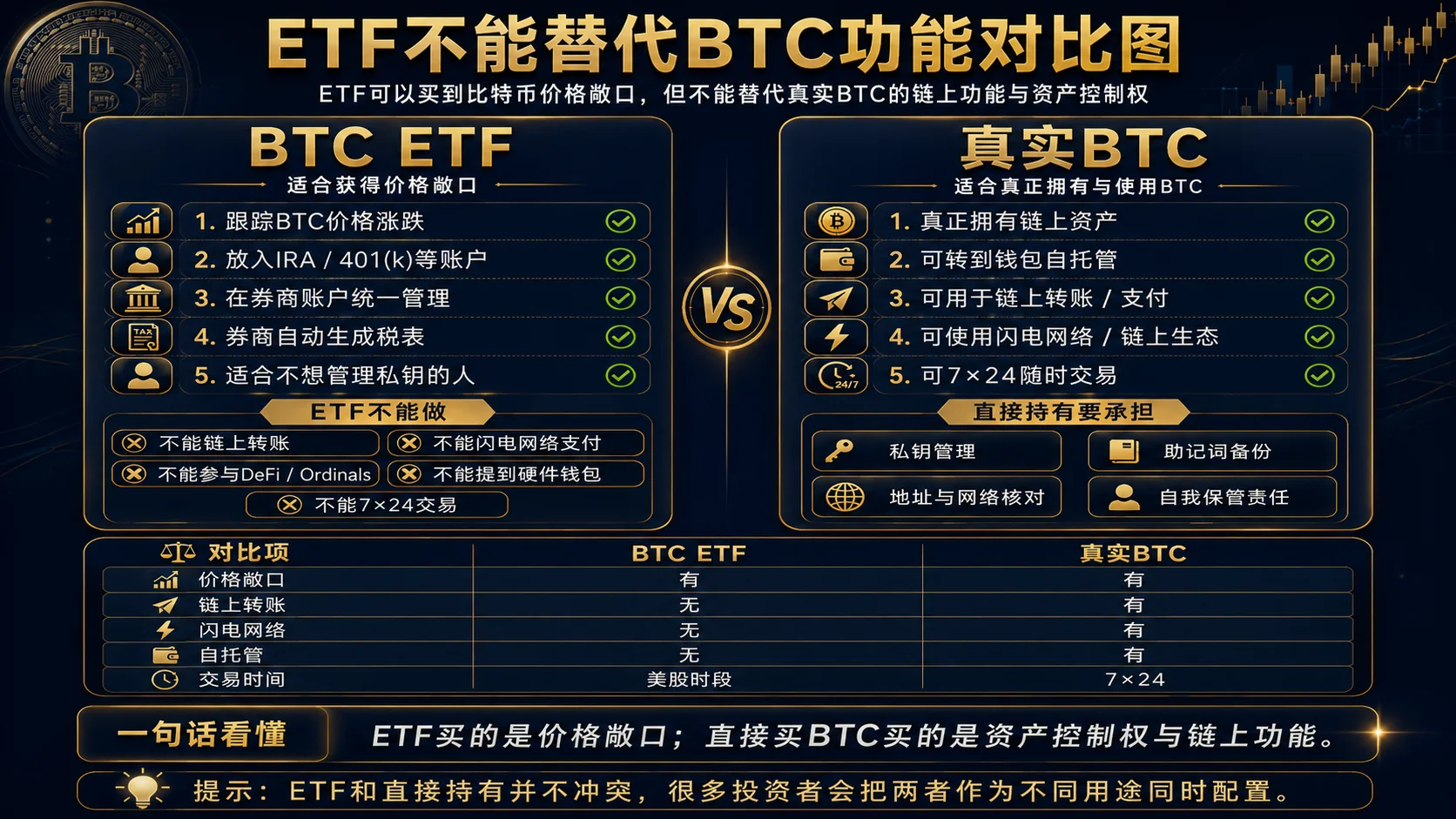
| An ETF can | An ETF cannot |
|---|---|
| Track BTC price moves | Transfer on-chain to someone else |
| Go into a retirement account (IRA/401k) | Lightning Network payments |
| Be managed in a US brokerage account | Use DeFi / Ordinals / on-chain apps |
| Enjoy traditional-finance compliance protection | Trade 7×24 (US market hours only) |
| Have taxes auto-generated by the broker | Withdraw to your own hardware wallet for self-custody |
In one sentence: an ETF buys Bitcoin's price exposure, not Bitcoin's on-chain functionality.
If you might later want to try Lightning payments, participate in the on-chain ecosystem, or truly experience "asset control that depends on no third party," then holding real BTC directly is necessary. An ETF and direct holding aren't mutually exclusive either — many people hold both.
For further comparison and a decision framework, see: Bitcoin ETF or Buy BTC Directly? Choose by Amount and Holding Period (2026).
For what self-custody requires, see: Bitcoin Wallets Compared: Cold, Hot, and Hardware Wallets (2026).
FAQ
What's the difference between a Bitcoin ETF and buying BTC directly?
A Bitcoin ETF means holding ETF shares and owning BTC indirectly. Buying BTC directly means holding on-chain assets and managing your own wallet and private keys.
An ETF is more convenient, more compliant, and simpler for taxes, but charges a management fee and has trading-hour limits. Direct holding has no management fee, can trade 24/7, and can participate in the on-chain ecosystem, but requires taking on self-custody responsibility.
The two aren't opposites — many investors hold a bit of both.
Can investors outside the US buy Bitcoin ETFs?
The US-listed spot Bitcoin ETFs are primarily aimed at US investors. Investors in other regions can access them through a US brokerage account where available, but must confirm for themselves whether this complies with local laws and regulations.
Availability and eligibility differ by country, so check your local rules and available channels before buying.
Does a BTC ETF affect Bitcoin's price?
Yes. The ETF's creation mechanism generates real demand for BTC. When ETFs see net inflows, authorized participants must buy BTC to create new shares, which pushes up the spot price. Likewise, large outflows create selling pressure.
But don't oversimplify it to "ETF up, BTC up" — the market is complex, and price is determined by many forces. ETF flows are just one of many factors.
Why do people still buy GBTC at such a high fee?
The main reasons are path dependence and tax lock-in. Many GBTC holders are early investors who bought before the ETF conversion, at a very low cost basis. Selling GBTC would trigger capital-gains tax, and for long-held whales the tax cost may far exceed the fee difference, so they'd rather keep holding.
Additionally, because GBTC is large and long-listed, it has an options market on some platforms, which has value for institutions running derivatives strategies.
Could Coinbase Custody run off?
Any company carries operational risk, and Coinbase is no exception. But Coinbase, as a Nasdaq-listed company supervised by the SEC, FINRA, and multiple state regulators, must meet strict compliance and audit requirements for its custody business. Probabilistically, a "run-off" style collapse of Coinbase Custody is unlikely, though technical security incidents and internal operational mistakes cannot be fully ruled out.
This is also why Fidelity's self-custodied FBTC attracts some investors — to diversify custody risk.
Is there a minimum amount to buy a Bitcoin ETF?
Bitcoin ETFs trade in shares like stocks, with each share representing a set proportion of BTC (set and managed by the ETF issuer). Most brokers support buying by share count (minimum 1 share), and some support fractional shares, allowing dollar-based buys (e.g. from $50, depending on broker rules). For small investors, the entry barrier is very low.
That said, if the amount is very small (e.g. $100), check whether your broker charges a commission — most mainstream brokers are now zero-commission, but some platforms still have minimum fees.
Which has lower fees, a Bitcoin ETF or buying BTC directly?
It depends on your holding size and horizon:
- Small regular investing (e.g. $200/month): the ETF is usually easier, with zero-commission broker trades. Buying BTC directly has exchange fees and withdrawal gas fees that are proportionally higher.
- Medium-to-long holding ($10,000+, 3+ years): buying BTC directly is cheaper — no management fee while holding. An ETF's 0.2%–0.25% annual fee keeps accumulating.
- Large long-term ($50,000+, 5+ years): buying BTC directly has a very clear cost advantage. Five years of ETF management fees run roughly $500–$2,500, while self-custody total cost is under $30.
For a detailed cost comparison and the calculation, see: Bitcoin ETF or Buy BTC Directly? Choose by Amount and Holding Period (2026).
Is a Bitcoin ETF suitable for long-term holding?
It suits some scenarios, but you need to be clear about your goal. If you want to hold BTC long-term in a traditional brokerage account, don't want to manage private keys, and can accept the 0.2%–0.25% annual fee, an ETF is a convenient option — especially inside an IRA/401k.
But if you hold ETF shares rather than on-chain BTC, you can't make on-chain transfers, Lightning payments, or use DeFi. Also, the ETF's annual fee accumulates over long holding periods. For holding beyond 5 years, buying BTC directly is more cost-effective. See: Bitcoin ETF or Buy BTC Directly? Choose by Amount and Holding Period (2026).
Are the ETF's BTC holdings real?
Yes. A spot Bitcoin ETF holds real on-chain BTC, and the custodian periodically publishes wallet addresses and proof of reserves. With IBIT, for example, BlackRock and Coinbase Custody periodically publish proof of holdings and third-party audit reports, ensuring BTC reserves correspond one-to-one with ETF shares.
This differs from certain "paper gold" products — a spot Bitcoin ETF must hold real BTC, which is a basic condition of SEC approval.
Summary
The spot Bitcoin ETF is an important bridge bringing crypto into the mainstream financial system.
It turned an asset that once required a certain technical threshold into a product you can buy and sell with a ticker in a traditional brokerage account.
Key takeaways:
- An ETF lets you hold BTC indirectly through traditional finance, without managing private keys;
- Spot ETFs (like IBIT, FBTC) hold real BTC directly and track more precisely than futures ETFs;
- The January 2024 SEC approval was the combined result of the Grayscale lawsuit win, BlackRock's entry, and a decade of regulatory contest;
- Mainstream product fees range from 0.20% to 0.30%, and GBTC's 1.50% fee is less competitive;
- Most ETFs are custodied by Coinbase Custody, with Fidelity's self-custody a differentiated option;
- Sustained institutional inflows have deepened the market, lowered volatility, and shifted BTC's price-discovery mechanism;
- An ETF is convenient but isn't "better BTC" — direct holding and ETF holding each have pros and cons depending on your needs.
If you'd like to go deeper on Bitcoin's value logic after understanding Bitcoin ETFs, recommended read: Why Does Bitcoin Have Value? Scarcity, Decentralization, Network Effects.
Data Verification
Key facts in this article were checked against SEC filings and each ETF issuer's official pages on 2026-10-16, item by item:
- Spot ETF approval: On January 10, 2024, the SEC approved 11 spot Bitcoin ETFs, letting investors gain BTC price exposure through a US brokerage account. Source: SEC statement approving spot Bitcoin ETPs.
- IBIT / FBTC fees: IBIT and FBTC currently both charge a 0.25% management fee, with IBIT also offering a phased promotional rate. Source: iShares Bitcoin Trust (IBIT) official page.
- BITB fee: The Bitwise Bitcoin ETF charges a 0.20% management fee, among the lowest in its class. Source: Bitwise Bitcoin ETF (BITB) official page.
- Size and flows: IBIT became one of the largest spot Bitcoin ETFs by AUM after listing; each product's size and flows can be checked on public data platforms. Source: Farside Investors Bitcoin ETF flow data.
- Custody concentration: Most leading US spot Bitcoin ETFs entrust their BTC to professional custodians such as Coinbase Custody, using institutional-grade cold wallets and multi-signature. Source: Coinbase Custody official documentation.
Related Reading
BTC ETF from understanding to decision (in reading order):
- What Is Bitcoin (BTC)? Principles, Value, and Risks (2026) ← Upstream: systematically understand Bitcoin basics
- How to Buy a Bitcoin ETF? IBIT vs FBTC Comparison & Fees (2026) (this article) ← You are here
- Bitcoin ETF or Buy BTC Directly? Choose by Amount and Holding Period (2026) ← Downstream: after the ETF basics, decide between the ETF and direct BTC
- Why Does Bitcoin Have Value? Scarcity, Decentralization, Network Effects ← Extension: understand Bitcoin's value foundation
- Bitcoin Wallets Compared: Cold, Hot, and Hardware Wallets (2026) ← Downstream: if you choose to hold BTC directly, start by picking a wallet
- Buying BTC for the First Time in 2026: Think Before You Order ← Hands-on: once you've chosen direct holding, start here
Disclaimer
This article is for educational purposes about Bitcoin ETFs and cryptocurrency only and does not constitute investment, financial, or trading advice.
Crypto asset prices are highly volatile, and ETF products themselves carry management-fee, tracking-error, custody, liquidity, and regulatory risks. Investors in different countries and regions are subject to different laws; before buying a Bitcoin ETF, confirm local compliance requirements and rely on the official prospectus and SEC filings.
Past performance is not indicative of future results. Investors should judge carefully based on their own risk tolerance, investment goals, and financial situation, and consult a licensed financial advisor where necessary.
This article was compiled by the CoinTrailHub editorial team from public sources, official documents, and industry data. The team has long followed Bitcoin, blockchain infrastructure, and digital-asset security, and the content is intended only to help readers better understand Bitcoin ETFs and the crypto market, without guaranteeing any asset price, platform outcome, or investment return.
- SEC statement approving spot Bitcoin ETPsBasis for the January 2024 spot ETF approval
- iShares Bitcoin Trust (IBIT) official pageIBIT fee and product terms
- Fidelity Wise Origin Bitcoin Fund (FBTC) official pageFBTC fee and product terms
- Coinbase Custody official documentationETF custody mechanism
- Farside Investors Bitcoin ETF flow dataETF flows and AUM data
- Bitwise Bitcoin ETF (BITB) official pageBITB fee and product terms
- 2026-10-17UpdateAdded evidence-chain superscripts and the data verification section.
See ourEditorial Policy and the correction process in ourCorrections Policy.
The CoinTrailHub editorial team focuses on crypto education for beginners, exchange security and P2P trading risk. This article is compiled from official sources and public data, reviewed by humans, and strives for accuracy but is not investment advice.
Last updated:2026-08-09 · Content reviewed by humans · Learn more
© 2026 CoinTrailHub · Original content. Reproduction or rewriting without permission is prohibited.