
New to crypto? Learn in this order to avoid detours

Table of contents

Binance new user rewards
20% trading fee rebate
Official Binance registration. Complete identity verification (KYC) to trade and withdraw.
When people first touch crypto, many people's first reaction is:
What should I buy?
But what actually causes problems is usually not "failing to buy some coin".
It's starting to operate assets before understanding the basic rules.
Some people treat their exchange account as a wallet.
Some people screenshot their seed phrase and keep it on their phone.
Some people see that TRC20 has a low fee and pick it directly, only to find the receiving platform doesn't support it.
Others get pulled into futures groups and signal groups before they even understand spot.
So this article is not a buying tutorial.
It's not a concept encyclopedia either.
It's a learning-order map for crypto beginners.
You can treat it as your first roadmap when you first touch crypto:
What to learn first, what to learn later, which content to avoid for now, and which safety habits to build in advance.
This article is for crypto fundamentals education only and does not constitute investment, financial or trading advice. Crypto operations involve asset risk; readers should judge independently based on their own situation and bear the related risks themselves.
Understand it in 30 seconds
When you first touch crypto, remember these lines first:
- Don't immediately ask "what to buy"
- First understand exchanges, wallets, USDT, seed phrases and withdrawal networks
- An exchange account and a Web3 wallet are not the same thing
- USDT isn't just a coin name — it also involves different networks
- A seed phrase isn't a verification code — don't screenshot it, don't send it to anyone
- Don't transfer a large amount the first time — do a small test first
- Futures, signal groups, airdrops and unfamiliar links are best set aside by beginners
One-line summary:
What matters most for a beginner isn't speed — it's not stepping into a pitfall on a basic operation.
The recommended order for learning crypto
If you're a complete beginner, you can learn in this order:
- First understand what crypto and blockchain are
- Then get to know exchange accounts and USDT
- Then learn wallets, addresses and seed phrases
- Then practice withdrawing and depositing with a small amount
- Finally learn to look up on-chain records with a TxID
| Stage | What to learn | Goal |
|---|---|---|
| 1 | What crypto and blockchain are | First know what system crypto is |
| 2 | Exchange accounts and USDT | Know why beginners start with exchanges and USDT |
| 3 | Wallets, addresses, seed phrases | Distinguish address, seed phrase, private key and control |
| 4 | Small withdrawal and deposit practice | Confirm address, network and arrival are all correct |
| 5 | TxID and block explorers | Check on-chain records first when something doesn't arrive |
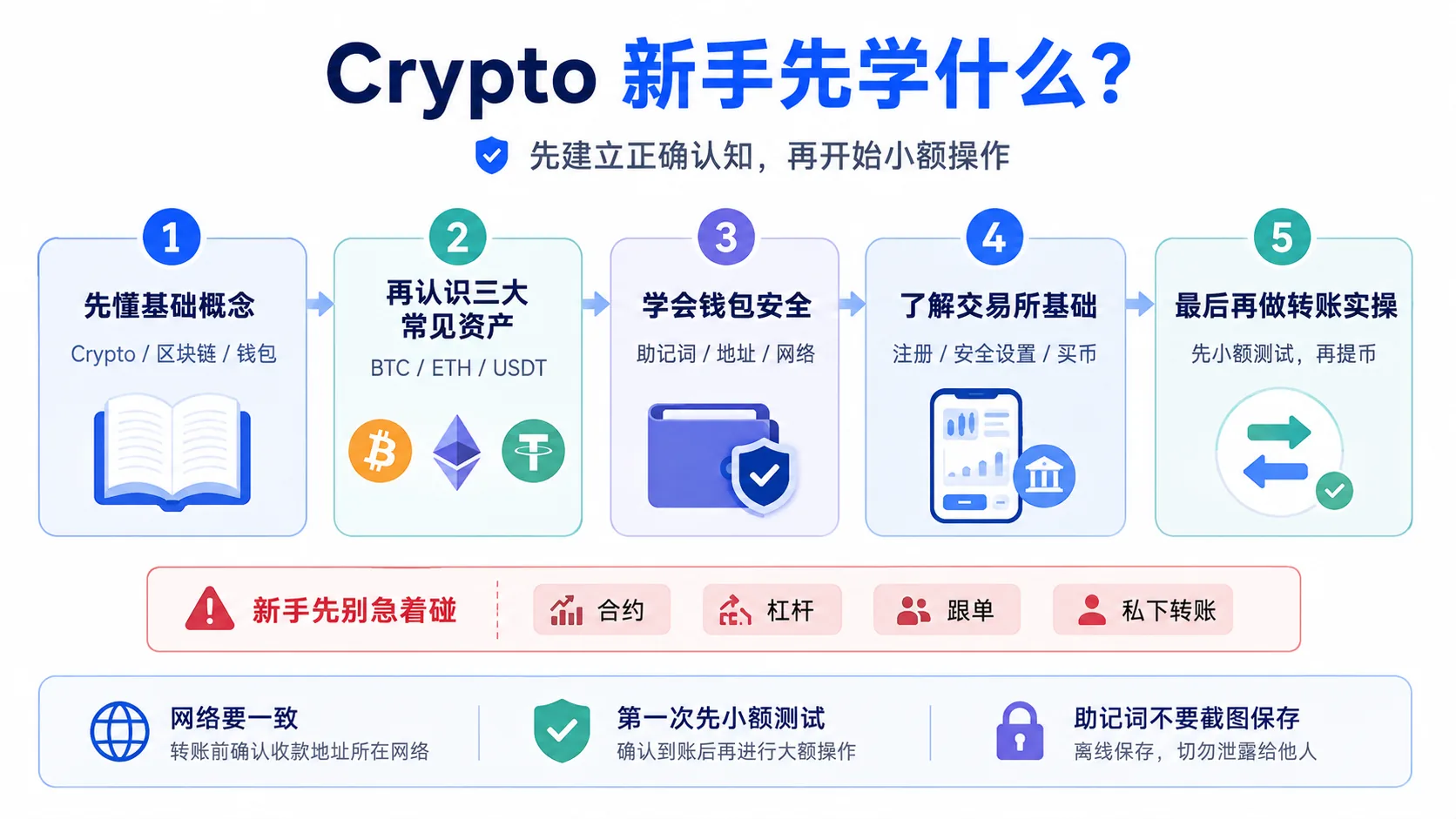
It's not recommended to start with futures, airdrops, DeFi or complex projects.
Because these pull your attention toward "opportunities" and "returns".
But where beginners actually make mistakes is often:
- Account security
- Wallet seed phrases
- Withdrawal networks
- On-chain transfers
- Fake support and phishing links
So the core of this article isn't teaching you to chase trends.
It's helping you first build a safe learning order.
What this article doesn't do
To avoid misleading beginners, this article won't:
- Recommend a specific coin to buy
- Predict price movements
- Compare returns
- Guide futures or leveraged trading
- Promise any asset recovery result
- Use phrases like "guaranteed profit", "capital preservation" or "low risk, high return"
This article solves only one problem:
When you first touch crypto, in what order should you build your basic understanding.
Who is this article for?
This article is for these kinds of beginners:
- Just heard about crypto and don't know where to start
- Read a lot of content but feel more and more confused
- About to register on an exchange but still don't understand wallets and withdrawals
- Already bought USDT but don't know what to learn next
- Want to use a wallet but are afraid of seed phrases, private keys and wrong-chain transfers
- Often see futures, airdrops, DeFi and RWA but don't know which to learn first
If you're already familiar with wallets, on-chain transfers, block explorers and basic safety rules, this may be quite basic.
But if you're just starting, this article can help you sort out the order first.
The 5 reasons beginners get their learning scrambled
Many beginners aren't lazy.
Their learning order is scrambled from the start.
1. Focusing on price from the start
Many people, when first touching crypto, see prices, ups and downs, and get-rich stories first.
So before understanding what BTC, ETH and USDT are, they start watching prices.
This turns learning into chasing rises and falls.
Once the price moves, it's easy to be swept away by emotion.
Beginners can follow the market, but shouldn't put all their attention on price at the start.
2. Treating the exchange as the whole thing
The exchange is indeed the easiest place for beginners to start.
But crypto isn't just exchanges.
Later you'll also encounter:
- Wallets
- Seed phrases
- Withdrawal networks
- On-chain addresses
- TxID
- Block explorers
- Authorizations
- Contracts
Only understanding exchanges doesn't mean you already understand crypto.
3. Learning too many concepts at once
Some beginners start reading in their first week:
- Bitcoin
- Ethereum
- USDT
- Wallets
- DeFi
- Airdrops
- Ordinals
- RWA
- Futures
- AI projects
- Meme projects
And end up more and more confused.
What matters most in the beginner stage isn't learning a lot — it's getting the basic order right first.
4. Operating before understanding security
Many pitfalls in crypto aren't about not having memorized knowledge points.
They're about not having built safety habits.
For example:
- Screenshotting the seed phrase
- Clicking unfamiliar links
- Authorizing wallets casually
- Trusting support in private messages
- Withdrawing without checking the network
- Transferring a large amount the first time
Once these mistakes happen, it may not be as simple as "learning a lesson" — they can cause real asset loss.
5. Being led by others
Beginners are easily led by "teachers", "group members", "support" and "inside information".
Whatever others say to buy, they buy.
Whatever others say to click, they click.
Whatever others say to authorize, they authorize.
This isn't learning.
It's handing your judgment to someone else.
When you first touch crypto, it's best to set a bottom line first:
Anyone who urges you to transfer, authorize or open futures in a hurry — stop first.
Stage 1: First understand what crypto is
The goal of this stage isn't buying coins or researching projects.
The goal is only one thing:
First know what kind of system crypto is.
You need to first understand:
- What crypto is
- What blockchain is
- What BTC is
- What ETH is
- What a stablecoin is
- What on-chain assets are
There's no need to operate in this stage.
Building basic understanding is enough.
You can start by reading:
What is crypto? Cryptocurrency, Web3 wallets and on-chain assets (2026)
This is a good starting point.
After reading, you should at least know:
Crypto is not ordinary app points, nor just buying and selling ups and downs — behind it are on-chain records, wallet control and asset security.
Stage 2: Get to know exchanges and USDT
After you roughly understand what crypto is, then get to know exchanges and USDT.
The focus of this stage is:
Know why beginners often start with exchanges and USDT.
The role of an exchange is to lower the entry barrier.
It can help you complete:
- Register an account
- Identity verification
- Buy USDT
- Swap BTC / ETH
- Deposit and withdraw
- View assets
But you should know:
An exchange account is not a wallet.
Exchange assets are held by the platform.
What you see is an account balance, not your own private key.
At the same time, USDT isn't simply a "dollar balance".
USDT is a stablecoin, often used for pricing and transfers.
But it exists on different networks, such as ERC20, TRC20 and BEP20.
If you want to know about USDT's issuance and reserves, you can check the Tether transparency page.
For beginners, the point isn't to understand USDT as "absolutely safe", but to know it's a stablecoin tool, while also paying attention to issuer, reserve transparency, network choice and platform risk.
This stage, I suggest focusing on:
What is USDT? Tether's uses and risks (2026)
After reading, you should at least understand:
USDT is a tool, not a bank deposit; USDT's network choice also affects the safety of later transfers.
Stage 3: Understand wallets, addresses and seed phrases
This stage is crucial.
Many beginners run into problems right here.
An exchange account can be logged into with email, phone number and password.
But a Web3 wallet is different.
What really matters in a wallet is:
- Wallet address
- Seed phrase
- Private key
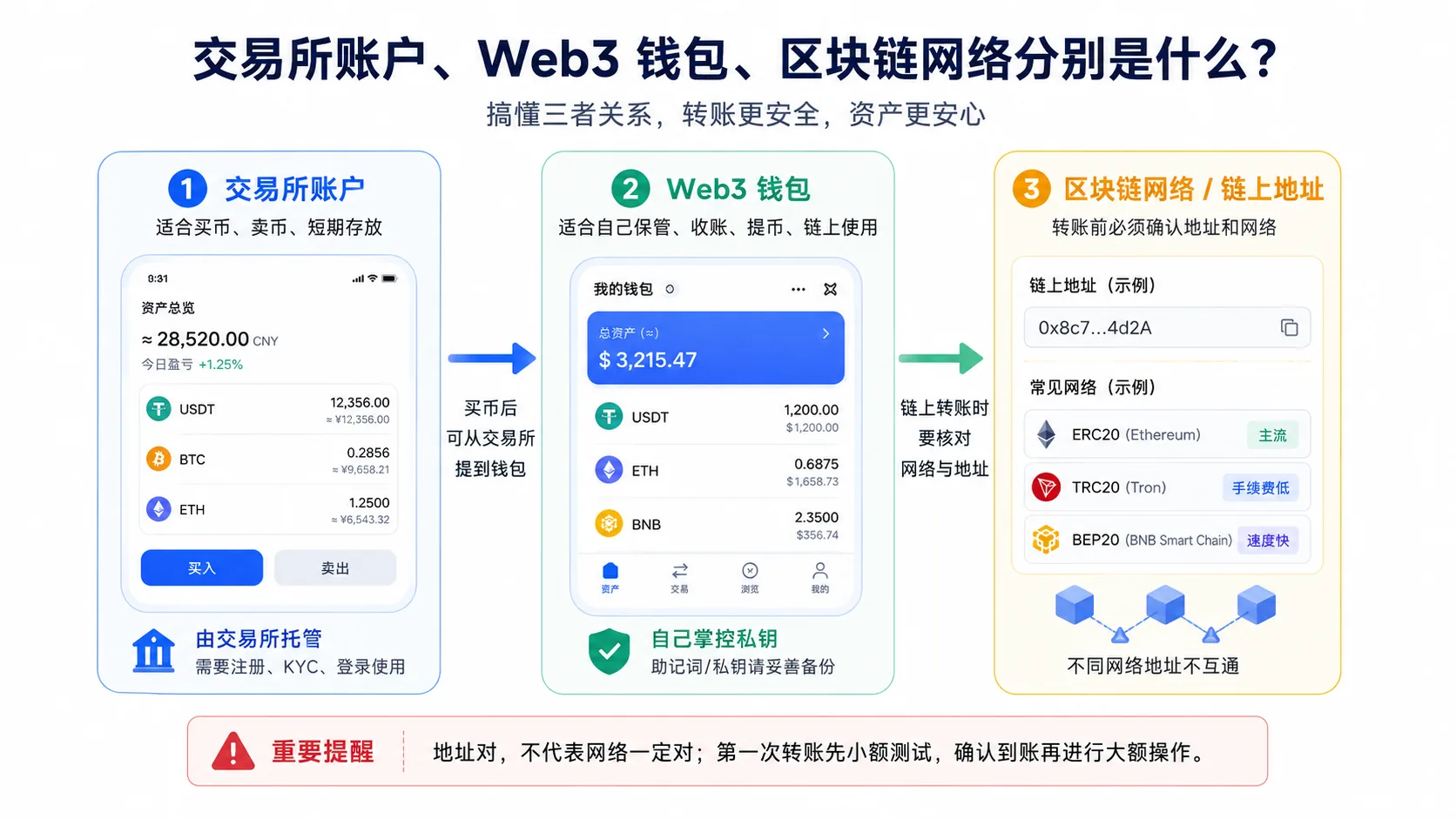
A wallet address can be understood as a receiving address.
The seed phrase and private key relate to asset control.
Whoever holds the seed phrase or private key may control the assets in the corresponding wallet.
From official material, a wallet is not just an "app for checking balances". Ethereum.org's wallet documentation notes that a wallet lets users control accounts, check balances, send transactions and interact with apps.
MetaMask's official support docs also emphasize that the Secret Recovery Phrase, password and private key are not the same concept. For beginners, the most important thing to remember first is: the seed phrase and private key relate to wallet asset control — don't screenshot them, don't send them to support, and don't enter them on unfamiliar websites.
So don't pursue speed in this stage.
Distinguishing the concepts of wallet address, seed phrase and private key matters more than transferring immediately.
Beginners need to build a few bottom lines first:
- Don't screenshot the seed phrase
- Don't send the seed phrase to support
- Don't store the seed phrase in cloud drives
- Don't enter the seed phrase on unfamiliar websites
- Don't let strangers remotely operate your wallet
This stage, I suggest reading two articles:
What is a crypto wallet? Wallet addresses, seed phrases and asset safety (2026)
What is a seed phrase? Why no one can recover your assets if you lose it (2026)
After reading, you should at least know:
A wallet has more freedom, but that also means you bear more security responsibility yourself.
Stage 4: Only practice transfers with a small amount
After understanding wallets, don't rush to withdraw a large amount.
This stage does only one thing:
Practice the transfer process with a small amount.
If you're withdrawing USDT from an exchange to a wallet for the first time, I'd suggest testing with a very small amount first, like 10–20 USDT.
The point isn't saving fees.
It's confirming three things:
- Whether the receiving address is correct
- Whether the withdrawal network matches
- Whether the assets can be found in the wallet or block explorer
After confirming, consider the next step.
This step looks simple but is very important.
Many beginners transfer on the wrong chain not because they can't operate at all.
But because they're overconfident.
They think copying the address means it's fine.
But crypto transfers aren't only about the address.
You also have to check the network.
For example, the same USDT may be on:
- ERC20
- TRC20
- BEP20
- Arbitrum
- Polygon
- Base
Whatever network the receiving platform supports, that's the network the sending platform should choose.
This stage, I suggest reading:
Can you recover a wrong-chain transfer? Withdrawal networks and wallet addresses (2026)
After reading, you should at least remember:
The address being right doesn't mean the network is also right.
Stage 5: Learn to look up TxID and block explorers
After you start transfer practice, the next step is learning to check on-chain records.
TxID is also called a transaction hash.
It's like the tracking number of an on-chain transfer.
If a transfer hasn't arrived, you shouldn't immediately transfer again.
Instead, first check:
- Whether the transaction succeeded
- Which network was used
- Which address the assets went to
- Whether they've already been moved out
- Whether the receiving address is one you control
Common block explorers include:
- OKLink
- Etherscan
- Tronscan
- BscScan
- Arbiscan
- Polygonscan
Beginners don't need to learn deeply at the start.
But at least know:
On-chain transactions aren't judged by feeling — they can be looked up with a TxID.
After learning this step, when you hit a deposit that hasn't arrived, a transfer delay or a wrong network, you at least won't completely panic.
Which content is better set aside by beginners?
When you first touch crypto, some content isn't that it can't be learned, but that it's not suitable to learn too early.
1. Futures and high leverage
Futures aren't just about going long or short.
They involve:
- Leverage
- Liquidation
- Margin
- Funding rate
- Stop-loss
- Emotional control
Before beginners understand spot, wallets and risk management, diving into futures makes large losses easy.
2. Signal groups and "teacher" guidance
Many "teachers" aren't teaching you to learn.
They're making you follow their operations.
Once you hand over your judgment, it's easy to be led.
Especially be cautious of those who make you download unfamiliar apps, transfer to a specified address, open futures, or join groups to copy trades.
3. Airdrops and authorizations
Airdrops look free.
But many scams start with "claiming an airdrop".
Before beginners understand wallet authorization, it's not recommended to casually click airdrop links.
Some malicious authorizations may move wallet assets out.
4. Complex DeFi operations
DeFi includes lending, liquidity, staking, cross-chain, bridges and contract interaction.
None of these are things beginners must learn in stage one.
First get wallets, networks, authorizations and risks clear, then look at them slowly.
5. High-yield financial products
Whenever you see phrases like "stable high returns", "guaranteed profit", "capital preservation" or "inside channel", raise your guard.
There's no risk-free high return in crypto.
The more a beginner wants to go fast, the easier it is to be trapped.
The CoinTrailHub 30-day beginner learning roadmap
This roadmap isn't for learning to trade within 30 days.
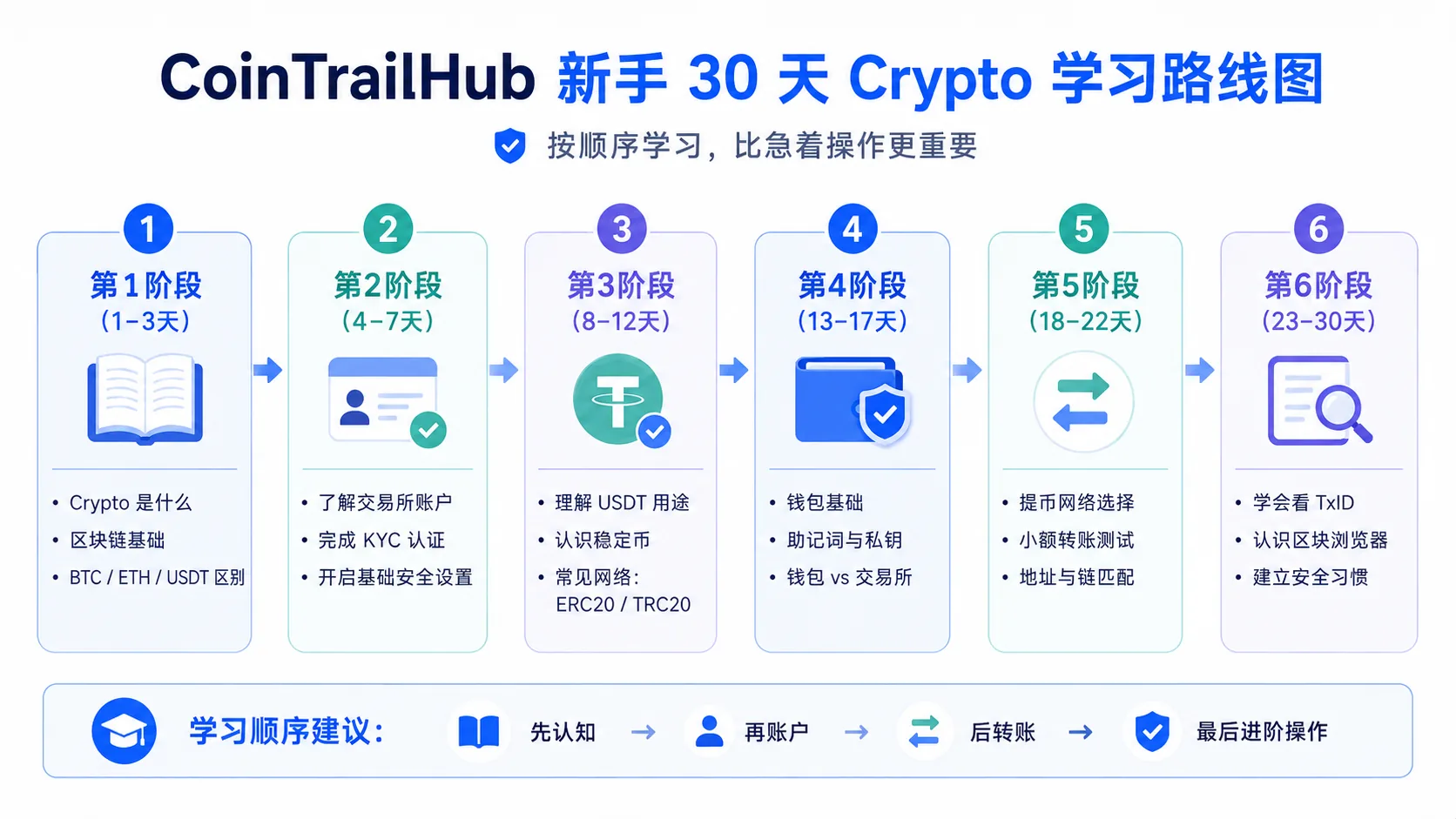
It's for building the most basic safety understanding within 30 days.
You don't need to learn a lot every day.
Just go stage by stage.
Days 1–3: Learn only basic concepts
Goal:
- Know what crypto is
- Know the rough difference between BTC, ETH and USDT
- Know that an exchange and a wallet are not the same thing
Recommended reading:
What is crypto? Cryptocurrency, Web3 wallets and on-chain assets (2026)
Don't rush to operate in this stage.
First understand the most basic concepts.
Days 4–7: Get to know exchanges and account security
Goal:
- Know what an exchange account is
- Understand KYC, passwords and 2FA
- Don't click fake official sites
- Don't trust support in private messages
You don't need complex trading in this stage.
First learn account security.
If you're about to register on an exchange, also check the official site, app download entry and security settings clearly, and don't enter through links in unfamiliar groups.
Days 8–12: Understand USDT and stablecoins
Goal:
- Know what USDT is
- Know the common uses of USDT
- Know that USDT has different networks
- Know that stablecoins also have risks
Recommended reading:
What is USDT? Tether's uses and risks (2026)
The focus of this stage isn't "how much to buy".
It's first understanding USDT's uses, networks and risks.
Days 13–17: Learn wallets and seed phrases
Goal:
- Know what a wallet address is
- Know why the seed phrase matters
- Know the private key must not be leaked
- Know a wallet is not an ordinary app account
Recommended reading:
What is a crypto wallet? Wallet addresses, seed phrases and asset safety (2026)
What is a seed phrase? Why no one can recover your assets if you lose it (2026)
Be sure to go slow in this stage.
Before you understand wallet security, it's not recommended to casually import a wallet or connect to a DApp.
Days 18–22: Learn withdrawal networks and small-amount tests
Goal:
- Know that ERC20, TRC20 and BEP20 aren't picked casually
- Know that the receiving and sending networks must match
- Know to do a small test on the first transfer
- Know to check the address and network together
Recommended reading:
Can you recover a wrong-chain transfer? Withdrawal networks and wallet addresses (2026)
In this stage you can start small-amount practice.
But don't transfer a large amount the first time.
Days 23–26: Learn TxID and block explorers
Goal:
- Know what a TxID is
- Know what a block explorer can look up
- Know to check records first when a deposit hasn't arrived
- Don't transfer again repeatedly
In this stage you can do simple lookup practice with OKLink, Etherscan and BscScan.
The focus is learning to read:
- Transaction status
- Transfer network
- Sending address
- Receiving address
- Token type
Days 27–30: Build your own safety checklist
Goal:
Build a safety-habits checklist of your own.
For example:
- Check the receiving network before withdrawing
- Do a small test on the first transfer
- Keep the seed phrase offline only
- Don't click unfamiliar links
- Don't trust support in private messages
- Don't touch high-leverage futures
- Don't put all your funds in one place
Only after learning this are you truly moving from "having heard of crypto" to "knowing how to get started safely".
Recommended reading order on this site
When you first touch crypto, you can read CoinTrailHub's basic content in this order.
1. Start with the overall concept
What is crypto? Cryptocurrency, Web3 wallets and on-chain assets (2026)
First know roughly what crypto is, and don't fall into prices and projects at the start.
2. Then USDT
What is USDT? Tether's uses and risks (2026)
USDT is the stablecoin many beginners encounter first; first understand its uses and networks.
3. Then wallets
What is a crypto wallet? Wallet addresses, seed phrases and asset safety (2026)
Understand the difference between an exchange account and a wallet.
4. Then the seed phrase
What is a seed phrase? Why no one can recover your assets if you lose it (2026)
The seed phrase is the core of wallet security and must be read carefully on its own.
5. Finally, withdrawal networks
Can you recover a wrong-chain transfer? Withdrawal networks and wallet addresses (2026)
Learn networks, addresses, small-amount tests and the approach to wrong-chain transfers.
Reading these 5 articles beats scattering across many short videos for building a complete understanding.
Before getting started, ask yourself these 7 questions
Before you actually start operating, ask yourself:
- Do I know the difference between an exchange and a wallet?
- Do I know the difference between USDT's different networks?
- Do I know why the seed phrase must not be leaked?
- Do I know why to do a small test before withdrawing?
- Do I know how to look up a TxID?
- Do I know to go to the official channel, not private-message support, when there's a problem?
- Do I know which content isn't suitable for beginners to touch yet?
If you can't answer most of these, you're not ready for complex operations.
Learning first isn't embarrassing.
Operating with large amounts before understanding is what's dangerous.
Related reading
- What is crypto? Cryptocurrency, Web3 wallets and on-chain assets (2026)
- How to dollar-cost average into crypto? A worry-free way to DCA BTC/ETH (2026)
FAQ
What should I learn first when I first touch crypto?
Learn basic understanding first.
Including what crypto is, what an exchange is, what a wallet is, what USDT is, and why seed phrases and withdrawal networks matter.
Don't immediately ask what coin to buy.
Do beginners have to register on an exchange first?
Not necessarily.
But many beginners start with an exchange, because its barrier is relatively low.
Still, before registering, pay attention to account security, whether the site is the real official site, KYC and 2FA.
Do beginners have to create a wallet right away?
Not necessarily.
Wallets matter, but they're also easier to get wrong on seed phrases, authorizations and network choices.
It's recommended to first understand wallet basics, then try with a small amount.
Why do a small test first?
Because once an on-chain transfer is confirmed, it often can't be reversed.
A small test helps you confirm the network, address and arrival are correct.
It's lowering the cost of mistakes.
How much is suitable for a first small test?
There's no fixed standard.
But if you're just learning the transfer process, you can test with a very small amount first, like 10–20 USDT.
The point isn't the amount, but confirming the network, address and arrival process are all correct.
Does choosing the wrong withdrawal network always lose the coins?
Not necessarily.
It depends on where the assets went, whether the address is one you control, and whether the receiving platform supports that network.
But whether or not they can be recovered, you shouldn't treat "recovery" as the default option.
Why shouldn't beginners touch futures?
Futures involve leverage and liquidation.
Before beginners understand spot, wallets and risk control, diving into futures makes it easy to incur a large loss from a single price swing.
Is an airdrop a free opportunity?
Not necessarily.
Some airdrops are normal events; some are fake links, malicious authorizations and phishing entries.
Before beginners understand wallet authorization, it's not recommended to casually click airdrop links.
After reading this, what should I read next?
I suggest reading in this order:
Crypto basics → USDT → wallets → seed phrases → withdrawal networks.
Don't skip around.
References
When organizing the crypto beginner learning order, wallet security, USDT basics and on-chain transfer fundamentals, this article referenced the following public material. Rules across platforms, wallet features and blockchain network states may change; before operating, follow the official pages, official apps and block explorer results.
Google Search Central: Creating helpful, reliable, people-first content https://developers.google.com/search/docs/fundamentals/creating-helpful-content
Google Search Central: SEO Starter Guide https://developers.google.com/search/docs/fundamentals/seo-starter-guide
Ethereum.org: Wallets https://ethereum.org/wallets/
MetaMask Support: Securing your Secret Recovery Phrase and password https://support.metamask.io/start/user-guide-secret-recovery-phrase-password-and-private-keys/
Tether Transparency https://tether.to/transparency/
OKLink block explorer https://www.oklink.com/
Etherscan https://etherscan.io/
Tronscan https://tronscan.org/
BscScan https://bscscan.com/
Content updates and limitations
Last updated: June 2026.
This article is mainly for sorting out a crypto beginner learning path and safety understanding. Different exchanges, wallets, blockchain networks and platform rules may change; before operating, follow the official app, official site instructions and actual page prompts.
This article provides no investment advice and promises no operating results.
Author note
The CoinTrailHub editorial team has long followed crypto beginner education, exchange usage, wallet security and on-chain transfer risks; team members have about 8 years of related experience in the crypto industry.
This article is compiled from public material, real operation pages and common beginner questions, with the focus on helping people new to crypto build a basic learning order and avoid getting their learning scrambled or operating wrong from the start.
This article is for crypto fundamentals education and safety education only, and does not constitute investment, financial or trading advice. Readers should judge independently based on their own situation and bear the related risks themselves.
Summary
When you first touch crypto, the most important thing isn't what to buy right away.
It's first knowing in what order to learn.
What beginners truly need isn't more complex concepts.
It's a clear route:
First understand crypto.
Then get to know exchanges and USDT.
Then learn wallets, seed phrases and withdrawal networks.
Finally, do small-amount practice.
Futures, airdrops, DeFi and complex projects can be looked at later.
Before the foundation is laid, the more you rush, the easier it is to step into a pitfall.
Sort out the learning order, and you'll find crypto isn't as chaotic as it seems.
What you truly need to do is go step by step.
Understand first, then operate.
Safety first, then go deeper.
The CoinTrailHub editorial team focuses on crypto education for beginners, exchange security and P2P trading risk. This article is compiled from official sources and public data, reviewed by humans, and strives for accuracy but is not investment advice.
Last updated:2026-06-20 · Content reviewed by humans · Learn more
© 2026 CoinTrailHub · Original content. Reproduction or rewriting without permission is prohibited.