
How Long Does a BTC Transfer Take? From Signing to 6 Confirmations
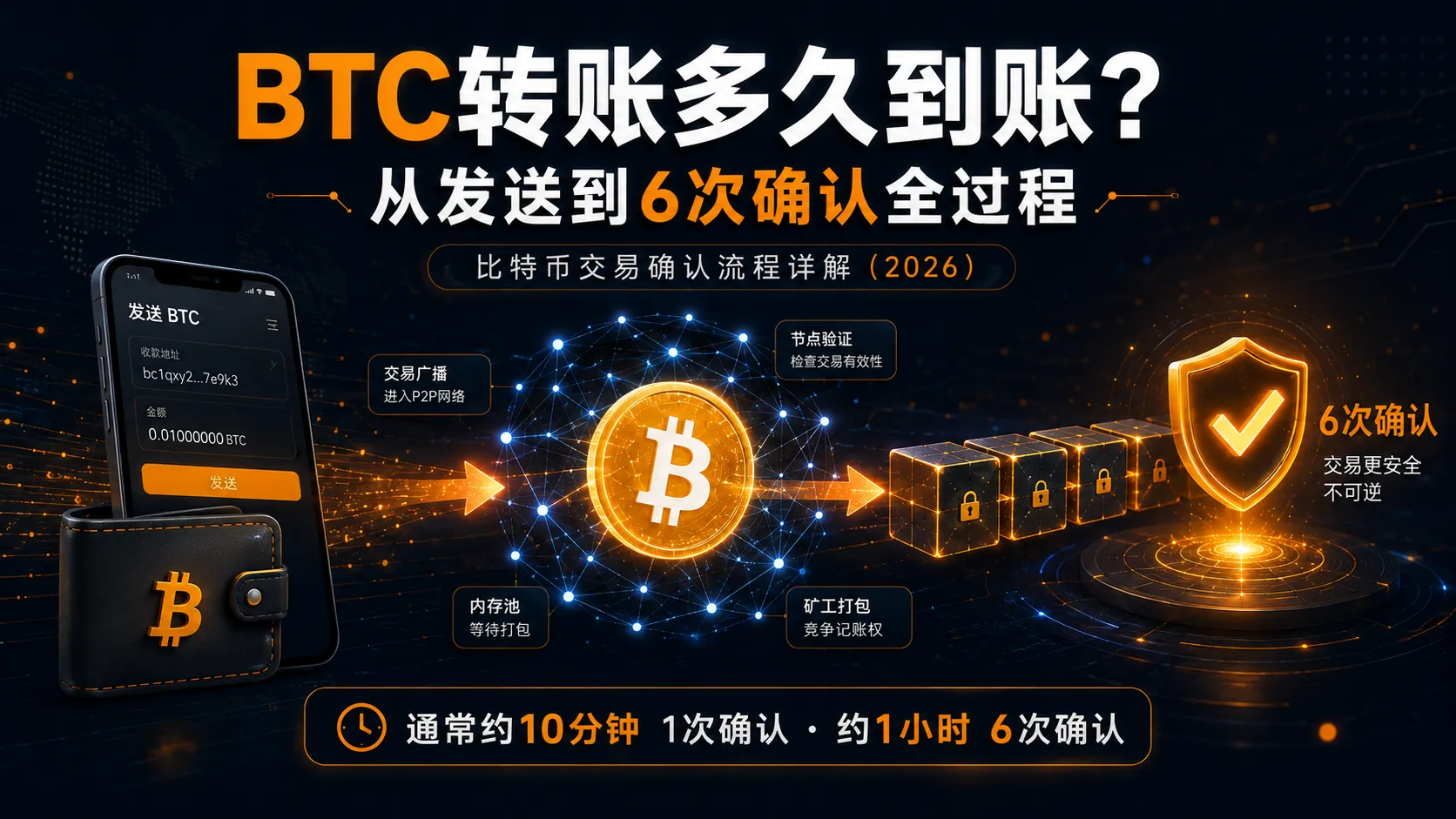
Table of contents

Binance new user rewards
20% trading fee rebate
Official Binance registration. Complete identity verification (KYC) to trade and withdraw.
From the moment you click "send" to the moment the other party sees "confirmed," a Bitcoin transfer goes through a complete lifecycle behind the scenes — it's not as simple as "money moving from A to B."
How long does a BTC transfer take? (Latest answer for 2026)
| Stage | Time | Description |
|---|---|---|
| Wallet builds transaction | <1 second | Select UTXOs, design inputs/outputs, calculate fee |
| Private-key signing | <1 second | Wallet generates a digital signature locally; the private key never goes online |
| Transaction broadcast | A few seconds | Propagates to many Bitcoin nodes via the P2P Gossip protocol |
| Waiting for miner packing | Seconds to hours | Depends on fee rate (sat/vB) and Mempool congestion |
| Getting 1 confirmation | ~10 minutes on average | Transaction packed into a new block; actually depends on when the next block is mined (not a fixed 10 minutes) |
| Getting 6 confirmations | ~1 hour | The next 5 blocks accumulate confirmations, reaching the security threshold most exchanges require for large deposits |
In one sentence: a BTC transfer usually arrives in about 10 minutes (1 confirmation); for large amounts, wait about 1 hour (6 confirmations). The higher the fee you pay, the more miners prioritize your transaction — bid too low and you may wait hours or never get confirmed.
Bitcoin has no account balance — your "money" is a set of UTXOs; miners don't audit transactions, full nodes are the referees; fees aren't fixed, they're a real-time auction.
These three facts are the prerequisites for understanding the whole Bitcoin transaction flow.
The core of this article: what happens to a BTC transaction?
- How long does a BTC transfer take to confirm? → Usually 10 minutes (1 confirmation); for large amounts, wait 1 hour (6 confirmations)
- How does the wallet choose UTXOs? → Like picking banknotes, completing payment with the fewest inputs or the best denomination combination
- What is private-key signing for? → Proving to the whole network that you have the right to spend this BTC, not "encrypting the transaction"
- Why does the fee affect confirmation speed? → Miners pick transactions by sat/vB rate, from high to low
- What if a BTC transaction is Pending? → RBF to replace with a higher fee, or CPFP child transaction to rescue
- Why do exchanges require 6 confirmations? → Each additional confirmation makes tampering exponentially more expensive
This article takes apart a BTC transfer step by step — from building, signing, broadcasting, queueing, to confirmation. No code, just concepts and logic.
After reading, you'll understand:
- What the wallet does behind the scenes after you click "send" — UTXO selection, output construction, fee calculation;
- The real purpose of private-key signing — not "encrypting the transaction," but "proving you have the right to spend this UTXO";
- The propagation path after broadcast — how it spreads to nodes worldwide within seconds;
- The nature of the Mempool — where transactions "queue" before being packed, and how fees determine priority;
- How miners select transactions — why your transfer sometimes arrives instantly, sometimes waits for hours;
- The security meaning of confirmation counts — how big the difference really is between 1 and 6 confirmations;
- What to do when a transaction gets stuck — the specific operations for RBF acceleration and CPFP rescue.
This article is technical education and does not constitute investment advice.
It's recommended to read the first two articles in this series first — Why Bitcoin Doesn't Need Banks: UTXO, Nodes, PoW and How Does Blockchain Record Transactions? Blocks, Hashing, Proof of Work (2026) — this one will read more smoothly after.
Quick reference of terms in this article:
| Term | Full name | One-sentence explanation |
|---|---|---|
| UTXO | Unspent Transaction Output | Bitcoin's "digital banknote," an unspent transaction output |
| Mempool | Memory Pool | The buffer of verified but not-yet-packed transactions |
| sat/vB | Satoshi per virtual Byte | Fee-rate unit, how many satoshis per virtual byte |
| RBF | Replace-By-Fee | Replace an unconfirmed transaction with a higher-fee version |
| CPFP | Child Pays For Parent | Use a high-fee child transaction to carry the parent along |
| PoW | Proof of Work | Miners compete for bookkeeping rights with computing power |
| Confirmations | Confirmation | The number of blocks mined after the block containing the transaction |
A Bitcoin transaction: the 6 steps from click to confirmation
After you click "send 0.01 BTC to Bob," what happens behind the scenes can be divided into 6 stages:
| Step | Stage | Who's acting | Time |
|---|---|---|---|
| ① | Build the transaction | Your wallet | <1 second |
| ② | Private-key signing | Your wallet (locally) | <1 second |
| ③ | Broadcast to the network | P2P node network | A few seconds |
| ④ | Queue in the Mempool | All miners' nodes | Seconds to hours |
| ⑤ | Pack into a block | Miners (PoW mining) | ~10 minutes on average |
| ⑥ | Accumulate confirmations | Subsequent miners keep producing blocks | ~10 minutes per confirmation |
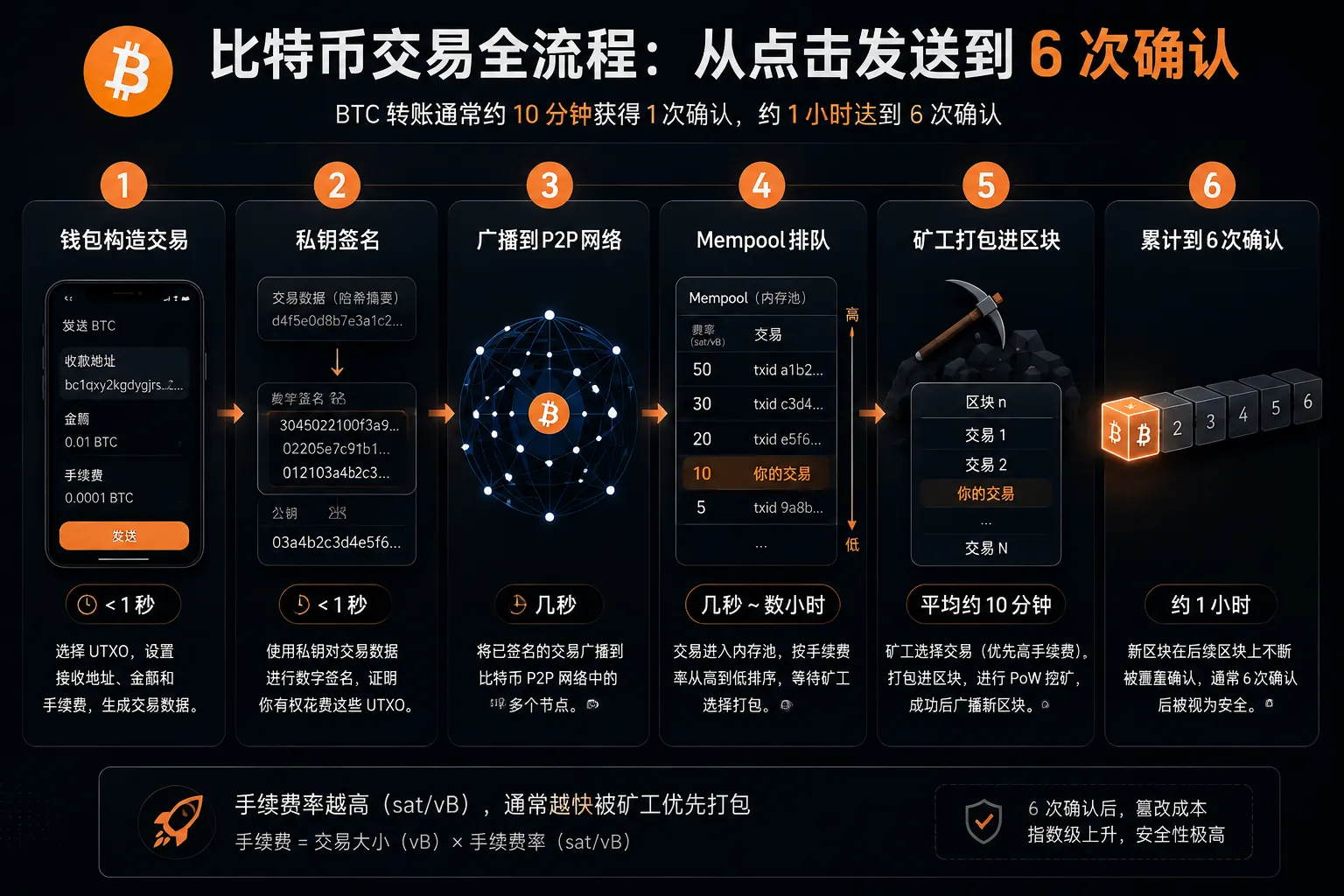
Let's take apart each stage one by one. The key is understanding "who verifies what" at each stage — that's the core of Bitcoin's security model.
Step 1: the wallet builds the transaction — selecting UTXOs, designing outputs, calculating the fee
When you enter Bob's address and amount (say 0.01 BTC) and click send — the first thing the wallet does behind the scenes is not "deduct the balance," but choose which UTXOs to pay with.
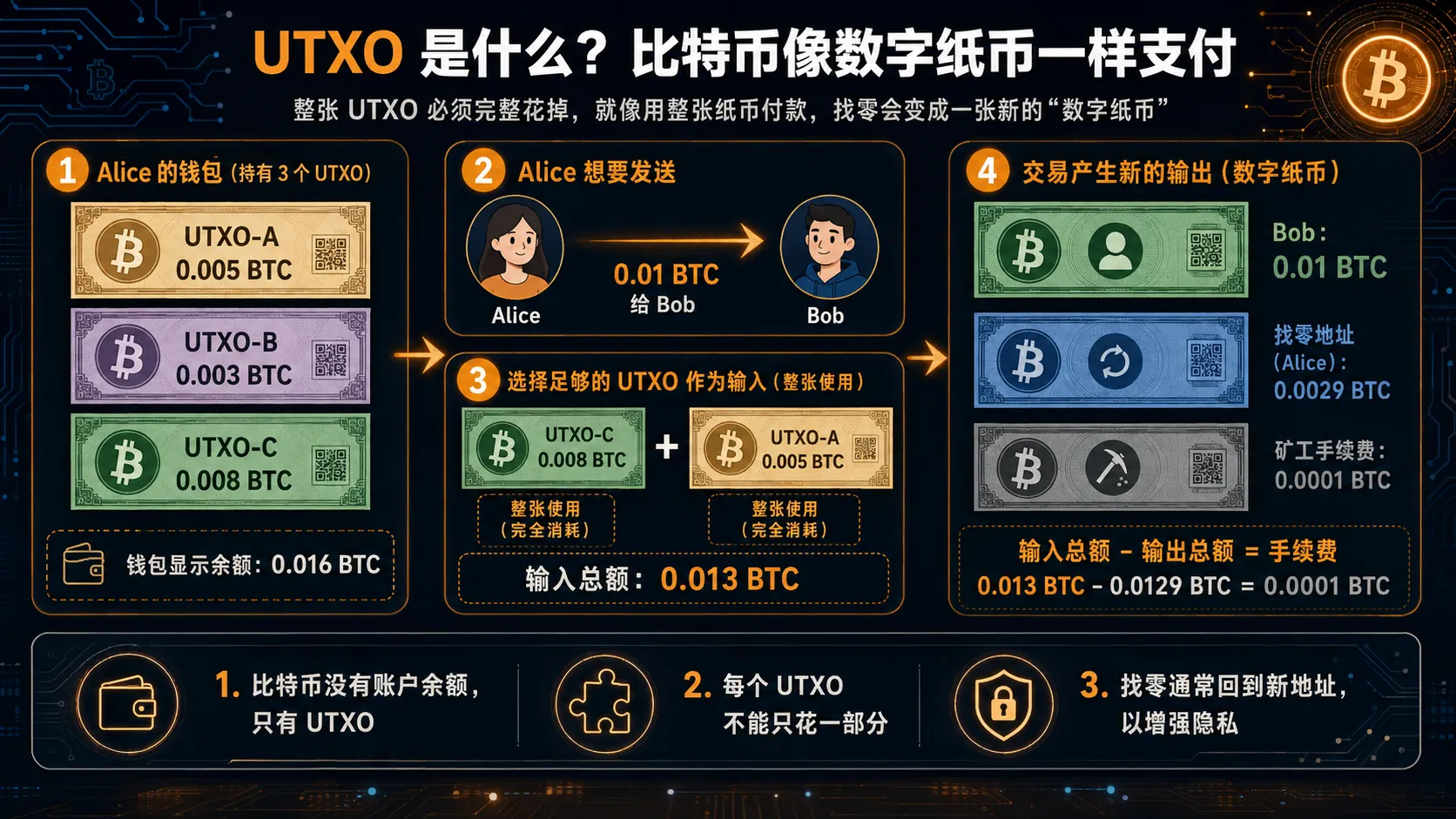
UTXO selection: Bitcoin has no "balance," only "unspent banknotes"
This point is mentioned repeatedly in the first two articles of this series, but it's the foundation for understanding transaction construction — Bitcoin's ledger has no "your balance" field, only a set of UTXOs (unspent transaction outputs).
Your wallet connects to a full node or an indexing service, queries all the UTXOs controlled by your wallet's keys that satisfy the unlocking conditions, and adds them up to display as a "balance." But underneath it's not a single number.
A UTXO (Unspent Transaction Output) can be understood as a "digital banknote" in the Bitcoin network.
You want to buy something costing 30 dollars:
- You can hand over a 50-dollar bill → get 20 dollars change;
- You can hand over two 20-dollar bills → get 10 dollars change;
- You can't "spend only 30 dollars of a 50-dollar bill" — the whole bill must be spent, with change coming back.
Bitcoin is exactly the same. Each UTXO must be fully spent; you can't spend just part of it.
A real example
Alice's wallet has 3 UTXOs:
  UTXO-A: 0.005 BTC (change from a transfer last week)
  UTXO-B: 0.003 BTC (sent by a friend)
  UTXO-C: 0.008 BTC (withdrawn from an exchange)

Total "balance" shown: 0.016 BTC

Alice wants to send Bob 0.01 BTC.
The wallet must do UTXO selection (Coin Selection). Common strategies include:
- Fewest-inputs principle: complete the payment with as few UTXOs as possible, reducing transaction size → lower fee
- Reduce change dust: prioritize combinations whose denominations just cover the payment amount, avoiding tiny change outputs
- Privacy optimization: some wallets deliberately choose UTXOs of different denominations, avoiding exposure of holding patterns
In this example, a reasonable combination is UTXO-C (0.008 BTC) + UTXO-A (0.005 BTC) = 0.013 BTC as input.
Designing the transaction outputs
After selecting inputs, the wallet builds the outputs:
Inputs:
  Spend UTXO-A (0.005 BTC)
  Spend UTXO-C (0.008 BTC)
  Total input: 0.013 BTC

Outputs:
  Output #1: 0.01 BTC → Bob's address
  Output #2: 0.0029 BTC → Alice's change address (a new address, for privacy)

Miner fee = total input − total output = 0.013 − 0.0129 = 0.0001 BTC

Three key points:
- UTXO-A and UTXO-C are completely destroyed — they no longer exist in the network from this point on;
- Two new UTXOs are created — one belongs to Bob, one to Alice's change address (usually a brand-new address, not the original);
- Fee = total input − total output — there is no "fee" field in a transaction; the miner takes the "leftover part."
This whole process happens automatically inside your crypto wallet — a good wallet also picks the optimal UTXO combination for you, avoiding creating too much "change dust" that would increase future fees.
Step 2: what is Bitcoin private-key signing? How it proves you have the right to spend BTC
The transaction is built, but there's still nothing proving the transaction was initiated by you. If you don't sign, anyone could build a transaction "spending Alice's UTXO to themselves" and broadcast it — although an unsigned transaction would be directly rejected by full nodes.
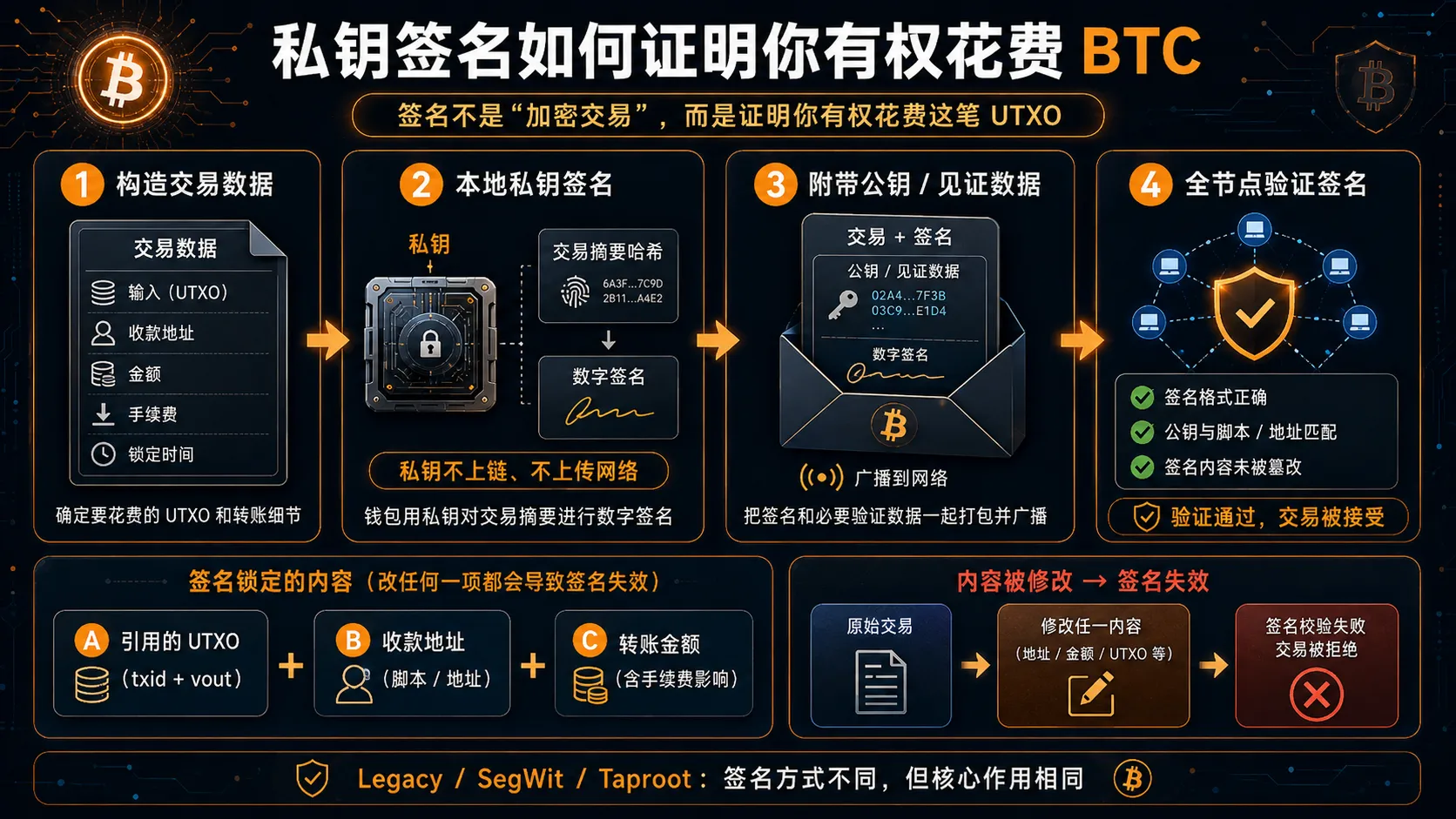
This is the purpose of private-key signing: it proves to the whole network that the person initiating the transaction indeed holds the unlocking right for the corresponding UTXO.
What exactly does the signature sign
What's signed with the private key isn't the "transaction content" as text, but the hash digest of the transaction data.
| What the signature covers | Purpose |
|---|---|
| Input UTXO reference | Makes clear which BTC you're spending, preventing the transaction from being "swapped" |
| Transaction outputs (amount + address) | Locks the recipient and amount; can't be tampered with after signing |
| The signature data itself | A digital signature on the transaction hash with the private key, verifiable by the whole network with the public key |
| The corresponding public key | Lets nodes verify "the signature really came from the private-key holder" without exposing the private key |
After signing, the transaction content cannot be modified — change even one digit and the signature becomes invalid.
Note: different address types (Legacy, SegWit, Taproot) have different signature coverage — SegWit separates signature data from the transaction body (which is where the name "segregated witness" comes from), reducing transaction size; Taproot introduces Schnorr signatures, replacing traditional ECDSA with a more compact signature. These upgrades don't change the core logic of "signing proves ownership," but they do affect transaction size and fee calculation.
The signature verification process
When any node receives this transaction, it verifies it with these steps:
- Take out the UTXO referenced by the transaction — see what public-key hash is written in that UTXO's "unlocking condition";
- Use Alice's public key and the transaction data to verify whether the signature matches;
- If it matches → proves: the signer holds Alice's private key → has the right to unlock these UTXOs;
- If it doesn't match → discard the transaction outright.
The whole process never requires Alice's private key to go online. Signing happens locally in the wallet; the private key never appears on the network. This is the principle behind "cold wallets can sign offline" — and it also explains why, once your seed phrase (the human-readable form of the private key) is leaked, anyone can spend your BTC without your phone and without a verification code.
Step 3: broadcasting to the P2P network — how a transaction spreads worldwide in seconds
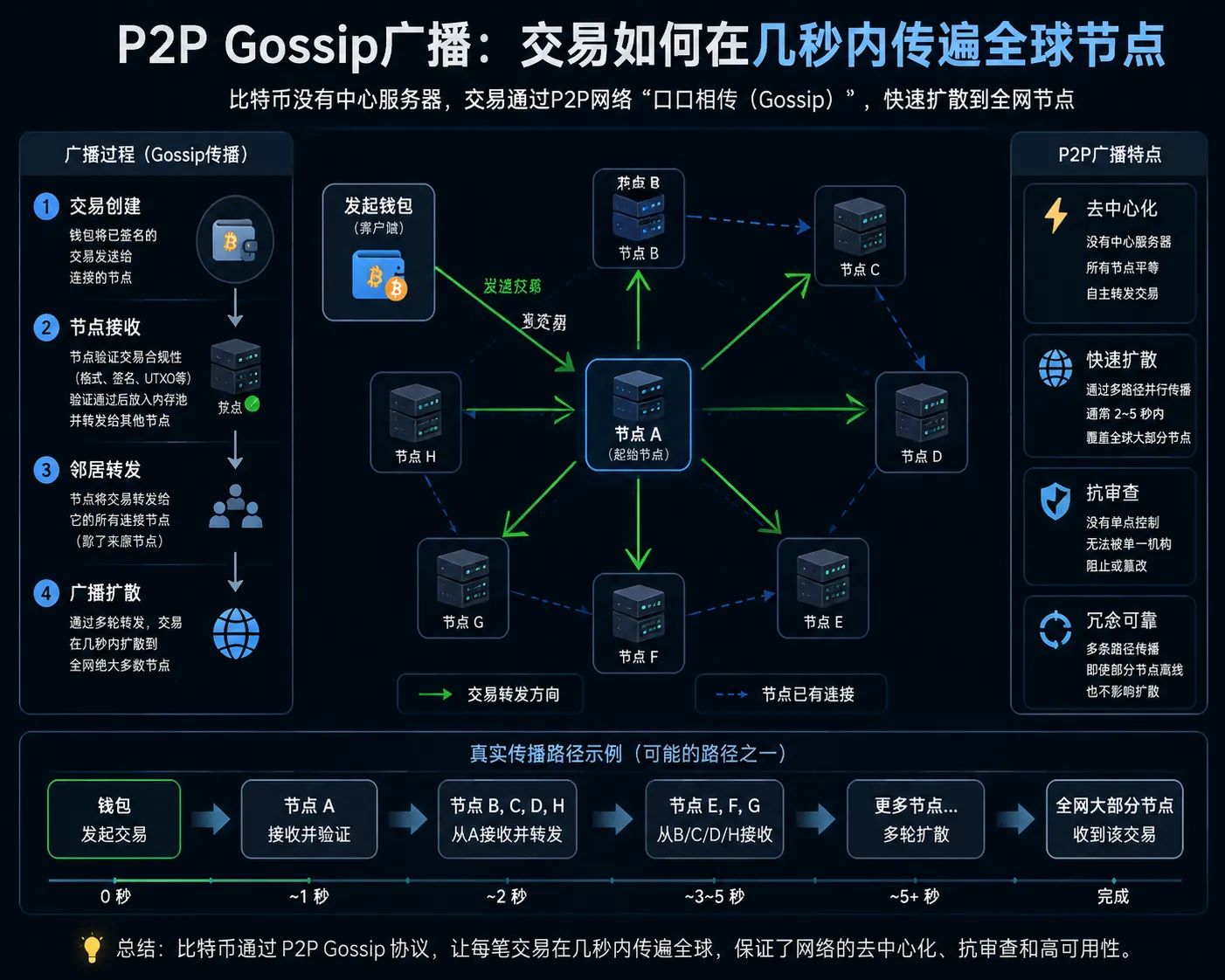
Signing is done. The wallet sends this signed transaction data to one or more connected Bitcoin nodes. What happens next completes within seconds.
The Gossip protocol: nodes playing "telephone"
The Bitcoin network has no central broadcast station. Transactions spread via the gossip protocol — each node tells its neighbor nodes about new transactions it knows, and those neighbors tell their neighbors.
Your wallet → Node A → Node B → Node D → Node G
                   ↘ Node C → Node E → Node H
                             ↘ Node F

Every node that receives the transaction immediately verifies it independently
This isn't "forward and done." Each node independently verifies whether the transaction is compliant before forwarding:
| Check | What's checked | What happens if it fails |
|---|---|---|
| Signature validity | Whether the signature matches the referenced UTXO's unlocking condition | Discard outright |
| UTXO existence | Whether the referenced UTXO really exists | Discard outright |
| No double-spend | Whether the referenced UTXO has already been spent by another transaction | Discard outright |
| Input ≥ output | Whether total input ≥ total output | Discard outright |
| Transaction size | Whether it exceeds the standard transaction size limit | Discard outright |
Miners aren't the auditors of transactions — full nodes are. Before a transaction enters the mempool, it has already passed the independent verification of thousands of full nodes across the network. Miners only pick and sort from the pool of "verified-legal" transactions.
The meaning of this design: even if a miner wanted to pack an illegal transaction, it wouldn't get past the full nodes — full nodes directly reject the entire block containing an illegal transaction. The miner's computing power is wasted, and they get no block reward.
Step 4: what is the Bitcoin Mempool? Why the BTC fee decides confirmation speed
The transaction passed full-node verification. But it still can't go on-chain — the miner hasn't packed it into a block yet. At this point the transaction enters the Mempool (memory pool).
What the Mempool is
Mempool = "the buffer of verified transactions not yet packed into a block."
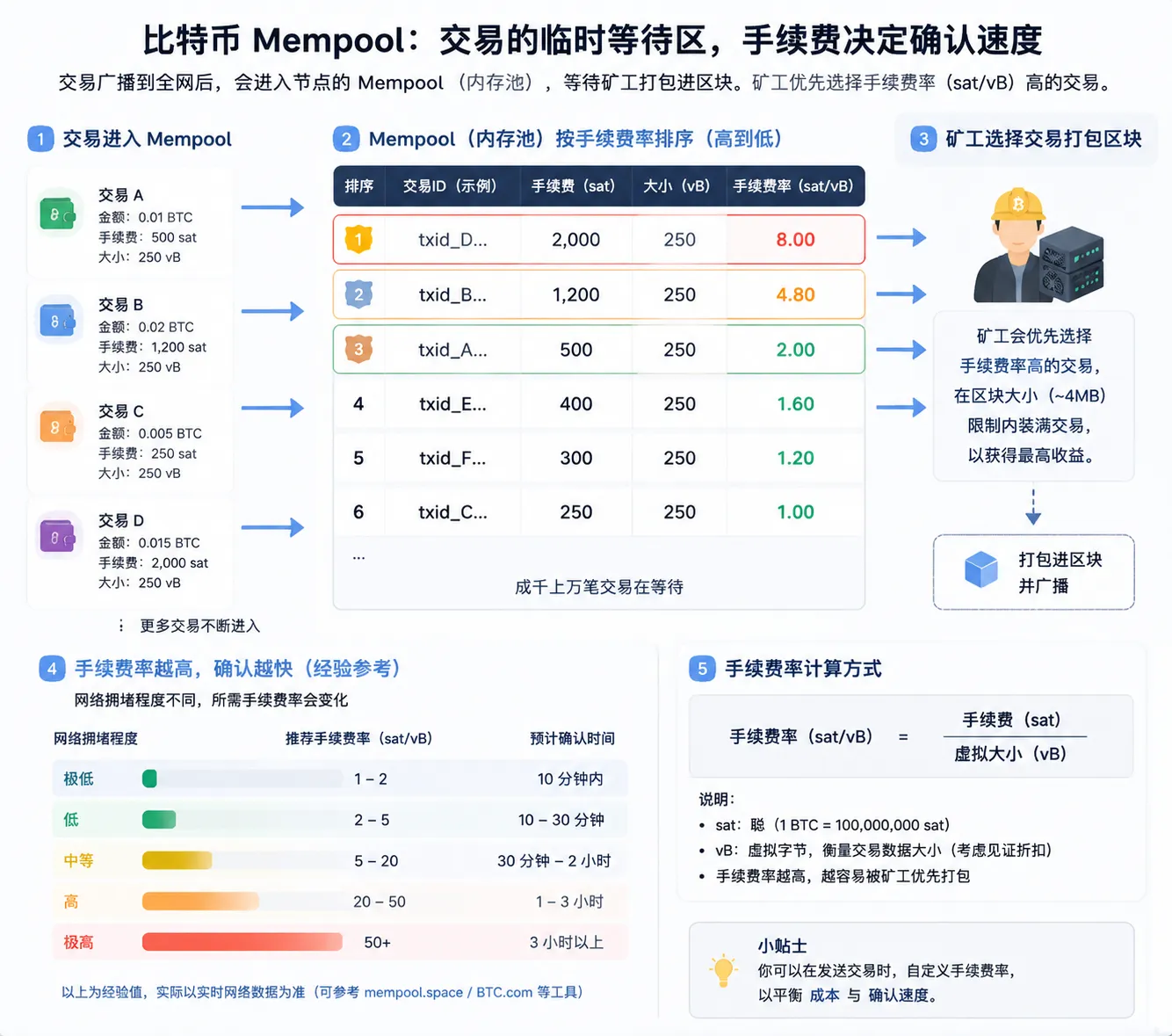
Every miner (and many full nodes) maintains its own mempool. Your transaction drifts in the network, lying in thousands of mempools, waiting to be picked and packed by some miner.
Think of it as an airport waiting lounge:
- Your transaction = a passenger, whose destination is "on-chain (into a block)";
- The fee = the "ticket price" you're willing to pay;
- Miners = the airline, boarding the highest bidders first;
- Block space = the number of seats per plane, which is limited.
The Mempool's sorting logic: fee rate decides priority
Miners don't sort by "first come, first served." They rank by fee rate (sat/vB) from high to low.
sat/vB = how many satoshis you pay per virtual byte as a fee. 1 sat = 0.00000001 BTC.
Transactions in the Mempool (sorted by sat/vB):

  High priority: 50 sat/vB  ← Alice's urgent transfer, miners pack it first
                 30 sat/vB
                 20 sat/vB
                 15 sat/vB
                 10 sat/vB  ← your ordinary transfer, sits here
                  8 sat/vB
                  5 sat/vB
  Low priority:   2 sat/vB  ← the transaction that only paid the minimum fee, may wait a long time

The number of transactions a block can hold is limited (~1 vMB of block weight, about 2000–4000 typical transactions). If the network is congested, low-fee transactions may wait several blocks before being packed.
Why the fee can't be set to zero
Theoretically it can — the Bitcoin protocol allows zero-fee transactions. But miners have no obligation to pack any particular transaction. If the mempool holds many higher-bidding transactions, miners prioritize those.
A zero-fee transaction may lie in the mempool forever, until a node cleans it up on timeout (default 2 weeks) — meaning this transfer effectively "never happened."
Readers who want to know the current Mempool congestion can open Mempool.space in a browser — this Bitcoin block explorer shows the whole network's mempool queue status, the backlog in each fee range, and the latest blocks in a very intuitive way.
How is the BTC fee calculated? Why it's sometimes cheap, sometimes absurdly expensive
The three factors that decide the fee
| Factor | How it affects the fee | Example |
|---|---|---|
| Transaction data size | The larger the transaction (more bytes) → the higher the fee | A simple 1-input + 2-output transfer ≈ 140 vB; 10 inputs + 2 outputs ≈ 1000+ vB, the fee can differ 7× |
| Network congestion | The fuller the mempool → the more expensive the rate | During the 2023 Ordinals craze, low-priority rates once spiked to 50+ sat/vB |
| Your urgency | The more urgent the confirmation → the higher you need to bid | Not in a hurry, bid a mid-low rate and wait; in a hurry, bid high to "cut the line" |
Where transaction size comes from
Transaction size isn't about "how much BTC you transferred," but how many inputs and outputs the transaction contains.
The structure of a typical transaction:
Transaction size ≈ inputs × ~68 vB + outputs × ~31 vB + ~10 vB fixed overhead
BTC fee formula:
Fee (BTC) = transaction size (vB) × fee rate (sat/vB) ÷ 100,000,000

Example: 250 vB × 20 sat/vB = 5000 sat = 0.00005 BTC
Simply put: the more "block space" your transaction takes and the higher your unit price (sat/vB) → the more expensive the fee. It has nothing to do with the transfer amount.
- More inputs = larger size: if you frequently receive small transfers (exchange withdrawals, airdrops, change), your wallet accumulates many small-denomination UTXOs. When you want to send a large amount, the wallet needs to merge many small UTXOs as inputs — the transaction size balloons and the fee doubles.
- Fewer outputs = smaller size: a simple 1 input → 2 outputs (payment + change) is the most compact structure.
That's why, when the chain isn't congested, merging multiple small UTXOs into one or two large-denomination UTXOs (called UTXO Consolidation) is a good habit — it saves on future fees.
The fee is unrelated to the transfer amount
Sending 0.001 BTC and sending 1000 BTC cost almost the same fee if the transaction structure is the same (1 input → 2 outputs).
Because miners don't care how much you transferred — they care about "how much space this transaction takes in my block."
That's also why Bitcoin suits large transfers (fee is a small share) and doesn't suit buying coffee (the fee may cost more than the coffee). The Lightning Network was designed exactly to solve this small-payment scenario.
Step 5: miners pack the transaction into a block — who decides when your transaction is confirmed
The transaction waits in the mempool. When does a miner pack it?
How miners select transactions
- Miners pull transactions from their own mempool by sat/vB, high to low;
- Fill the candidate block (within the ~1 vMB block-weight limit);
- Build the coinbase transaction (the miner's own "reward-claiming" transaction, containing the block reward + the fees of all packed transactions);
- Compute the Merkle Root, start PoW mining — brute-forcing the nonce.
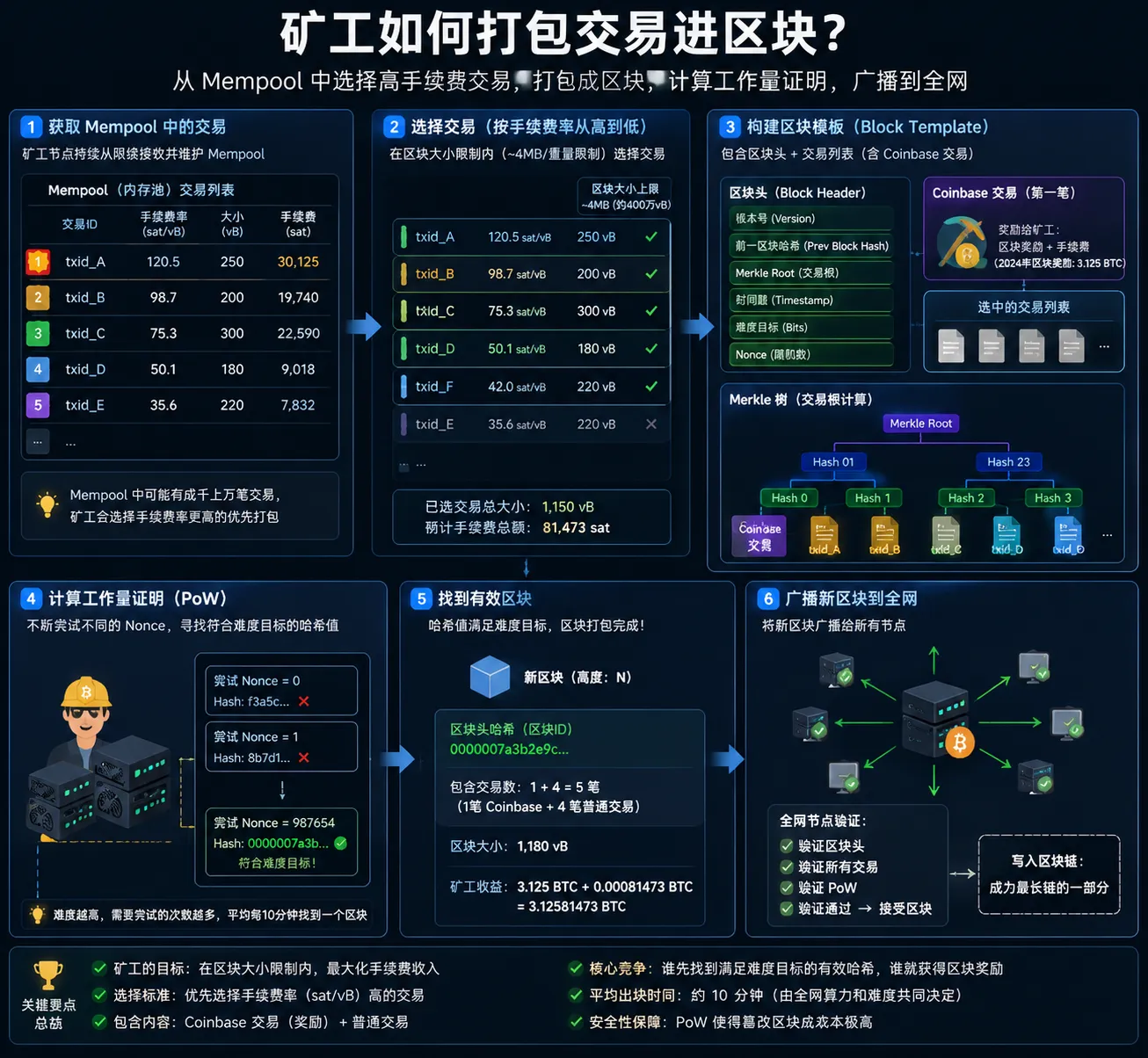
The coinbase transaction is the only "input-less" special transaction in the whole Bitcoin system — it doesn't reference any UTXO, because its BTC comes from network rules (block reward) and fees (collected by the miner), not transferred from anyone. Satoshi Nakamoto described this mechanism of issuing new coins via the coinbase transaction in Section 2 of the Bitcoin whitepaper.
When your transaction gets confirmed
It depends on two variables:
a) Where your fee rate ranks in the mempool.
If the "cutoff line" for what current miners pack is 15 sat/vB and you only bid 10 sat/vB — this block isn't for you.
b) When the next block is mined.
It's not "bid high and get confirmed instantly." Miners average 10 minutes to mine a block. Even if your transaction is first in the mempool, it still waits for the next block to be mined.
So the fastest confirmation time ≈ the average wait from now to the next block (~10 minutes), not "instant."
Why it sometimes feels "instant"
Some exchanges and wallets show a balance on the receiving side right after "transaction sent" or "pending confirmation" — that doesn't mean it's confirmed on-chain.
This is usually the receiver doing zero-confirmation trust: seeing the transaction in the mempool, with a high fee and no double-spend signs, they display the balance early. This is risky — the transaction could still be replaced or never confirm. Bitcoin Optech's technical documentation also notes that zero-confirmation transactions were a long-standing difficulty in Bitcoin's payment experience before the Lightning Network appeared.
Step 6: why Bitcoin confirmation time isn't fixed — the security gap between 1 and 6 confirmations
Each additional confirmation grows security exponentially
Bitcoin confirmation time (BTC confirmation time) has no fixed value — because each new block takes about 10 minutes on average, but actual block times follow a Poisson distribution: sometimes a block is mined in minutes, sometimes it takes 20–30 minutes. So "1 confirmation ≈ 10 minutes" is a statistical average, not a promise.
When your transaction is packed into a block, it gains 1 confirmation.
After that, each new block mined on top of it adds one confirmation to the transaction. Each additional confirmation means one more block that would need to be recomputed to "undo" this transaction from the chain.
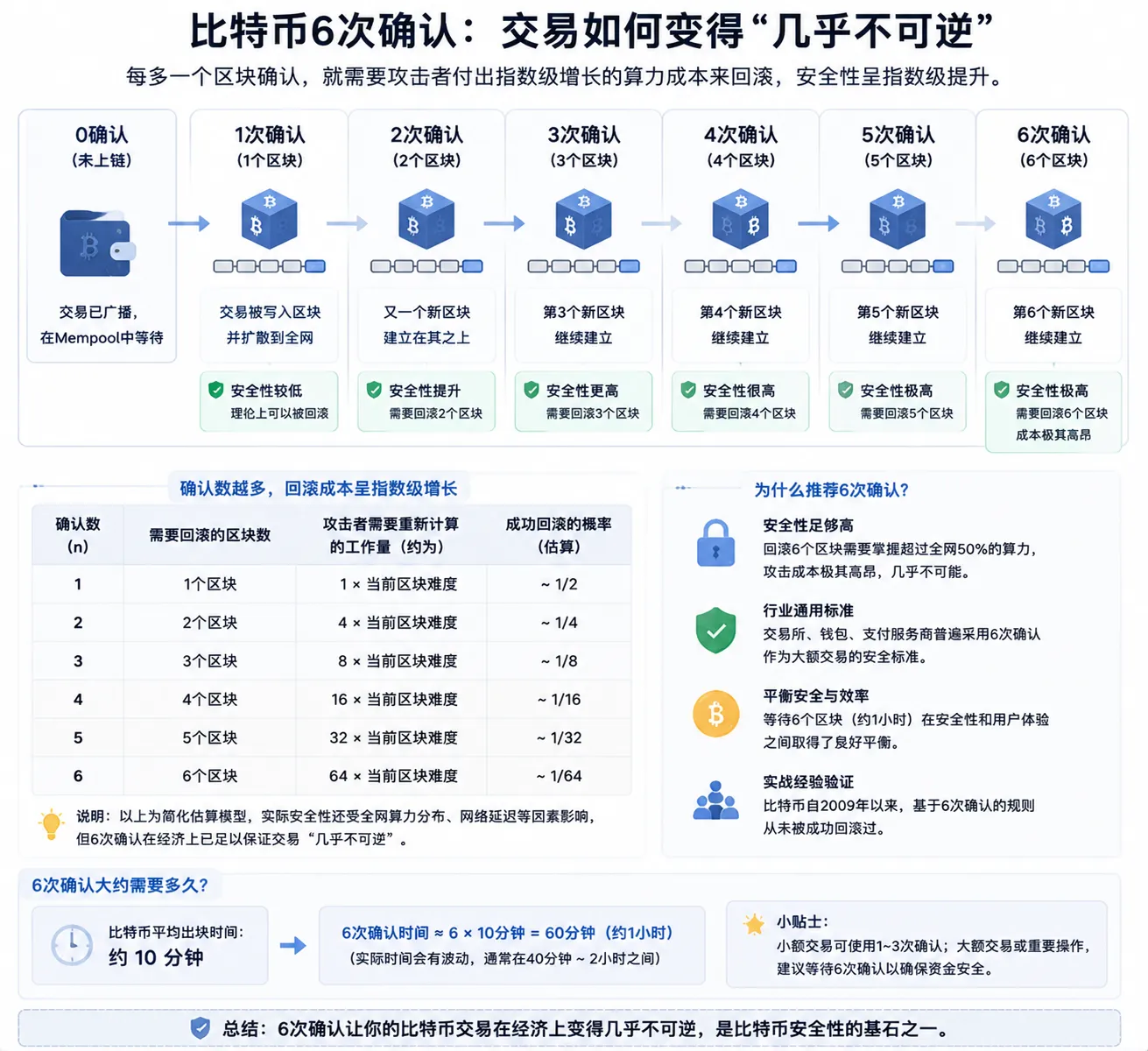
| Confirmations | Security meaning | Applicable scenario |
|---|---|---|
| 0 | Transaction still in the mempool, may be replaced or never confirm | Not trustworthy |
| 1 | On-chain, but the block could become an orphan (replaced by a longer chain) | Small, low-risk transfers |
| 2–3 | Extremely likely irreversible, unless facing a targeted hashrate attack | Most everyday transfers |
| 6 | Satoshi's whitepaper proves with a probability model: even for an attacker with considerable hashrate, the double-spend success rate is already negligible | Exchange deposits, large settlements |
The origin of "6 confirmations"
Satoshi calculated in Section 11 of the whitepaper: the probability of an attacker with a given share of hashrate catching up N blocks. As confirmations increase, the attack success rate decays exponentially — the specific probability depends on the attacker's hashrate share and the network's current state, but the core conclusion stays the same: the economic cost of an attack far exceeds its benefit.
This isn't absolute security (there's no absolute security in mathematics), but rather the economic cost of an attack far exceeding its benefit — which is the core philosophy of Bitcoin's security model. Worth emphasizing, though: even if an attacker controlled the majority of hashrate, they can't steal others' coins, can't mint coins out of thin air, and can't change the issuance rules — full nodes reject any block violating the protocol, and no amount of hashrate gets around that bottom line.
BTC transaction unconfirmed (Pending)? RBF acceleration and CPFP rescue
"I sent some BTC, bid the fee too low, and it hasn't confirmed for hours — what do I do?"
This is one of the most common questions on the blockchain. When a transaction sits in the Mempool long-term because the fee is too low, there are two ways to raise the probability of being packed: RBF (Replace-By-Fee) and CPFP (Child Pays For Parent).
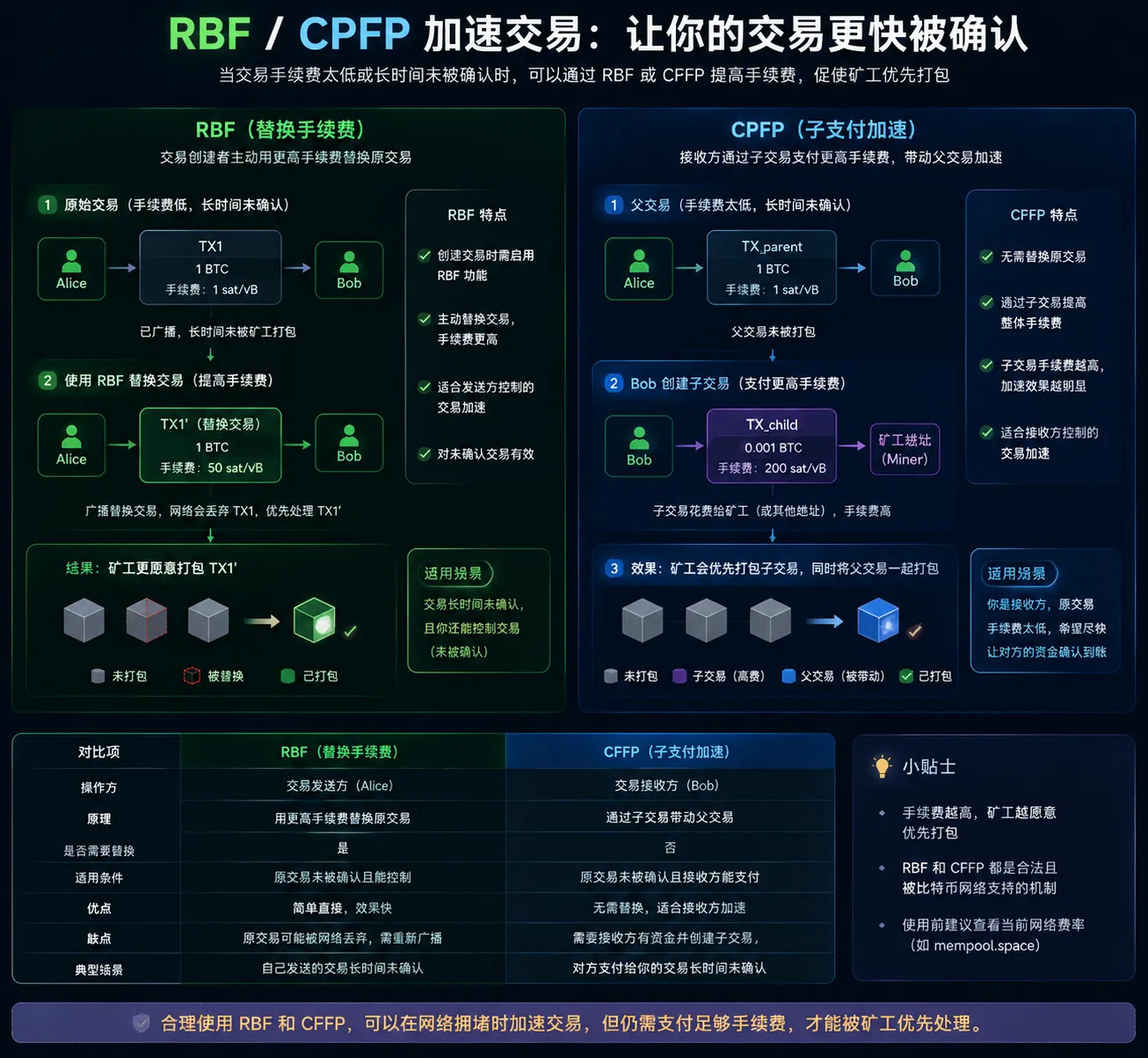
Method one: RBF (Replace-By-Fee)
If your wallet marked this transaction as RBF-enabled when sending (most modern wallets enable it by default), you can:
- Build a transaction with identical content (same input UTXOs, same output addresses and amounts);
- But raise the fee (the new rate must be higher than the original by a certain proportion);
- Re-broadcast → miners see the new transaction has a higher fee, and prioritize packing it;
- Once the new transaction confirms, the old one — because it references the same UTXOs (now spent by the new transaction) → is judged a double-spend by full nodes → automatically voided.
Limitation: the wallet must support RBF, and the original transaction must have been marked replaceable when sent. This mechanism has a complete protocol-level definition in BIP 125 — simply put, your original transaction needs to carry a "I'm willing to be replaced" signal, so miners know it can be overwritten by a higher-fee version.
Method two: CPFP (Child Pays For Parent)
If your wallet doesn't support RBF, or the original transaction wasn't marked replaceable — there's another way: CPFP.
The logic is clever: miners don't necessarily sort by single-transaction rate. If a transaction (the parent) has too low a fee, but its change output is immediately spent by another transaction (the child) — and the child pays a very high fee — the miner will pack both together, to collect the child's high fee.
Steps:
- Find your own change output in the stuck transaction (the UTXO that came back to your address);
- Immediately use this unconfirmed change UTXO to start another transaction (to another address of yours);
- The new transaction pays an extremely high fee;
- Miners see: to collect the high-fee child → must also pack the low-fee parent → both get packed together.
The beauty of CPFP: you don't need to modify the original transaction, and don't even need the original wallet to support any special feature. As long as you can spend your own change output, you can rescue yourself.
That said, both RBF and CPFP only solve the "bid the fee too low" problem. If your transaction is stuck for other reasons — like sending to the wrong chain, or authorizing a malicious contract — that needs a completely different set of responses. Recommended reading: the detailed explanation in How to Prevent Wallet Theft? Seed Phrases, Wrong-Chain Transfers, Authorization Risks (2026).
In practice: how to estimate a suitable fee
You don't need to calculate it yourself. A few methods:
Method one: wallet auto-estimation (most common)
Modern wallets (Bitcoin Core, Electrum, Sparrow, BlueWallet, etc.) have built-in fee estimators that recommend three tiers based on current mempool conditions:
| Tier | Estimated confirmation time | Applicable scenario |
|---|---|---|
| High priority | Next block (~10 minutes) | Urgent transfers, exchange deposits |
| Medium priority | 1–3 blocks (~10–30 minutes) | Everyday transfers |
| Low priority | 6+ blocks (~1 hour+) | Non-urgent transfers, UTXO consolidation |
Method two: check the Mempool's real-time status
Open Mempool.space and you can see:
- The current backlog of transactions in each fee range;
- The "fee line the next block is expected to pack up to" — transactions above this line likely confirm in the next block;
- Historical fee trends — to judge whether it's congested or quiet right now.
Method three: transfer when the chain is quiet
Bitcoin network traffic has clear periodicity:
- Weekends are usually quieter than weekdays → lower fees;
- Asian nights (Western days) tend to be more congested;
- During big market moves (sharp rises or falls), on-chain volume surges and fees spike.
If you're not in a hurry, transfer or consolidate UTXOs on weekend off-peak hours — you'll save a lot on fees.
One table to summarize: the full Bitcoin transaction flow
| Stage | Who's acting | Core mechanism | How long | What happens if something goes wrong |
|---|---|---|---|---|
| ① Build transaction | Your wallet | UTXO selection + output design | <1 second | — |
| ② Private-key signing | Your wallet (locally) | Elliptic-curve digital signature (ECDSA/Schnorr) | <1 second | Wrong signature → transaction invalid, full nodes reject |
| ③ Broadcast | P2P node network | Gossip protocol propagation | A few seconds | Connect to a few more nodes and re-broadcast |
| ④ Full-node verification | Thousands of full nodes | Independently verify signature, UTXO, double-spend, amount | <1 second | Non-compliant transactions discarded outright |
| ⑤ Mempool queue | Miners' memory pools | Sorted by sat/vB rate | Seconds to hours | Too low a rate → may never confirm |
| ⑥ Miner packing | Miners + ASIC | PoW brute-forcing the nonce | ~10 minutes on average | Miner may not pick your transaction |
| ⑦ Confirmation accumulation | Whole network's miners keep producing blocks | Longest-chain rule | ~10 minutes each | Orphan-block risk (within 1–2 confirmations) |

FAQ
Why can't I find my transaction in a block explorer?
Possible reasons: ① The transaction was just broadcast and the explorer hasn't received it yet — wait 10–30 seconds and refresh; ② Broadcast failed — the wallet didn't successfully connect to a node; try sending again; ③ The transaction was rejected by nodes — wrong signature, UTXO doesn't exist or has already been spent.
My transaction has been "pending confirmation" for 2 hours — what now?
First check the fee rate: go to Mempool.space and enter your transaction ID, see where it ranks and what the current fee cutoff line is. If your rate is far below the current cutoff → either wait (the rate drops when the network quiets down), or use RBF or CPFP to accelerate.
RBF or CPFP — which to use?
Prioritize RBF (if the original transaction supports it) — simpler and cheaper. If RBF isn't supported or you don't know whether it is → use CPFP, which is almost always available (as long as you still control the change output).
Can the fee exceed the transfer amount?
Yes. If you send 5 dollars' worth of BTC to an address, and the transaction is a multi-input heavy transaction (large size) + the network is congested → the fee could reach 10–20 dollars. That's one reason Bitcoin isn't suited to small payments — use the Lightning Network for small amounts.
Why is an exchange withdrawal fee so much higher than a wallet transfer?
An exchange's withdrawal fee isn't pure miner fee — it includes: miner fee + platform operating costs + batched aggregation sharing. Exchanges usually merge multiple withdrawals into one on-chain transaction (batch transfer), then charge each user a fixed amount — and that fixed amount is usually far higher than the actual shared miner fee.
Are 0-confirmation transactions safe?
Small, low-risk scenarios are acceptable (e.g., you trust the counterparty), but it's not absolutely safe. A 0-confirmation transaction can be replaced via RBF, dropped due to a network fork, or cleaned up on mempool timeout. Any scenario requiring definitive settlement (exchange deposits, large payments) must wait for at least 1 confirmation, ideally 2–3.
Can miners selectively ignore my transaction?
Yes. Miners have no obligation to pack any particular transaction. As long as your fee isn't attractive enough, miners have the right to pick higher-fee transactions. This isn't "censorship" — it's "profit-seeking."
Why does my BTC transaction keep showing Pending?
Pending means the transaction is still queued in the Mempool and hasn't been packed into a block. The most common reasons: ① Fee bid too low — the current Mempool cutoff line is above your rate, and miners prioritize other transactions; ② Network congestion — during big market moves, the Ordinals craze, etc., volume surges and low-fee transactions get pushed back; ③ Large transaction size — multi-input transactions take more space, and at the same rate miners don't prioritize them. Solutions: use RBF to raise the fee or CPFP to accelerate, or patiently wait for the network to quiet down.
Can a BTC transfer be cancelled?
Confirmed transactions cannot be cancelled. This is a core property of Bitcoin — once a transaction is confirmed on-chain, it's irreversible. But for unconfirmed transactions (still in the Mempool), you can "reroute" via RBF (replace the original with a higher-fee version, effectively "overwriting" the old transaction, but the original must have been marked replaceable when sent) or CPFP (use a high-fee child transaction to "carry" the parent to confirmation). If the transaction has no RBF mark and CPFP can't be used, the only option is to wait for the Mempool timeout (default about 2 weeks) — after nodes auto-clean it, the transaction effectively "never happened," and your BTC isn't lost: it returns to your wallet's available balance.
What if I send Bitcoin to the wrong address?
This is one of the most headache-inducing situations on the blockchain. Because Bitcoin transactions are irreversible, a confirmed wrong-address transaction can't be undone — no customer support, no "refund button." Responses: ① If you know who the recipient is (e.g., a friend or an exchange), contact them directly to negotiate a return — that's the only viable path; ② If you mistyped a character, it's almost impossible for it to land on a valid address (Bitcoin addresses have a built-in checksum), and the wallet usually rejects invalid addresses before sending; ③ Prevention is the best strategy — always verify the first 4 and last 4 characters of the address before sending, and send a small test amount first for large transfers. It sounds clichéd, but in the crypto world, irreversible transfers mean there's no "customer support will refund you" option — building the habit of verifying addresses may one day save you a few thousand USDT.
What's the fundamental difference between a Bitcoin transaction and a PayPal transfer?
A PayPal transfer: PayPal changes two numbers in its database (A's balance −100, B's balance +100), completed in milliseconds — but the trust rests entirely on PayPal. A Bitcoin transfer: a transaction must go through broadcast, independent full-node verification, miners' PoW competition to pack, and multi-block confirmation — slow, but it doesn't need to trust any single entity. Speed and security are two sides of the same coin.
Bitcoin transaction speed comparison: how long different scenarios take
| Scenario | Recommended confirmations | Estimated wait | Security note |
|---|---|---|---|
| Small payment (friend transfer, tip) | 0–1 | A few seconds to 10 minutes | 0-confirmation has replacement risk; only for trusted scenarios |
| Ordinary transfer | 1–3 | 10–30 minutes | Enough for daily use; orphan risk extremely low |
| Exchange deposit | 3–6 | 30–60 minutes | Platform risk-control requirement; wait for 6 to be safe |
| Large settlement | 6+ | ~1 hour+ | Equivalent to the whitepaper's security standard |
Summary
The lifecycle of a Bitcoin transaction, once understood, is 6 stages:
Wallet builds → private-key signing → network broadcast → Mempool queue → miner packing → accumulating confirmations
But behind these 6 stages lie three core designs of Bitcoin as a decentralized settlement layer:
Separation of verification and execution. A transaction's legality is independently verified by full nodes (anyone), while sorting and packing are done by miners (the highest-bidding computing power). Miners aren't the judge; full nodes are. The separation of these two roles is the cornerstone of Bitcoin's checks and balances.
The fee market self-regulates. There's no "official pricing," only bidding competition. When the network is quiet, fees approach zero; when congested, they rise automatically. This market allocates block space (a scarce resource) to the transactions most willing to pay — regardless of who you are.
Confirmation count isn't magic; it's probability. 1 confirmation = the block could become an orphan; 6 confirmations = the recomputation work needed for an attack has grown economically infeasible. Bitcoin's security isn't a switch ("safe" or "unsafe"), but a gradually converging probability curve.
One sentence to remember this article: a Bitcoin transaction is the destruction and reconstruction of UTXOs — from wallet coin selection, private-key signing, and network verification to miner packing, every step is independently checked by someone, and no one can unilaterally call the shots at any step.
Next, it's worth understanding Bitcoin's node network — what full nodes, light nodes, and miner nodes each do, and how they collectively maintain decentralization. Recommended reading, the next article in this series: What Are Bitcoin Nodes? Full Nodes, Light Nodes, and Miner Nodes Explained.
Related reading
- Why Bitcoin Doesn't Need Banks: UTXO, Nodes, PoW — the first article in this series, UTXO + PoW + the four-layer power structure
- How Does Blockchain Record Transactions? Blocks, Hashing, Proof of Work (2026) — the second article in this series, block construction and PoW mining
- What Is Bitcoin (BTC)? How It Works, Value, and Risks (2026) — BTC basics
- How to Prevent Wallet Theft? Seed Phrases, Wrong-Chain Transfers, Authorization Risks (2026) — transfer security in practice
- What Is a Seed Phrase? Why No One Can Help You Recover Your Assets If You Lose It (2026) — private-key management
- What Is a Crypto Wallet? Wallet Addresses, Seed Phrases, and Asset Security (2026) — wallet basics
- What Is Blockchain? How It Works, Uses, and Risks (2026) — full blockchain overview
Disclaimer
This article is for technical education about the Bitcoin transaction flow and does not constitute investment advice, financial advice, or trading advice.
Crypto asset prices are volatile, on-chain operations are irreversible, and related services may carry platform risk, market risk, network-security risk, and operational risk. Before making any on-chain transfer, users should fully understand the fee mechanism and confirmation flow, test with a small amount before large operations, and follow the laws and regulations of their location.
- Bitcoin Whitepaper (Satoshi Nakamoto)Principles of transaction confirmation and the security model
- Bitcoin Developer DocumentationTransaction structure and script details
- Mempool.spaceMempool congestion and fee data
- Bitcoin OptechExplanations of acceleration methods such as RBF/CPFP
- BIP 125 (Opt-in RBF)Replace-by-fee (RBF) specification
See ourEditorial Policy and the correction process in ourCorrections Policy.
The CoinTrailHub editorial team focuses on crypto education for beginners, exchange security and P2P trading risk. This article is compiled from official sources and public data, reviewed by humans, and strives for accuracy but is not investment advice.
Last updated:2026-08-05 · Content reviewed by humans · Learn more
© 2026 CoinTrailHub · Original content. Reproduction or rewriting without permission is prohibited.