
OKX Review 2026: Is It Worth Using? Pros, Cons, Fees and Binance Comparison
Table of contents

Binance new user rewards
20% trading fee rebate
Official Binance registration. Complete identity verification (KYC) to trade and withdraw.

OKX new user rewards
20% trading fee rebate
Official OKX registration. Complete identity verification (KYC) to trade and withdraw.
This article contains the OKX referral code OK800; using it to sign up gives you a 20% fee rebate. The review's conclusions are not influenced by the referral relationship.
This is a full review of OKX. If you're trying to decide "how good OKX actually is, whether it's safe, and whether it's right for me":
OKX is one of the world's leading crypto trading platforms, with no obvious problems in security, liquidity or product experience.
But it is not a simple "Binance substitute." My take:
- Just want to buy BTC and ETH and trade occasionally → Binance and OKX are both fine, the difference is small
- Often use Web3, DeFi and multi-chain interactions → OKX has the edge
- Completely new to crypto → OKX has more features, so it needs a bit of a learning curve
One-sentence answers to your biggest concerns
| What you most want to know | Straight answer |
|---|---|
| Is OKX safe? | Top-tier exchange level. 8 years old, publishes proof of reserves regularly, no platform-level security incident |
| Are the fees cheap? | Spot maker 0.02% lower than Binance, futures slightly lower overall. For ordinary users the difference is small |
| Beginner-friendly? | Medium. Lots of features and dense information; total beginners need to adapt |
| How does it compare to Binance? | Just buying BTC/ETH → little difference. On-chain/DeFi/Web3 → OKX is smoother |
| Is it right for me? | Some crypto background and frequent on-chain activity → yes. Pure beginner who only buys spot → Binance is enough |
About 7 minutes to read. Remember first: more features doesn't mean suitable for total beginners, and the OKX Card is not available in every region.
After reading this article you'll know:
- Whether OKX is safe
- Whether the fees are actually cheap
- What useful features OKX has
- What annoying parts OKX has
- Who should use OKX and who shouldn't
Risk notice: this article is for basic crypto education and platform-feature review only, and is not investment advice or account-opening advice. Crypto trading carries risk; make your own independent judgment.
1. What is OKX?
OKX (formerly OKEx) was founded in 2017 and is headquartered in Seychelles. It is one of the world's highest-volume crypto exchanges, supporting 200+ countries and regions. You can check the latest trading volume on the CoinMarketCap exchange rankings.
A few key figures:
- Daily trading volume: tens of billions of dollars
- Users: 50 million+
- Supported coins: 300+ cryptocurrencies
- Core products: spot, futures, options, Web3 wallet, OKX Card (Visa card)
OKX grew especially fast from 2022–2024. A big reason is that while Binance ran into regulatory headwinds in several global markets, OKX secured compliance licenses in Dubai, Hong Kong, the EU and elsewhere. For users, compliance means your assets on the platform get an extra layer of legal protection.
If you haven't signed up yet, start here: How to Register for OKX: 2026 Account Setup with Email, Phone and KYC.
2. Is OKX safe?
This is the most important question when choosing an exchange. I'll look at three angles: security track record, asset transparency, and compliance licenses.
Security track record
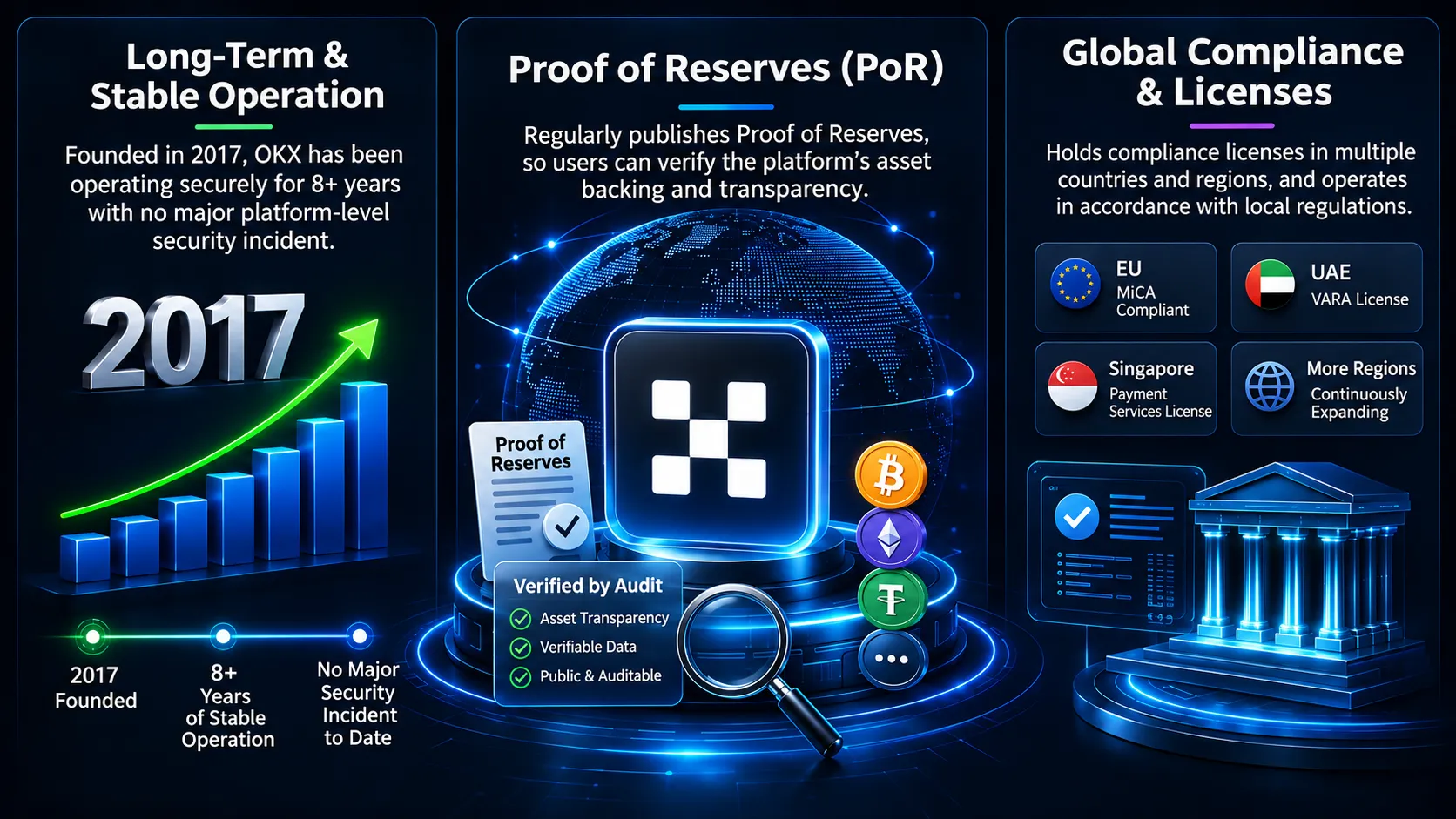
As of now, OKX has had no public FTX-style collapse, and no large-scale security incident affecting user assets.
That is rare in crypto. FTX was the second-largest exchange in the world and collapsed overnight; Mt.Gox once held 70% of global volume and lost 850,000 BTC to theft. OKX survived the 2017 ICO bubble, the 2020 crash, and the 2022 LUNA/FTX cascading blowups without a major problem.
Of course, a clean history can't guarantee future safety. But it at least shows the platform's risk and internal controls aren't made of paper.
Asset transparency: Proof of Reserves (PoR)
OKX has regularly published Proof of Reserves since late 2022, letting users check the reserve status of its major assets. You can view the latest data yourself on the OKX Proof of Reserves page.
Compliance licenses
| Region | Compliance status | Status |
|---|---|---|
| EU | MiCA compliance underway (Malta entity) | Compliant |
| Dubai | Obtained VARA-related license | Compliant |
| Singapore | Obtained relevant payment license | Compliant |
| Hong Kong | Withdrew license application, exited the market | Exited |
| US | Faced regulatory penalties, later re-entered | Partially compliant |
License information is compiled from public sources and search results from August 2026. For EU MiCA details, see the Malta MFSA official announcement and OKX's official MiCA explainer. Ordinary users don't need to study every license detail — the key is whether the platform operates stably long-term, discloses its asset status transparently, and operates legally across multiple regions.
Two things deserve separate attention, because they directly affect how you judge OKX's trustworthiness:
First, the US DOJ settlement (February 2025). OKX's operator, Aux Cayes FinTech, pleaded guilty to violating US anti-money-laundering laws and operating an unregistered money-transmitting business, paying about $505 million (roughly $84.4 million in fines plus $420 million in forfeiture).[1] That's what the "faced regulatory penalties" row in the table above refers to. OKX's public framing is that these were "legacy compliance gaps"; prosecutors did not allege money laundering or customer losses, and no employees were charged.[2] This shouldn't be avoided — you have a right to know it before choosing a platform. See the Reuters report.
Second, ICE's strategic investment (March 2026). NYSE parent ICE invested about $200 million in OKX at a $25 billion post-money valuation and took a board seat; the two plan to cooperate on clearing, risk control and institutional access, and ICE will launch US-regulated crypto futures based on OKX's spot prices.[3] This is a clear endorsement of OKX by a traditional-finance giant.[4] See the The Block report.
3. Are the fees actually cheap?
Many people say "OKX fees are cheaper than Binance." Is that right? It depends.
Spot fees
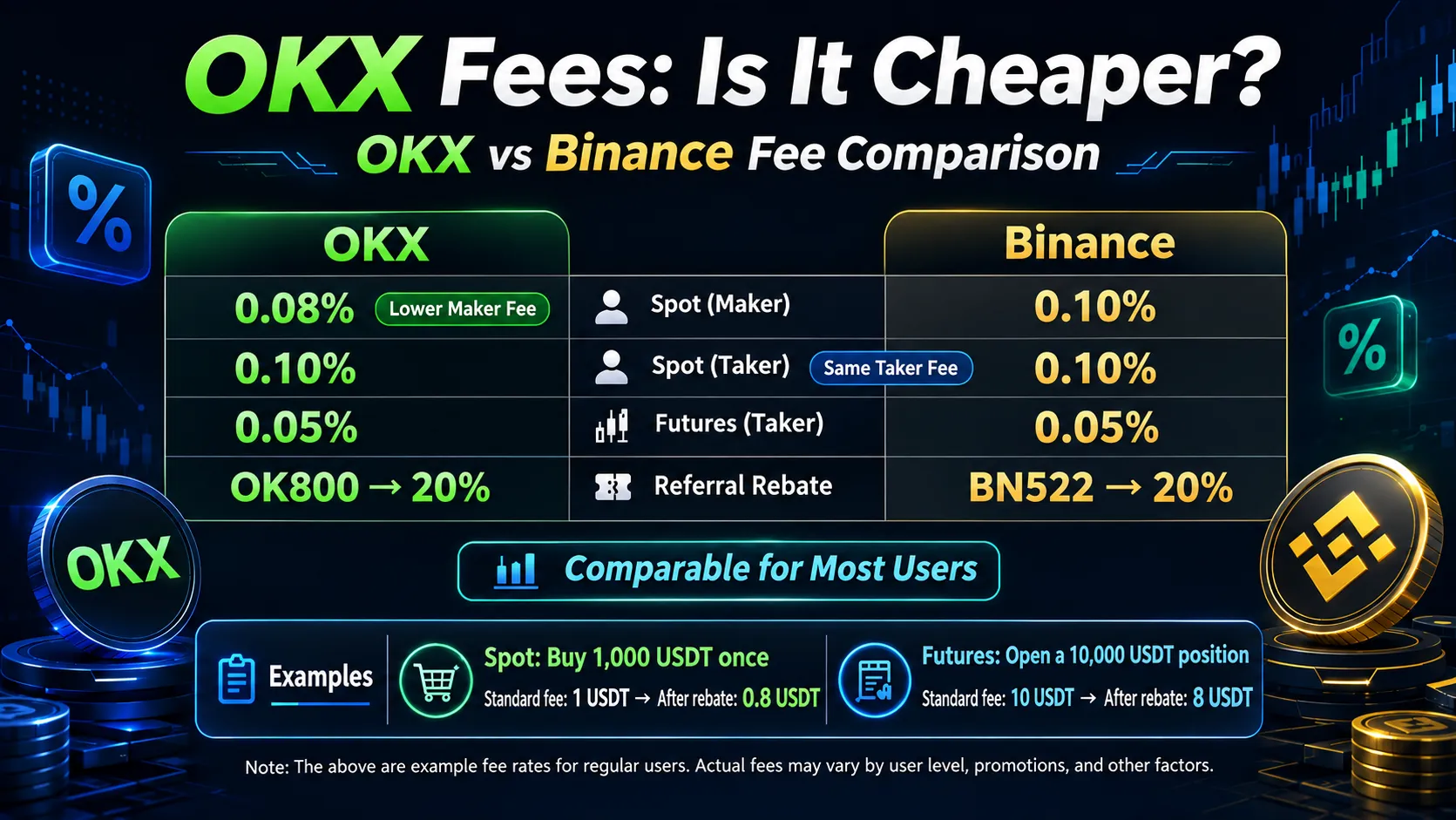
| Tier | OKX Maker | OKX Taker | Binance Maker | Binance Taker |
|---|---|---|---|---|
| Regular user | 0.08% | 0.10% | 0.10% | 0.10% |
| VIP 1 (30-day volume > $100K) | 0.07% | 0.08% | 0.09% | 0.10% |
| VIP 2 (30-day volume > $500K) | 0.06% | 0.07% | 0.08% | 0.09% |
For ordinary spot users, OKX's maker is indeed cheaper than Binance's (0.08% vs 0.10%), and the taker is the same. The gap isn't big, but if you trade mostly by placing maker orders, OKX saves you a little on each trade.
Futures fees
The futures fee structure is similar — OKX is generally 0.01%–0.02% lower than Binance. For futures traders, the difference adds up over time.
How to save further on fees
① Use the referral code OK800: enter it at signup to get a 20% fee rebate. This is the same logic as Binance's BN522 — once the referral relationship is confirmed, a portion of the relevant trading fees is returned proportionally, not a one-time bonus.
② Use OKB to offset fees: just like Binance's BNB discount, OKX supports paying fees with its platform token OKB for a discount. With it enabled, spot fees drop another tier.
An example (using 20% rebate; the actual ratio is what your account page shows):
| Scenario | Standard fee | After 20% rebate |
|---|---|---|
| Spot buy of 1,000 U once | ~1 U | ~0.80 U |
| Futures 10,000 U, open and close once each | ~10 U | ~8 U |
The smaller the amount, the smaller the difference. If you trade a lot, confirm the rebate ratio at signup. Registration tutorial: OKX KYC: How to Verify Your Identity — Review Time, Failure Reasons & Fixes (2026).
4. Pros: where OKX beats Binance
OKX has a few features that Binance either lacks or does worse.
1. Smoother Web3 wallet experience
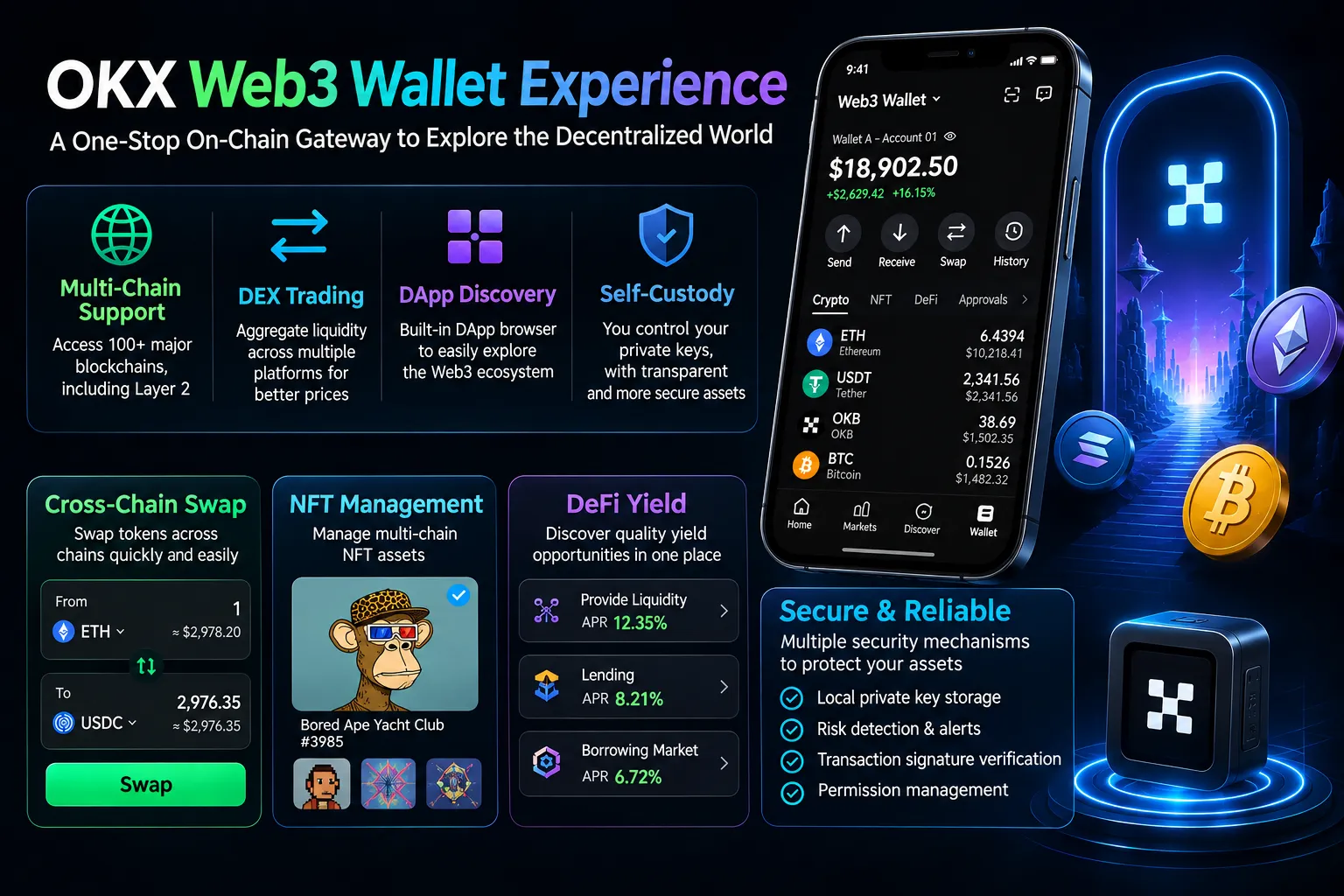
Both OKX and Binance have built their Web3 wallets into the main app, so there's no extra download. But in practice, OKX's wallet feels smoother.
The biggest difference is asset transfers. Moving between OKX's trading account and its Web3 wallet is nearly frictionless — pick the amount, confirm, done, three steps. Binance's transfer flow has more layers, and you sometimes have to jump between menus.
A personal example. Once I was testing an ecosystem app on a new chain with a very short time window. I was on Binance — buy U → withdraw to Web3 wallet → bridge across → swap on a DEX, switching between several screens, and by the time it was all done I'd missed the best moment.
Later I moved my on-chain positions to OKX. Buy U, transfer to wallet inside the app, bridge, trade — all in one flow. I can't guarantee I always catch the earliest opportunity, but at least I no longer waste time on tool-level friction.
If you frequently do cross-chain interactions or farm airdrops on new chains, OKX's wallet will save you from some "this chain isn't supported" pain.
If you're not familiar with wallets yet, start here: What Is a Crypto Wallet? Wallet Address, Seed Phrase and Asset Security (2026).
2. Richer derivatives lineup
OKX's derivatives product line is more complete than Binance's. Beyond standard USDT-margined and coin-margined futures, OKX also has:
- Options trading: Binance currently has no options product
- Shark Fin, Dual Investment and other structured products: for users who don't want to watch the market but still want some yield
- Copy trading: copy another trader's strategy with one click, a beginner-friendly entry point
If you're a pure spot user, this advantage doesn't matter much. But if you might touch futures or structured products later, OKX gives you a wider menu.
3. Better multilingual support and documentation
OKX's customer-support response times and the completeness of its localized documentation are among the best across major exchanges. For complex features like copy trading and structured products, OKX's documentation tends to be more detailed than Binance's.
For most users, this means it's easier to find help in your own language when something goes wrong. If you're not yet familiar with exchange basics, start here: Binance/OKX Account Security Checklist: 2FA, Anti-Phishing Code and Withdrawal Whitelist (2026).
5. Cons: the uncomfortable parts
This isn't saying OKX is bad, but a few things need getting used to.
1. Steeper beginner learning curve than Binance
Binance's home screen is quite "idiot-proof" — right after signing up you can see the buy-crypto entry, spot trading and earn products, with a clear path.
OKX's app has too many features, with a dense home screen. Newcomers can feel lost at first — "I want to buy BTC, which one do I tap?" It's not that the operations are complicated, but that too many options make it unclear which one to pick.
2. Some fiat on/off-ramps are weaker than Binance's
Binance's P2P merchant count and trading depth are the largest in the world. OKX's P2P works well in major markets, but in some smaller markets its fiat channels aren't as complete as Binance's.
If you mainly use fiat to buy USDT, the two are basically the same. But if you later need on/off-ramps in more niche fiat currencies, Binance has a wider selection.
3. The OKX Card isn't available everywhere
OKX has launched its own OKX Card (a Visa debit card) that lets you spend USDT directly — a plus for users in supported regions. But it's not currently available for applications in every country or region, so for many readers this feature isn't usable for now.
6. OKX vs Binance: one table to make it clear
No rambling, just the table:
| Dimension | OKX | Binance |
|---|---|---|
| Founded | 2017 | 2017 |
| Global ranking | Top-tier exchange | Top-tier exchange |
| Spot maker fee | 0.08% | 0.10% |
| Futures taker fee | 0.05% | 0.05% |
| Web3 wallet | Smoother transfers, good multi-chain support | Built-in but more transfer layers |
| Options trading | Supported | Not supported |
| Copy trading | Supported | Supported |
| P2P depth | Good in major fiat markets | Strongest globally |
| Localized experience | Better | Some features lag in localization |
| Referral rebate | OK800 → 20% | BN522 → 20% |
| Proof of reserves | Monthly | Irregular |
| Visa card | Supported (not available in all regions) | Supported (not available in all regions) |
If you're torn between OKX and Binance, see this more detailed comparison: Binance vs OKX: Which Is Better for Beginners? A 5-Dimension Hands-On Comparison.
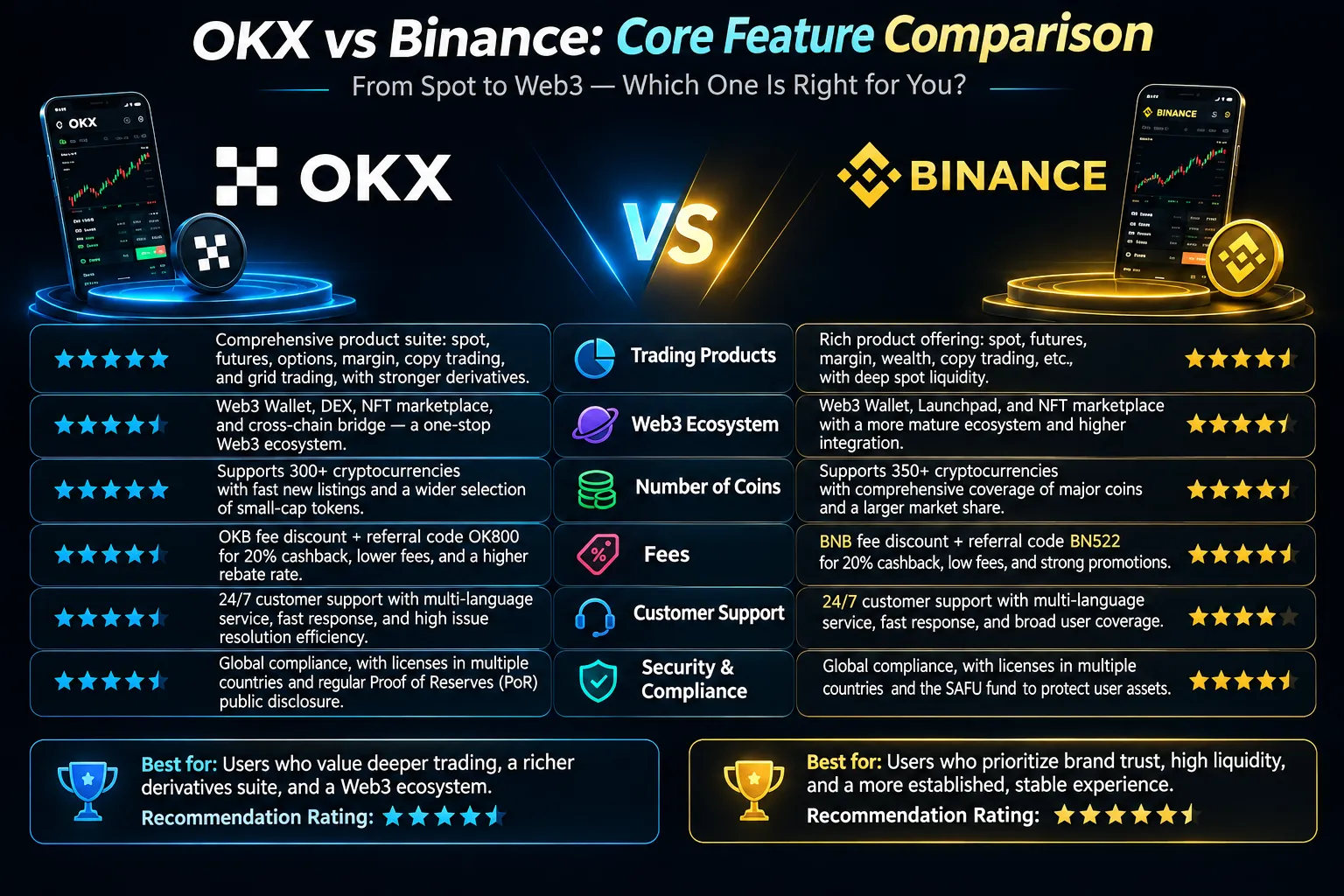
7. Who should use OKX?
Rather than "is OKX good or bad," it's better to ask "is OKX right for you."
Recommended, if you:
- Have used Binance and want to try another platform
- Frequently interact on-chain (DeFi, airdrops, memecoins) and want an exchange with a built-in wallet
- Need futures / options / structured products
- Care about customer support and localized content quality
- Want to use copy trading to follow experienced traders
Probably not ideal, if you:
- Have never touched crypto and can't tell BTC from USDT yet — OKX's feature density will feel overwhelming
- Only do spot, only buy BTC and ETH, and have no interest in Web3 — Binance is probably enough
- Mostly do P2P to buy USDT and withdraw — the two are similar, pick whichever UI you prefer
8. Beginner usage advice
If you decide to use OKX, follow this order:
- Sign up first: How to Register for OKX: 2026 Account Setup with Email, Phone and KYC, and enter the referral code OK800 at signup
- Set up security: enable Google 2FA, set an anti-phishing code, configure the withdrawal whitelist. Don't skip this step
- Buy a small amount of USDT via P2P to test the flow: How to Buy USDT on OKX: P2P Step-by-Step, Payment Methods & Avoiding Account Freezes (2026)
- Get familiar with the app: spend 10 minutes tapping through each section of the app, no need to operate — just figure out where things are
9. FAQ
1. Will OKX run away?
No exchange can guarantee 100% it won't collapse — FTX is the best warning in this industry.
But OKX's fundamentals are much better than second-tier exchanges: 8 years old, top-3 global volume, licenses in multiple countries, monthly proof of reserves, and no platform-level security incident ever. It's more trustworthy than the vast majority of exchanges, but you still shouldn't keep all your assets on any single exchange long-term.
2. Which is safer, OKX or Binance?
On safety they're basically at the same level. Both have proof of reserves, both have a security fund (Binance's SAFU and OKX's risk reserve), and neither has had a platform-level security incident.
The real safety gap isn't in the platform but in how you use it — whether you enable 2FA, set a withdrawal whitelist, and spread large assets across multiple places.
3. Are OKX fees really cheaper than Binance?
For ordinary users, OKX's spot maker fee is 0.02% cheaper (0.08% vs 0.10%), and the taker is the same. Futures fees are generally 0.01%–0.02% lower.
The difference exists, but for ordinary users it isn't decisive. What you save in fees over a year may be less than what one impulsive trade loses.
4. Is OKX suitable for beginners?
If "beginner" means someone who has never touched crypto and doesn't even know what an exchange is — not very suitable; start with Binance first.
If "beginner" means someone who has traded on Binance but is interested in Web3 and on-chain operations — very suitable; OKX's built-in wallet will save you from many pitfalls.
5. Is OKX available in my country or region?
OKX supports 200+ countries and regions, but specific products and features — such as the OKX Card or certain fiat channels — can vary by region. Check OKX's official site or app for what's available where you are.
Summary
OKX is a good exchange.
But "good or bad" matters less than "right for you."
If you just buy some BTC to hold and trade occasionally, choosing Binance or OKX doesn't make much difference — pick whichever interface you like, but remember the referral code (Binance BN522, OKX OK800) to save a little on fees.
If you're interested in on-chain interactions, the Web3 wallet and DeFi, OKX's built-in wallet experience is genuinely better than Binance's and worth trying.
One last time, my own operating habits: confirm the rebate ratio is active at signup, set up 2FA and the withdrawal whitelist, and don't keep all your assets on one platform.
If you decide to use OKX, you can sign up with the referral code OK800, and confirm the rebate ratio is active in the "Referral" page before you start trading.
If you prefer Binance, the referral code BN522 also gives a 20% fee rebate: Sign up for Binance.
Want to chat? Join the CoinTrailHub Telegram community.
Related reading
- How to Register for OKX: 2026 Account Setup with Email, Phone and KYC
- How to Buy USDT on OKX: P2P Step-by-Step, Payment Methods & Avoiding Account Freezes (2026)
- Binance vs OKX: Which Is Better for Beginners? A 5-Dimension Hands-On Comparison
- How Much Are Binance Fees? Spot/Futures/Withdrawal Rates, BNB Discount + BN522 Rebate Saving Up to 40%
- Beginner Trading Pitfalls: Don't Trust Signal Group "Masters", Stay Away from High Leverage
- Is Binance Safe? Is It a Scam? SAFU Reserve + $4.3B Settlement, Verified Item by Item (2026)
- Is Bitget Safe? Reserves, Fees and 2026 Controversies Verified Item by Item
- How to Spot Trade on OKX? Market Orders, Limit Orders and Steps (2026)
Data verification notes
The key facts in this article were checked against public reports from Reuters and The Block on 2026-10-16, item by item:
- US DOJ settlement amount: in February 2025, OKX's operator Aux Cayes FinTech pleaded guilty to violating US anti-money-laundering laws and operating an unregistered money-transmitting business, paying about $505 million (roughly $84.4 million in fines plus $420 million in forfeiture). Source: Reuters (via Yahoo Finance) — OKX operator reaches a $505 million settlement with the US DOJ.
- Scope of charges and official framing: OKX's public framing is "legacy compliance gaps"; prosecutors did not allege money laundering or customer losses, and no employees were charged. Source: Reuters (via Yahoo Finance) — OKX operator reaches a $505 million settlement with the US DOJ.
- ICE investment terms: in March 2026, NYSE parent ICE invested about $200 million in OKX at a $25 billion post-money valuation and took a board seat. Source: The Block — NYSE parent ICE makes a strategic investment in OKX at a $25 billion valuation.
- ICE–OKX cooperation direction: the two plan to cooperate on clearing, risk control and institutional access, and ICE will launch US-regulated crypto futures based on OKX's spot prices. Source: The Block — NYSE parent ICE makes a strategic investment in OKX at a $25 billion valuation.
This article was first published on August 2, 2026, and last updated on August 19, 2026. The review conclusions are based on hands-on experience; fees and platform features may change over time, so refer to OKX's latest official pages.
- 2026-10-16UpdateAdded evidence-chain superscripts and "Data verification notes"; updated the key-fact verification date.
- 2026-09-15UpdateAdded two key facts — the $505 million US DOJ settlement and ICE's 2026 strategic investment — and updated the verification date.
See ourEditorial Policy and the correction process in ourCorrections Policy.
The CoinTrailHub editorial team focuses on crypto education for beginners, exchange security and P2P trading risk. This article is compiled from official sources and public data, reviewed by humans, and strives for accuracy but is not investment advice.
Last updated:2026-09-15 · Content reviewed by humans · Learn more
© 2026 CoinTrailHub · Original content. Reproduction or rewriting without permission is prohibited.