
Binance Stock Perps vs Stocks: Ownership, Leverage and Risk (2026)
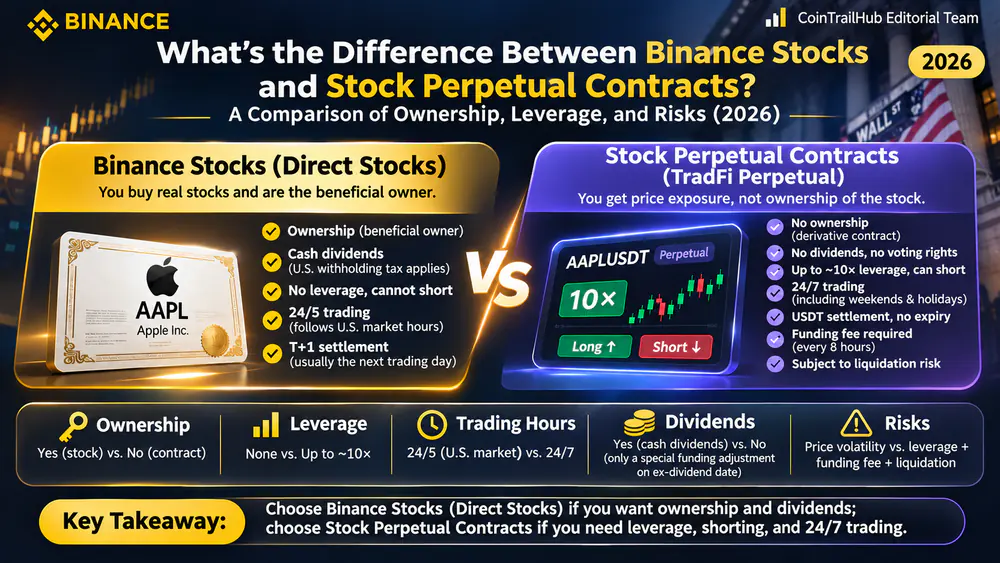
Table of contents

Binance new user rewards
20% trading fee rebate
Official Binance registration. Complete identity verification (KYC) to trade and withdraw.
The difference between Binance stocks and Binance stock perpetuals is not whether you can trade Nvidia or Tesla. It is what you actually own after you click buy.
Binance stocks (Direct Stocks) give eligible users beneficial ownership of real US-listed shares and ETFs through a partner brokerage structure. There is no built-in leverage, no shorting, and no margin call.
Binance stock perpetuals (part of the TradFi perps range) are derivatives that track a stock price. You can go long or short, use leverage and trade around the clock, but you do not own the share, you do not receive dividends as a shareholder, and you do not get voting rights.
Both products may show the same ticker and the same price chart. They are not interchangeable. Three questions settle most of it:
- Do you own the stock after buying?
- How far does the price have to move before you lose the whole position?
- How much does it cost to hold the position for 30 days?
This guide walks through ownership, leverage, trading hours, fees and liquidation risk in that order.
Two products, two sets of rights
Binance puts stocks, tokenized stocks and stock perpetuals close together inside one account. The legal structure is completely different.
| What you see on Binance | What it actually is | Key trait |
|---|---|---|
| TSLA (Stocks page) | Real shares (Direct Stocks) | Beneficial ownership, dividends, US market hours |
| TSLAUSDT (Futures → TradFi) | Stock perpetual | USDT-settled derivative, no ownership, 24/7 |
| TSLAB (bStocks) | Tokenized certificate | 1:1 backed, not direct share ownership, ADGM only |
The deciding factor is not the price chart, it is whether you hold an asset or a contract. Get this wrong and you will misjudge dividends, selling, and liquidation.
bStocks is a third, separate product. For that comparison, see tokenized US stocks vs traditional stocks.
Side-by-side comparison
| Dimension | Binance stocks (Direct Stocks) | Stock perpetuals |
|---|---|---|
| Product type | Beneficial interest in real US stocks and ETFs | USDT-settled perpetual derivative |
| Ownership | Yes, beneficial owner | No, price tracking only |
| Dividends | Cash dividends where applicable (US withholding) | No dividends; only a funding adjustment around ex-dates |
| Voting rights | Binance documents dividends and corporate actions, not voting | None |
| Leverage | None; cash purchase | Yes, currently 10x on documented contracts, some newer listings announced up to 20x |
| Shorting | Not supported | Supported |
| Trading hours | 24/5, following US market sessions | 24/7 |
| Settlement | Securities settlement, usually within T+1 | USDT mark-to-market, no expiry |
| Minimum size | From about $5, fractional shares | 5 USDT notional, 0.01 share units |
| Main cost | Platform fee or spread per order | Trading fee plus funding every 8 hours |
| Liquidation risk | No margin, no forced liquidation | Yes, liquidation when margin falls below maintenance |
| Eligibility | Account and jurisdiction dependent | Account and jurisdiction dependent |
Save this table. The rest of the article explains each row.
Ownership: what you actually get
Direct Stocks is the only Binance product that buys the actual stock. Eligible users can trade more than 7,000 US-listed stocks and ETFs, including fractional shares, starting from about $5. Execution, clearing and custody run through a partner brokerage structure, and the user is the beneficial owner of the shares.[1]
That gives you three things: cash dividends where applicable (US withholding tax usually applies to non-US persons), automatic handling of corporate actions such as splits, and settlement that usually falls within the next trading day (Binance says it may fall within T+1).[1]
One nuance matters: beneficial ownership is not the same as having shares registered in your own name. The shares are held through the partner broker and its custody and clearing chain. You get the applicable economic rights, but registration, corporate-action handling and whether you can vote depend on the securities terms and custody arrangements. Binance's FAQ mentions dividends and corporate actions, not voting rights.[1]
Stock perpetuals give you none of that. Binance Academy states plainly that TradFi perpetuals are derivatives and do not give you ownership of the underlying stock, ETF or commodity, nor dividends or voting rights.[5] You hold a USDT-denominated price contract with no expiry.
There is one detail that gets misreported: perps are not entirely indifferent to dividends. When a stock goes ex-dividend, its price drops by roughly the dividend. Binance offsets that mechanical gap with a one-time special funding settlement, paid by shorts to longs.[6] That is a price adjustment, not a dividend from the company, and it does not give you shareholder rights.
Rule of thumb: if you want shareholder economics, use Direct Stocks. If you only want price exposure, a perpetual is the tool.
Leverage: none vs a contract-dependent cap
Direct Stocks is a cash purchase. There is no built-in leverage and no shorting. The most you can lose is what you put in, and you will not receive a margin call.
Stock perpetuals are leveraged. Binance Academy's guide lists 10x as the current maximum for the stock contracts it covers, with tiered margin so larger notional positions usually get lower maximum leverage.[4] Some newer listings have been announced with up to 20x, so leverage is contract-specific: check the specification page for the ticker you intend to trade.[4]
Perps also support multi-asset mode, where assets such as BTC can be posted as collateral at a valuation haircut. Minimum notional is 5 USDT and minimum order size is 0.01 units of the underlying stock.[4]
The same $1,000 behaves very differently:
| Price move | $1,000 of stock | 10x perp ($10,000 notional) |
|---|---|---|
| +5% | +$50 | +$500 |
| -5% | -$50 | -$500 |
| -8% | -$80 | -$800 |
| -10% | -$100 | Margin wiped in theory; usually liquidated earlier |
This ignores fees, funding, slippage and maintenance margin. In practice, liquidation usually happens before a 10% adverse move because maintenance margin and account risk parameters take effect earlier.
The other side of leverage is funding. Stock perpetuals settle funding every 8 hours, with each interval capped at +/-2.00% and a 0% interest-rate component. Routine funding does not shorten to hourly settlement even when it hits the cap.[4] The exception is the special dividend adjustment, which temporarily moves the funding interval to 1 hour around an ex-date.[6]
When longs are crowded, longs pay shorts; when shorts are crowded, the reverse. Funding is not a fee, but it is a cost of holding. For a $10,000 notional long at a steady +0.01% per 8 hours:
| Holding period | Cumulative funding (illustrative) |
|---|---|
| 1 day | about $3 (0.03%) |
| 7 days | about $21 (0.21%) |
| 30 days | about $90 (0.9%) |
| 90 days | about $270 (2.7%) |
This is arithmetic, not a forecast. It assumes constant notional, a funding rate that stays positive, and no fees or price changes. In live markets funding moves and can flip sign, sometimes paying the holder instead.
Rule of thumb: if you just want to hold and wait, leverage is an extra cost. Use it only when you specifically need size or a short.
Trading hours and pricing: 24/5 is not 24/7
Direct Stocks follows the US calendar: up to 24 hours a day, five days a week, with regular, extended and limited 24-hour sessions; weekends and US public holidays are closed. Market orders generally execute only during the regular US session.[1] Settlement usually lands on the next trading day.
Stock perpetuals trade 24/7 and settle in USDT with no expiry.[4] Since 16 May 2026, equity-based TradFi perpetuals use an order-book EWMA index mode during daily maintenance, weekends and holidays, smoothing the impact bid/ask midpoint and capping price moves.[7]
The practical consequence: when the US market is closed, the perp keeps trading, but its price is produced by a model and the order book, not by live stock trading. Weekend, holiday and overnight mark prices can diverge materially from the next US open.
Rule of thumb: use perps when you need overnight or weekend exposure. Otherwise you are paying for a layer of model-price risk you do not need.
Fees: a per-order spread vs a running funding bill
The two products do not charge the same way, so comparing a single percentage is misleading.
| Cost item | Binance stocks (Direct Stocks) | Stock perpetuals |
|---|---|---|
| Trading fee | $0.17 platform fee on small orders (standard $0.35) | Futures fee schedule, plus TradFi promo discounts |
| Larger orders | 0.05% spread (standard 0.10%), minimum platform fee waived | Same schedule, varies by VIP tier |
| Size threshold | Official pages say $340 or $350 | No such threshold |
| Holding cost | None | Funding every 8 hours, capped at +/-2% |
| Account/custody fee | $0.00 | None |
| Promo window | Until 2026-12-31 23:59 UTC | Discounts adjust periodically |
Direct Stocks uses a two-track structure: small orders pay a fixed platform fee, larger orders pay a spread instead and skip the minimum platform fee. Account opening, maintenance, dormancy and custody fees are all $0.00, and both tracks are marked as running until 31 December 2026.[2]
The size threshold is not consistent across Binance pages. The English landing page says "350 USD or below", while the Chinese fee page says the equivalent of $340. Both use $0.17 and 0.05%, and neither page shows an effective date. Treat it as a page or region version difference and check the order confirmation screen. The pages we checked do not break out US stock fees by VIP tier; if your account page shows VIP tiers, use that.[2][3]
For perps, the actual maker/taker rate depends on your fee tier and current TradFi promotions. Check the order confirmation screen rather than relying on a rate quoted in an article.
Rule of thumb: for short trades, compare per-order fees; for long holds, funding dominates. The longer you hold, the larger funding's share of total cost.
Liquidation risk: how 10x turns a small move into a closed position
This section gets its own space because it is the least symmetrical part of the comparison. With stocks, the worst case is a lower price. With perps, the worst case is losing the position first.
What it is. When your margin balance falls below the maintenance margin requirement, the system force-closes the position.[4] At 10x, an adverse move of roughly 10% can consume the entire margin. Add the off-hours mark price described above, and a weekend gap can trigger liquidation on its own.
Why it happens. Three common causes: position size too large relative to margin; the whole account on one directional bet with no hedge; and full size going into earnings, ex-dividend dates or major announcements, when both price volatility and funding can spike.
How to reduce it. Use leverage below the cap, choose isolated margin rather than cross margin, keep a margin buffer, avoid full size around earnings and ex-dates, and never post living expenses or borrowed money as margin. Stop orders help but can slip in fast or thin markets.
If you do get liquidated. Liquidation is irreversible. Export the trade and funding history, check whether the liquidation price matches the mark price, and contact support only if you believe there was a system fault. Most liquidations come from leverage and sizing, not from platform failures.
By contrast, Direct Stocks has no margin mechanism and no liquidation path. The share price can still fall sharply, but the position is not closed by a margin engine.
Who can use it
Neither product is available just because you have a Binance account. Direct Stocks depends on account eligibility and jurisdiction; if there is no buy entry in your account, you do not have access.[1]
Binance's ADGM-licensed entity group (Nest Exchange, Nest Clearing and Custody, Nest Trading) handles traditional-finance activity. The Academy article does not map each contract to a specific contracting entity, so check the user agreement on the order page.[5] Binance.com is not available to US users, and both stock products are offered only in certain jurisdictions.
Eligibility can change with regulation, account status and region. Do not attempt to bypass restrictions with a VPN or false residency details; the account-level consequences fall on you.
How to choose
| Your situation | What to use | Why |
|---|---|---|
| Long-term holding, dividends, shareholder exposure | Direct Stocks or a regulated broker | Real beneficial ownership, no liquidation |
| Already hold stablecoins and want small US stock exposure | Direct Stocks | No need for a separate brokerage or USD wire |
| Need 24/7 trading, shorting or overnight exposure | Stock perpetuals | Only the derivative offers those |
| First time with US equities | A regulated broker or Direct Stocks | Learn the asset side before the margin side |
| Want to post BTC as collateral and size up | Perps in multi-asset mode | Highest leverage and highest risk; only for money you can lose |
| Saw a "stock contract" and assumed dividends | Stop | The rights are completely different |
For most people the real fork is simpler: do you want to own the asset or trade the price? If you want the asset, compare Direct Stocks, bStocks and a traditional broker on fees, tax and access. If you want the price, the perpetual is the instrument, and you are no longer buying a stock.
FAQ
Are Binance stock perpetuals the same as Binance stocks?
No. Direct Stocks gives beneficial ownership of real US-listed shares. Stock perpetuals are USDT-settled derivatives that track the price without owning the underlying stock.
Do Binance stock perpetuals pay dividends?
No cash dividends and no voting rights. Around an ex-dividend date Binance runs a one-time special funding settlement from shorts to longs, but that is a price adjustment, not a dividend.
What leverage do Binance stock perpetuals offer?
Binance Academy lists 10x for the stock contracts it documents, with tiered margin reducing maximum leverage as position size grows. Some newer listings have been announced with up to 20x, so check the contract specification for the ticker you trade.
Can you short stocks on Binance?
Not through Direct Stocks; it is a cash product with no shorting. Shorting requires the perpetual contract, which carries margin and liquidation risk.
How often is funding settled?
Every 8 hours in routine conditions, with each interval capped at +/-2.00% and a 0% interest component. The special dividend adjustment around ex-dates temporarily uses a 1-hour interval.
Are stock perpetuals cheaper than buying stocks?
Not directly comparable. Stocks charge a platform fee or spread per order. Perps charge a trading fee plus funding that accrues for as long as the position is open. Short holds can be cheaper; long holds usually are not once funding is included.
Can US users trade Binance stock perpetuals?
No. Binance.com is not available to US users, and these products are restricted to certain jurisdictions. Check your account eligibility and local rules.
Related reading
- How to Buy US Stocks on Binance: Steps, Fees & Dividends — the full Direct Stocks workflow
- Binance stocks vs Futu/Tiger: fees and transfer, tested (2026) — Binance against traditional brokers
- Binance Futures Tutorial 2026: How to Trade, Leverage & Fees — the futures mechanics behind perps
- Tokenized vs Traditional US Stocks: Platform vs Broker — where bStocks fits
- Are Binance US stocks real stock? Stock tokens vs real stocks (2026) — tokenized equity basics
- Buying US Stocks on Binance: My Real 0.015 TSLA Test — small-size walkthrough
Data verification notes
Key facts were checked on 17 November 2026 against Binance's official FAQ, fee pages, Academy articles, announcements and support documents.
- Direct Stocks product and rules: 7,000+ US stocks and ETFs, fractional shares from about $5, 24/5 trading, settlement usually within T+1, market orders generally limited to the regular session, eligibility depends on account and jurisdiction. Source: Binance Stocks trading FAQ.
- Direct Stocks fees: $0.17 platform fee on small orders (standard $0.35), 0.05% spread on larger orders (standard 0.10%) with the minimum platform fee waived, $0.00 account/custody fees, promo until 2026-12-31 23:59 UTC. Source: Binance Stocks fee page.
- Fee threshold discrepancy: the English landing page states "a minimum of 0.17 USD applies to orders of 350 USD or below", while the Chinese fee page says $340. Neither page shows an effective date. Source: Binance Stocks landing page and fee page, checked 17 November 2026.
- Stock perpetual parameters: around 10x leverage on documented stock contracts with tiered margin; funding every 8 hours, capped at +/-2.00%, interest component 0%; 5 USDT minimum notional, 0.01 share minimum order; USDT settlement, 24/7 trading; forced liquidation when margin falls below maintenance. Source: Binance Academy guide and the U-margined stock perpetual listing announcement.
- No ownership: TradFi perpetuals are derivatives and do not grant ownership of the underlying stock, ETF or commodity, nor dividends or voting rights. Source: Binance Academy, TradFi assets on Binance Futures.
- Dividend adjustment: a one-time special funding settlement around the ex-dividend date, paid by shorts to longs; the US stock funding interval is temporarily shortened to 1 hour and the contract moves to reduce-only before the settlement. Source: Binance FAQ, Equity Perpetual Futures dividend adjustment methodology.
- Index pricing: Binance announced on 13 May 2026 that from 16 May 2026, equity-based TradFi perpetuals use order-book EWMA index pricing during daily maintenance, weekends and holidays, replacing the fixed mode. Source: Binance announcement on price index calculation mode.
Disclaimer
This article explains how two Binance products differ. It is not investment, securities, tax or legal advice. Both products involve market risk, and perpetuals add leverage, funding costs and forced liquidation; you can lose your entire margin. Availability, fees, leverage and trading rules vary by contract, account and jurisdiction and can change. Verify the details on your account and the official product terms before trading.
- Binance Stocks trading FAQDirect Stocks support 7,000+ US stocks and ETFs, from about $5, 24/5 trading, beneficial ownership, dividends and corporate actions
- Binance Stocks fee pageSmall orders pay a $0.17 platform fee (standard $0.35); larger orders pay a 0.05% spread (standard 0.10%); promo until 2026-12-31
- Binance Stocks landing pageSame fee structure but the order-size threshold is written as $350, while the Chinese fee page says $340
- Binance Academy — How to trade stock perpetual contractsStock perps currently 10x leverage, funding every 8 hours capped at +/-2%, 5 USDT minimum notional, 24/7 trading
- Binance Academy — TradFi assets you can trade on Binance FuturesTradFi perpetuals are derivatives and do not grant ownership of the underlying stock, ETF or commodity
- Binance FAQ — Equity Perpetual Futures dividend adjustment methodologyA one-time special funding settlement around ex-dividend dates, paid by shorts to longs; the funding interval is temporarily shortened to 1 hour
- Binance announcement — price index calculation update for equity-based TradFi perpetualsOrder-book EWMA index mode applies during daily maintenance, weekends and holidays from 2026-05-16
- 2026-11-17UpdateInitial English release. Rewritten for a global audience, with leverage ranges per contract, the $340/$350 fee discrepancy, dividend adjustment mechanics and liquidation risk.
See ourEditorial Policy and the correction process in ourCorrections Policy.
The CoinTrailHub editorial team focuses on crypto education for beginners, exchange security and P2P trading risk. This article is compiled from official sources and public data, reviewed by humans, and strives for accuracy but is not investment advice.
Last updated:2026-11-17 · Content reviewed by humans · Learn more
© 2026 CoinTrailHub · Original content. Reproduction or rewriting without permission is prohibited.