
How to Buy US Stocks from China in 2026: Futu, IBKR, Binance and 5 Routes Compared
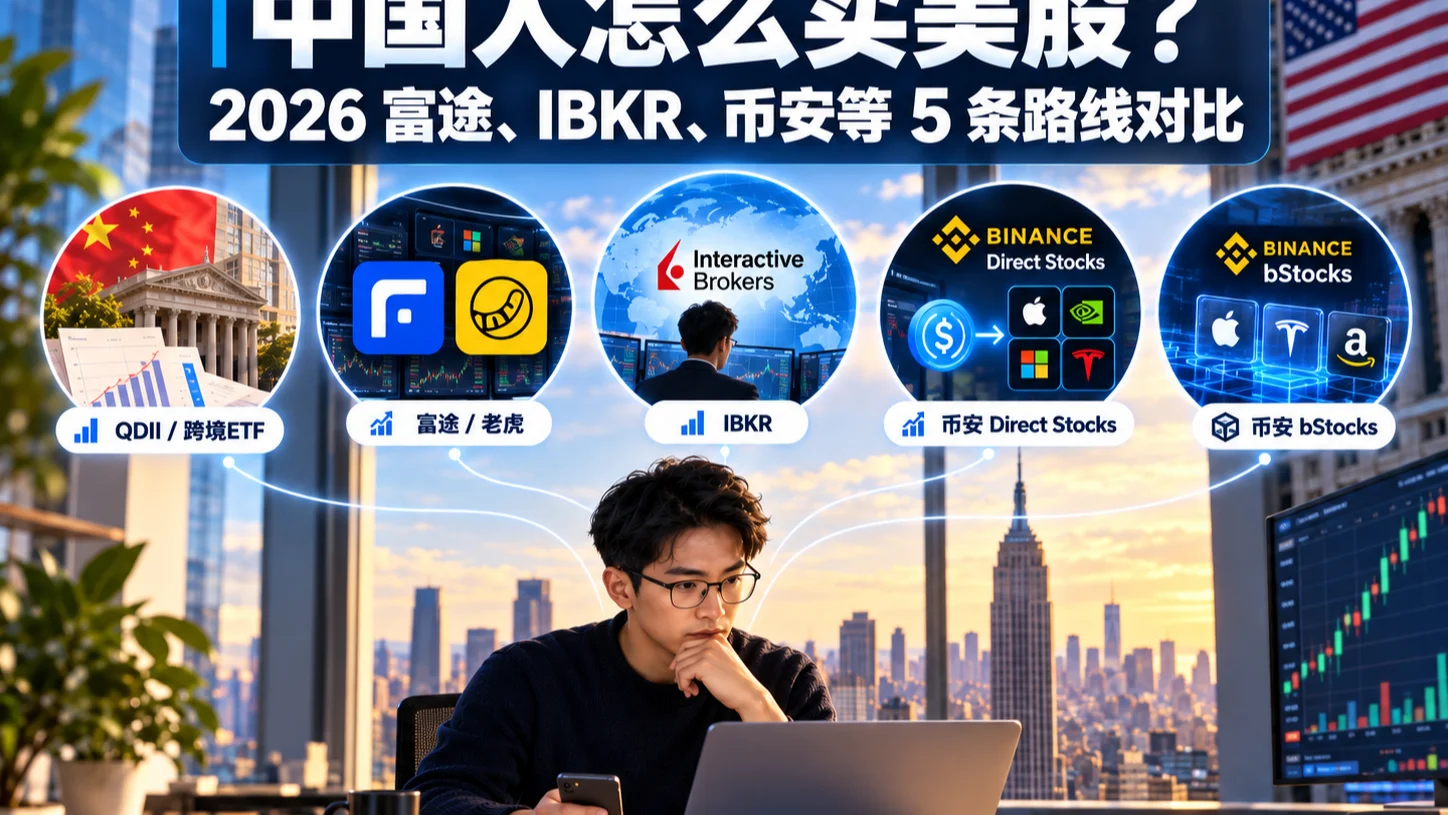
Table of contents

Binance new user rewards
20% trading fee rebate
Official Binance registration. Complete identity verification (KYC) to trade and withdraw.
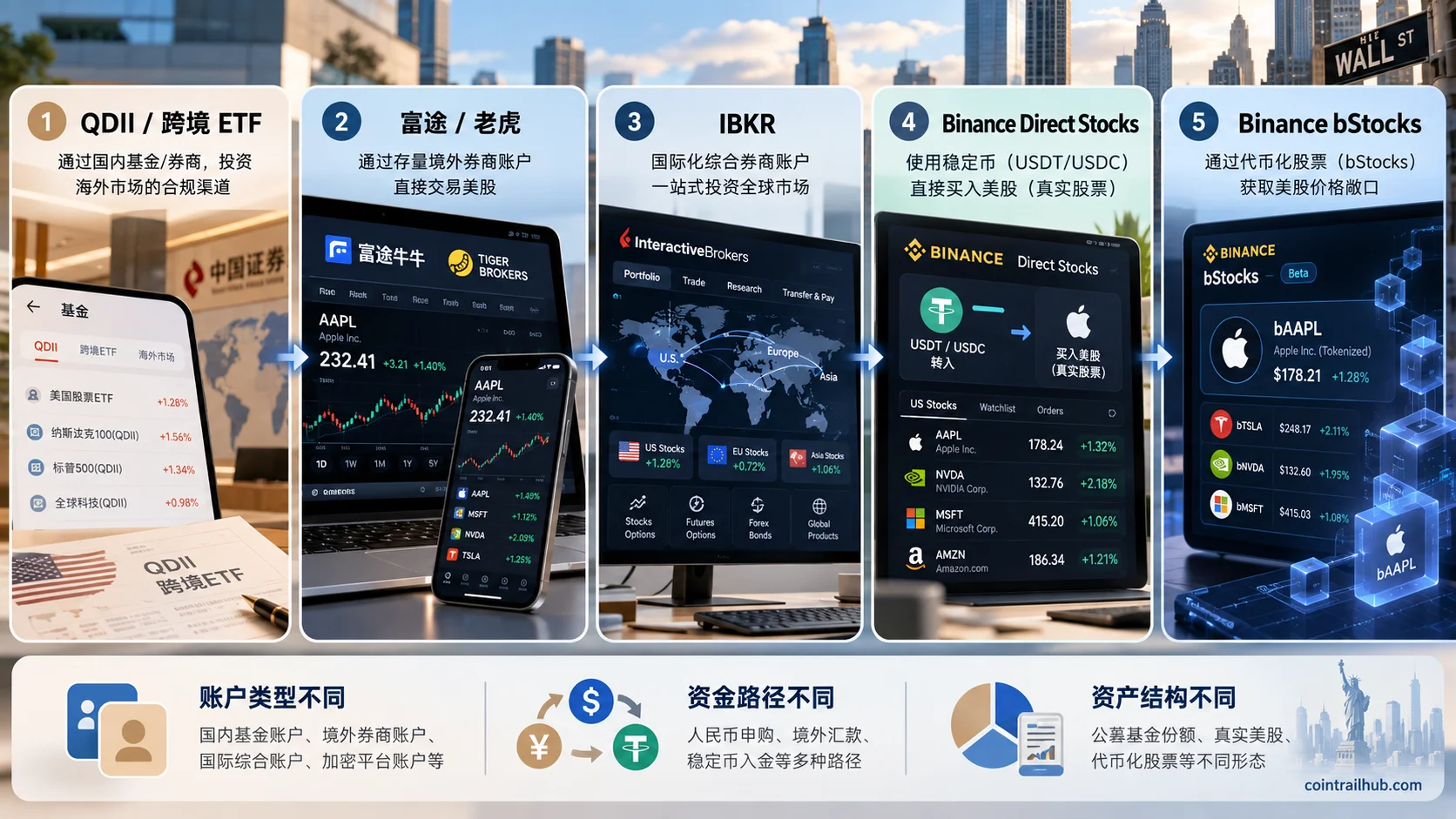
How to buy US stocks from China? Don't rush to download an app or open an account. In 2026, mainland China residents can get exposure to US stocks or the US equity market mainly through five routes: domestic QDII / cross-border ETFs, existing overseas broker accounts like Futu/Tiger, international brokers like IBKR, Binance Direct Stocks, and Binance bStocks.
But these five routes differ completely in legal structure, account-opening requirements and funding methods. After May 2026, the first step isn't choosing a platform — it's figuring out which category you fall into. Get that wrong and everything downstream is wasted effort. This article breaks it down by four things — residency, account, funds and asset nature — and a table at the end tells you directly which route to take.
Especially since May 2026, China has further tightened its crackdown on illegal cross-border securities, futures and fund business. For investors who live long-term in mainland China, it is no longer correct to think of it as simply "download an overseas broker app → open an account → wire USD → buy US stocks."
What you actually need to determine first is: where you live long-term, whether you already have an overseas securities account, whether your funds are currently onshore or offshore, whether your account has the required product eligibility, and whether you want traditional US stocks, funds or tokenized securities.
Here's the short version:
| Route | Core positioning in 2026 |
|---|---|
| QDII / cross-border ETF | Get US market exposure through an onshore account |
| Futu / Tiger | New onshore account opening restricted; existing accounts depend on current permissions |
| Interactive Brokers (IBKR) | For people with genuine offshore circumstances |
| Binance Direct Stocks | Eligible users can buy real US stocks and ETFs |
| Binance bStocks | Eligible users can trade tokenized US equity securities |
If your funds, residency and bank account are all in mainland China, start by researching QDII / cross-border ETFs. If you have genuine offshore residency and banking conditions, compare international brokers like IBKR. If you already hold digital assets, first confirm whether your Binance account actually has Direct Stocks or bStocks enabled, then compare the specific products.
About 11 minutes to read. Remember this up front: the $50,000 annual foreign exchange quota doesn't mean you can use it to trade US stocks; and Stock Connect can't buy NASDAQ or NYSE-listed stocks.
Can mainland China residents still buy US stocks in 2026?
You can get exposure to US stocks or the US equity market, but the regulatory nature of the different routes is completely different.
In May 2026, the CSRC and seven other departments issued the Implementation Plan on Comprehensively Cracking Down on Illegal Cross-Border Securities, Futures and Fund Business (CSRC Document No. 28 of 2026). The crackdown covers overseas institutions providing marketing, account opening, order handling, fund transfer and related securities trading services in China without approval. The plan sets a 2-year centralized enforcement period, during which illegal existing business within scope is, in principle, not allowed to continue providing buy-side transactions and fund-in services in China — only one-way selling and fund withdrawal are permitted.[1]
So when discussing "how to buy US stocks from China" in 2026, the biggest change isn't which broker has lower commissions — it's first confirming whether a channel is legally applicable to your identity and place of residence, then talking about account opening, funding and fees.
At the same time, the authorities made clear that legal outbound investment channels are not closed: investors can still invest offshore through Stock Connect, Qualified Domestic Institutional Investor (QDII) and the Wealth Management Connect.[2]
Route 1: QDII / cross-border ETF — for people whose funds are still onshore
QDII is the scheme under which onshore qualified institutions invest in overseas securities markets within a regulatory framework. For mainland investors who have no overseas bank account, no overseas residency, but still want exposure to the performance of the US stock market, this is actually the most easily overlooked route.
What you buy may not be Apple, NVIDIA or Tesla shares in your own name, but a fund product that invests in US stocks or indices — for example, onshore funds tracking the Nasdaq-100, the S&P 500, or US tech and consumer sector indices.
| QDII / cross-border ETF | Overseas broker |
|---|---|
| Onshore securities or fund account | Overseas securities account |
| Mainly RMB | Overseas currency or account funds |
| Buys funds or ETFs | Can hold US stocks directly |
| No need to fund an overseas broker yourself | Involves overseas account opening and a funding path |
If your core goal is simply to "participate in the US market" rather than to own TSLA, NVDA or AAPL directly, you should compare onshore QDII / cross-border ETFs first.
Route 2: Futu / Tiger — the issue is no longer opening an account, but existing accounts
Futu and Tiger were once the most common online brokers for mainland China investors buying US stocks. But discussing them in 2026, the search focus is no longer "how to open a Futu account" but "can the Futu/Tiger account I opened before still keep buying."
Since late 2022, regulators have required the relevant overseas institutions to rectify illegal cross-border business, prohibiting soliciting mainland investors and opening new accounts in violation of the rules; the new round of enforcement in May 2026 further covers buy-side transactions and fund-in for existing business. During the enforcement period, existing accounts are in principle only allowed to sell and withdraw funds one-way, not buy or transfer funds in (the enforcement period is about 2 years, until around May 2028). So "can log in, can view quotes, can sell, can keep buying, can keep funding" are no longer the same thing.
| Account situation | What to confirm first in 2026 |
|---|---|
| No Futu/Tiger account | Don't assume you can still open a new account using old tutorials |
| Already have an existing account | Confirm buy-side and fund-in permissions |
| Live offshore long-term | Judge by your actual residence and account entity |
People living in mainland China with no existing account should not treat Futu or Tiger as the default US-stock account-opening route in 2026.
Route 3: IBKR — for people with genuine offshore circumstances
Interactive Brokers (IBKR) covers US stocks, ETFs, options, futures, bonds and multi-country stocks. Looking at securities account functionality alone, it is clearly more complete than platforms that only offer simple stock trading.
But what mainland China users should really focus on isn't "is IBKR good", but "can my real residence, tax identity, address and banking conditions satisfy the current account review requirements." If you live long-term in Hong Kong, Singapore, the US, Europe or elsewhere, with a real residential address, bank account, tax records and identity documents, international brokers are still worth researching; conversely, if you live long-term in mainland China without genuine overseas banking and living conditions, you should not assume — based on network tutorials from years ago — that you can definitely open an account.
IBKR is better suited to people who already have genuine offshore financial conditions, not to finding a "mainland account-opening loophole."
Route 4: Binance Direct Stocks — stablecoins can buy real stocks
Binance Direct Stocks is a stock trading service for eligible users that lets them buy US-listed stocks and ETFs through a Binance account, with order execution, clearing, settlement and custody handled through partnered securities institutions.
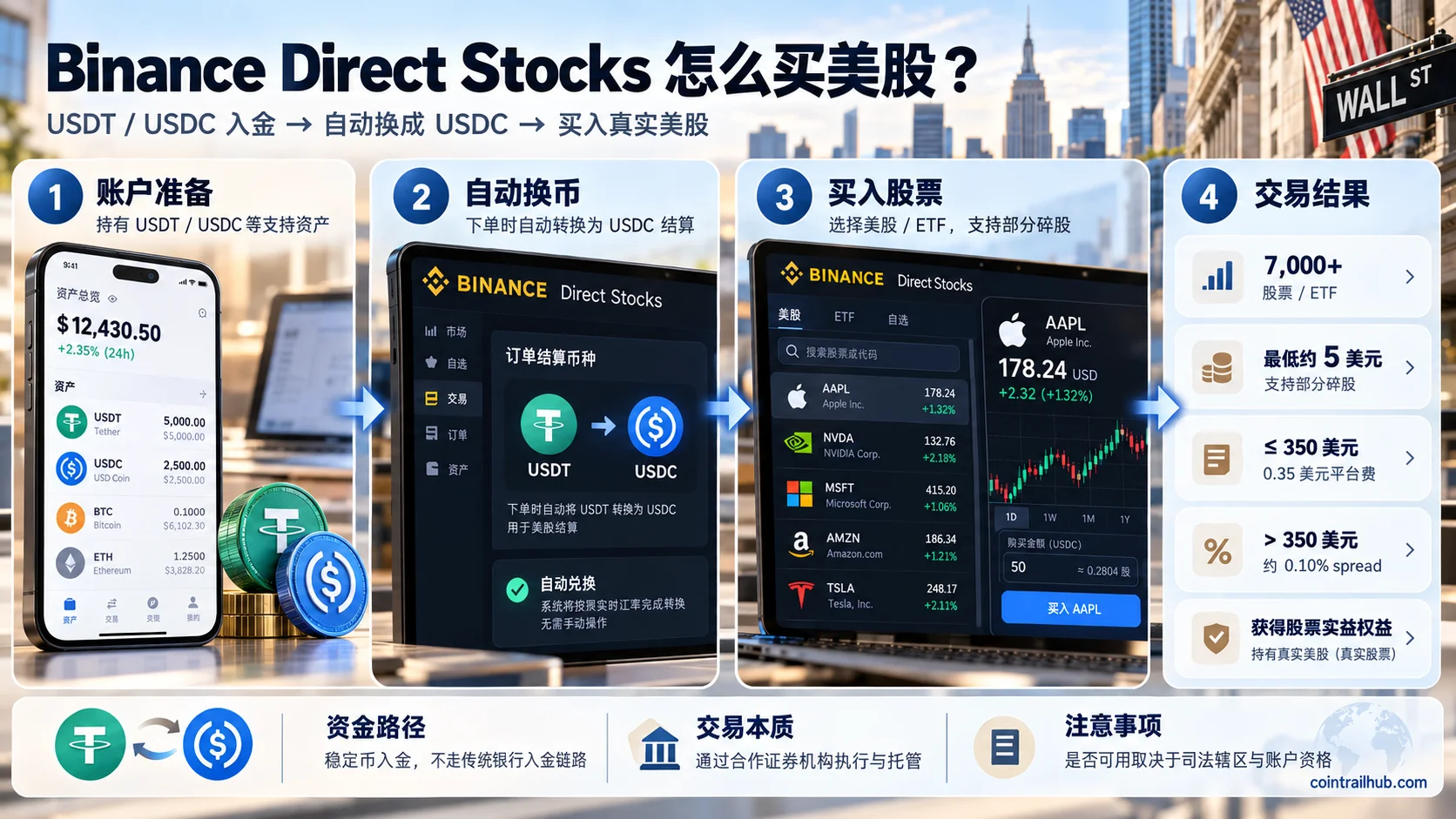
Current official materials show that eligible users can trade more than 7,000 US-listed stocks and ETFs, starting at a minimum of about $5, with fractional shares supported on some securities.[3]
It is not bStocks, and it is not a perpetual contract like TSLAUSDT:
| Product | Asset nature |
|---|---|
| Direct Stocks | Stock equity interest under a traditional securities structure |
| bStocks | Tokenized securities |
| Stock perpetual contracts | Price derivatives |
The fact that they all say "Tesla" doesn't mean you're buying the same asset.
Can USDT buy Binance US stocks?
Yes. Users who meet the Binance Direct Stocks product eligibility can place orders with supported assets such as USDT. Stock trading itself is settled in USDC; if your account holds supported assets like USDT or BNB, Binance can automatically convert them to USDC at order time and then complete the stock purchase.[4]
You can think of the funding path as:
USDT → auto-convert to USDC → buy US stocks or ETFs
Compared with the traditional broker path of "bank funds → overseas account → USD → buy stocks", Direct Stocks is a shorter funding path for users who already hold USDT or USDC.
Mainland China residents are not categorically barred from Binance Direct Stocks. Whether you can actually trade depends on the stock trading entry Binance opens for you based on your country or region of residence, KYC status and account product eligibility.
What are the fees
"Zero commission" must not be understood as no trading cost at all:
| Order amount | Main fee |
|---|---|
| ≤ $350 | $0.35 platform fee |
| > $350 | About 0.10% spread |
Buy $10 of stock, and the $0.35 fee is roughly 3.5%; buy $100 and it drops to about 0.35%.[5] So the $5 minimum doesn't mean buying only $5–10 each time is the most cost-efficient. Other costs may also apply, including USDT/USDC conversion, ADR fees, dividend tax and other securities-related fees.
If you already hold stablecoins and your account actually shows Direct Stocks trading eligibility, this route's funding path is much shorter than a traditional broker. To take this route, go straight to How to buy US stocks on Binance: order steps, fees and dividend withdrawal full guide (2026) and follow it; to see each step on screen, watch Binance App US stocks trading walkthrough video.
No Binance account yet? Register first and then check whether the stock function is open — new users entering referral code BN522 get spot and futures fee rebates; the entry is in How to Register on Binance (2026).
Route 5: Binance bStocks — 24/7 tokenized US stocks
bStocks are tokenized securities offered by Binance. Each bStock that meets the product structure is backed 1:1 by real US stocks, with 24/7 spot trading, partial on-chain withdrawal support and BNB Chain self-custody.
But the structure needs to be stated clearly first: bStocks are issued by BTech Holdings Limited, a Binance Group affiliate, and offered through an ADGM-approved prospectus.[6] Binance's official announcement explicitly states that bStocks are not offered in other jurisdictions, and that the relevant products and services may not be available in your region.
A bStock itself is not common stock in the underlying listed company. It represents an interest in the securities held by the issuer, with each unit backed 1:1 by US stocks held by a regulated custodian, but the holder does not thereby become a registered shareholder of the listed company.
So bStocks are better understood as "on-chain economic exposure to US stocks", not stock in an ordinary securities account. For a full comparison of the two, see Tokenized US stocks vs traditional stocks: platform asset vs broker account (2026); to see how bStocks actually trade, watch Binance bStocks 24/7 trading walkthrough video.
What exactly is the difference between Direct Stocks and bStocks
| Direct Stocks | bStocks |
|---|---|
| Beneficial interest in stock | Tokenized securities |
| Execution and custody via securities partners | Backed 1:1 by real stocks |
| Trading mechanics subject to securities market rules | Can offer 24/7 spot trading |
| Traditional securities structure | Can support on-chain self-custody |
The authorities also explicitly note that bStocks' availability is restricted by jurisdiction — not all users in all regions can use it, and it must not be equated with "having a Binance account means you can buy."
Can Stock Connect buy US stocks
No. This one isn't placed among the "five routes" but called out separately to clear up a misconception.
Stock Connect lets you buy eligible Hong Kong-listed securities, not US stocks listed on NASDAQ or NYSE. So Apple, NVIDIA and Tesla cannot be bought directly through Stock Connect. If you want US market exposure with RMB and an onshore securities account, what you should research is QDII, cross-border ETFs and similar products — not Stock Connect.
How to finally choose among the five routes
| Your situation | Route to research first |
|---|---|
| Funds mainly onshore | QDII / cross-border ETF |
| Already have a Futu/Tiger account | First verify your current existing-account permissions |
| Live offshore long-term with a local bank | International brokers like IBKR |
| Already hold stablecoins and the account has the stock function open | Binance Direct Stocks |
| Accept tokenized securities and on-chain structure | Binance bStocks |
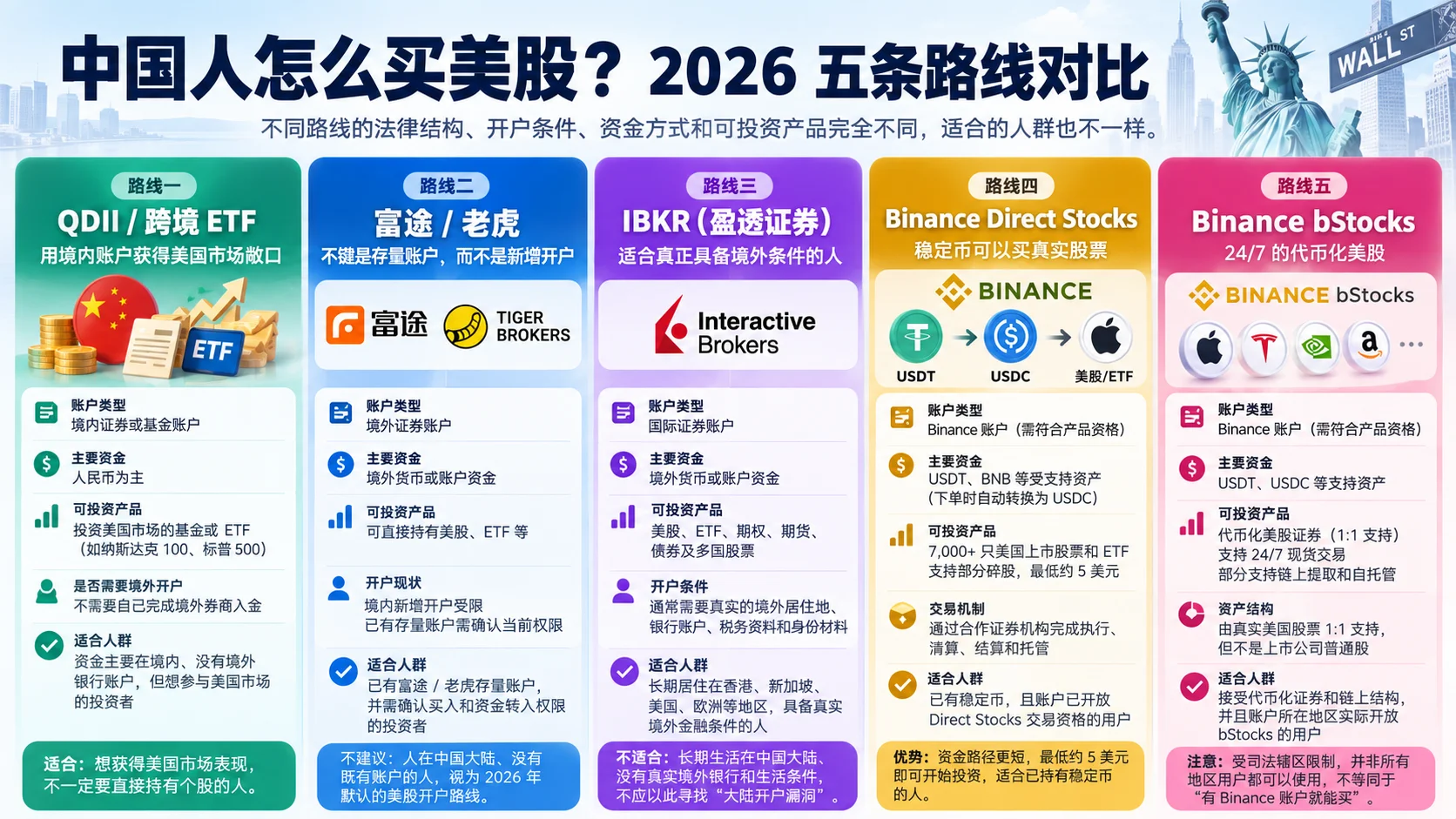
The correct 2026 decision order is not "pick a platform first" but: residence → account eligibility → fund location → asset nature → finally compare fees. Once you've picked a route, see the "Related reading" at the end for the corresponding hands-on article on where to open an account and what to do first.
6 pitfalls mainland residents most easily hit when buying US stocks
- Treating the $50,000 foreign exchange quota as "$50,000 a year to trade US stocks." The annual personal convenience foreign exchange quota and the purpose of overseas securities investment are not the same thing; cross-border use of funds must still comply with foreign exchange regulations.
- Treating Stock Connect as a US-stock account. Stock Connect cannot directly buy US stocks listed on NASDAQ or NYSE.
- Opening an account using tutorials from 2022–2025. The cross-border securities regulatory environment has changed. Don't treat "open with a mainland ID", "fill in any overseas address", "VPN to change region" or "buy a proof of address" as reliable account-opening methods.
- Treating Direct Stocks, bStocks and stock contracts as the same asset. All three may track companies like Tesla or NVIDIA, but the asset structure differs — confirm the product type before buying, not just the ticker.
- Treating "zero commission" as "zero cost." The real cost can include platform fees, spread, FX or conversion costs, ADR fees, taxes and deposit/withdrawal costs.
- Filling in fake identity information to gain product eligibility. Regional restrictions are part of securities product compliance; don't use fake addresses, proof of residence, identity or tax records to bypass product restrictions.
FAQ
Can mainland residents still buy US stocks in 2026?
You can get exposure to US stocks or the US equity market, but you need to distinguish between onshore funds, existing overseas securities accounts, international brokers, Direct Stocks and tokenized securities. For people living long-term in mainland China, it can no longer be understood — as old tutorials suggest — as "register with an overseas broker and buy US stocks."
Can mainland China residents still open Futu or Tiger?
Futu and Tiger cannot be treated as new account-opening channels that are broadly open to mainland China residents right now. If you have an existing account, you need to further confirm whether it currently allows continued buying and fund-in.
Can an old Futu account still buy US stocks?
You can't judge that all functions are still normal just because you can still log in. In 2026 you need to separately confirm login, quotes, sell, buy and fund-in permissions.
Can mainland China residents still open IBKR?
Account-opening eligibility cannot be judged by nationality alone; the actual review may involve residence, address, tax identity, banking relationships and account entity information. Someone living long-term offshore with genuine offshore financial conditions is in a different situation from an applicant living long-term in mainland China.
Can Stock Connect buy Tesla, NVIDIA or Apple?
It cannot directly buy these US-listed common stocks. Stock Connect is mainly used to trade eligible Hong Kong-listed securities.
Can Binance buy US stocks?
Binance has launched the Direct Stocks product; eligible users can trade more than 7,000 listed stocks and ETFs with a minimum investment threshold of about $5. But whether the product is open depends on your jurisdiction and specific account eligibility.
Is Binance Direct Stocks real stock?
It is a direct stock trading structure: users gain the corresponding beneficial interest in the stock through partnered securities institutions, which differs from bStocks' tokenized securities structure.
What is the minimum to buy US stocks on Binance?
Official materials show a minimum of about $5 to gain fractional-share exposure to some US stocks or ETFs, but small orders incur a $0.35 minimum platform fee.
Can USDT buy Binance US stocks?
Users who meet the stock product eligibility can place orders with supported assets such as USDT; the system can automatically convert them to USDC and then use it to buy stocks.
What are Binance's stock fees?
Current official standard fees: orders up to $350 incur a $0.35 platform fee, and orders over $350 incur a spread of about 0.1%. Re-check Binance's latest fee page before actually trading.
Is bStocks real US stock?
It is not directly holding common stock of a listed company. bStocks are tokenized securities backed 1:1 by the corresponding US stocks; you gain economic exposure to the securities rather than being directly registered as a common-stock shareholder of the listed company.
How to buy the US market without an offshore account?
If your funds, life and bank account are all in mainland China, it's more worthwhile to research onshore QDII, cross-border ETF and similar products first. This isn't the same as opening an overseas US-stock account, but it can give you exposure to the corresponding US stock index or market.
Related reading
- How to Register on Binance (2026) — email/phone account opening, KYC and security setup; new users entering referral code BN522 get fee rebates
- Binance Referral Code 2026: Which Code Really Gets 20% Rebate? BN522 Verified — rebate rules and payout conditions
- How to buy US stocks on Binance: order steps, fees and dividend withdrawal full guide (2026) — the actual Direct Stocks order, fees, dividend and sell process
- Binance stocks vs Futu/Tiger: fees and transfer, tested (2026) — comparing traditional securities accounts and stablecoin stock accounts
- Can You Buy US Stocks on Binance? My Real 0.015 TSLA Buy — Fill and Fee Record (2026) — breaking down the trading process with a real fractional-share order
- Tokenized US stocks vs traditional stocks: platform asset vs broker account (2026) — clarify the structure of stocks, tokenized securities and broker custody
- Are Binance US stocks real stock? Stock tokens vs real stocks (2026) — distinguish Direct Stocks, bStocks and stock contracts
Data verification notes
The key facts in this article were checked on 2026-10-16 against the eight-department plan (including the CSRC) and Binance's official stock materials, point by point:
- 2026 cross-border securities crackdown framework: the CSRC and seven other departments issued the Implementation Plan on Comprehensively Cracking Down on Illegal Cross-Border Securities, Futures and Fund Business (CSRC Document No. 28 of 2026); the scope covers overseas institutions providing marketing, account opening, order handling and fund transfer in China without approval. The plan sets a 2-year enforcement period during which illegal existing business in scope is, in principle, only allowed one-way selling and fund withdrawal. Source: Implementation plan on cracking down on illegal cross-border securities, futures and fund business (eight departments including the CSRC).
- Legal outbound investment channels are not closed: the authorities explicitly stated that investors can still invest offshore through Stock Connect, Qualified Domestic Institutional Investor (QDII) and the Wealth Management Connect. Source: Implementation plan on cracking down on illegal cross-border securities, futures and fund business (eight departments including the CSRC).
- Binance Direct Stocks' scope and threshold: eligible users can trade more than 7,000 US-listed stocks and ETFs, starting at about $5, with fractional shares supported on some securities. Source: Binance stock trading FAQ.
- How USDT buys Binance US stocks: stock trading is settled in USDC; when the account holds supported assets like USDT or BNB, the system auto-converts them to USDC at order time before completing the purchase. Source: What is Binance stocks trading (Binance Academy).
- Binance stock fee structure: orders ≤ $350 incur a $0.35 platform fee, orders > $350 incur about 0.10% spread; buying $10 means a platform fee of roughly 3.5%, buying $100 drops to about 0.35%. Source: Binance stock trading FAQ.
- bStocks' issuance and backing structure: bStocks are issued by BTech Holdings Limited, a Binance Group affiliate, offered through an ADGM-approved prospectus; each unit is backed 1:1 by US stocks held by a regulated custodian, tradable 24/7 spot with partial on-chain withdrawal support. Source: Binance bStocks announcement.
Disclaimer
This article only introduces the ways mainland China investors may participate in the US stock market in 2026, and does not constitute investment advice, securities recommendation, account-opening advice, foreign exchange advice, tax advice or legal advice. Mentioning a platform or product does not mean it is open to mainland China residents, nor that mainland China identity alone is enough to open an account or trade.
You must not use a fake identity, fake residence, forged proof of address or other means to bypass jurisdiction, securities regulation or platform eligibility restrictions. Stocks, ETFs, tokenized securities and crypto assets all carry principal-loss risk; cross-border investment also involves securities regulation, foreign exchange, tax, custody, FX rate, platform and jurisdiction risks.
- 2026-10-17UpdateAdded a registration CTA (referral code BN522) and the Futu/Tiger existing-account "sell-only until around May 2028" wording; related recommendations now include registration and referral-code entries.
- 2026-10-17UpdateAdded a match-by-situation action anchor at the start, "next step" internal links after route four and the decision table, and US-stock walkthrough video links in routes four and five to improve click conversion.
- 2026-10-16UpdateAdded evidence-chain superscripts and the Data Verification Notes; updated the key-fact verification date.
See ourEditorial Policy and the correction process in ourCorrections Policy.
The CoinTrailHub editorial team focuses on crypto education for beginners, exchange security and P2P trading risk. This article is compiled from official sources and public data, reviewed by humans, and strives for accuracy but is not investment advice.
Last updated:2026-10-17 · Content reviewed by humans · Learn more
© 2026 CoinTrailHub · Original content. Reproduction or rewriting without permission is prohibited.