
What is cryptocurrency? Basics, common misconceptions and a learning path
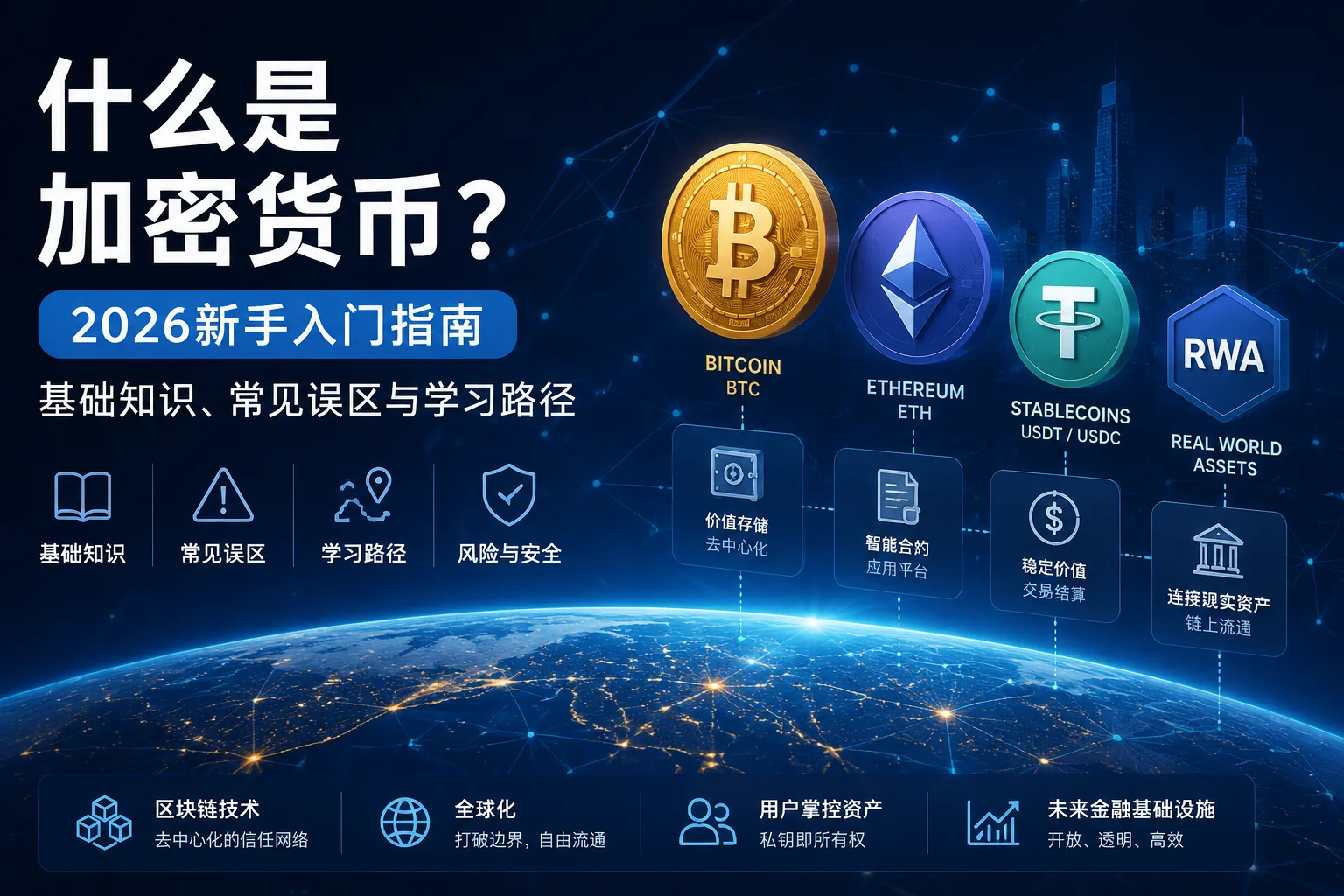
Table of contents

Binance new user rewards
20% trading fee rebate
Official Binance registration. Complete identity verification (KYC) to trade and withdraw.
Many people first searching for "what is cryptocurrency" don't actually want to study the technology.
More often, it's because:
- Friends started talking about Bitcoin;
- BTC and Ethereum keep appearing in the news;
- They see people discussing stablecoins, RWA and on-chain stocks.
But after really getting into crypto, many people discover:
There are a lot of unfamiliar concepts here.
What is blockchain?
Why does a digital asset have value?
Why can USDT circulate?
Why does a wallet need a seed phrase?
Why do some people care about on-chain stocks?
If you only understand cryptocurrency as:
"Buy a coin, then wait for it to rise."
You've only seen the most superficial layer of this industry.
What really matters about cryptocurrency is that it changes how a digital asset is recorded and transferred.
In the past:
Asset records relied on centralized institutions like banks and brokers.
Now:
Blockchain tries to let assets be recorded and transferred through a public network.
Of course, this doesn't mean every crypto project has value.
Over the past few years, the market has seen a lot of concept projects:
Swap in a hot concept, issue a token, and wrap it in a future story.
So the first step into the crypto world is not looking for which project might rise.
It's building judgment first:
- What problem does it solve?
- Is there real demand?
- Where does the risk come from?
This article will take you through:
- What cryptocurrency is;
- Why Bitcoin and Ethereum matter;
- Why stablecoins became infrastructure;
- Why RWA is worth watching;
- How beginners should build their understanding of crypto.
Basic understanding of cryptocurrency
What exactly is cryptocurrency?
Simply put:
Cryptocurrency is a type of digital asset that runs on blockchain networks.
In traditional finance:
- Banks record account balances;
- Brokers record stock positions;
- Payment institutions process fund flows.
Cryptocurrency, by contrast, records asset state through blockchain networks.
For example:
- Bitcoin runs on the Bitcoin network;
- Ethereum runs on the Ethereum network;
- USDT and USDC run on different blockchain networks.
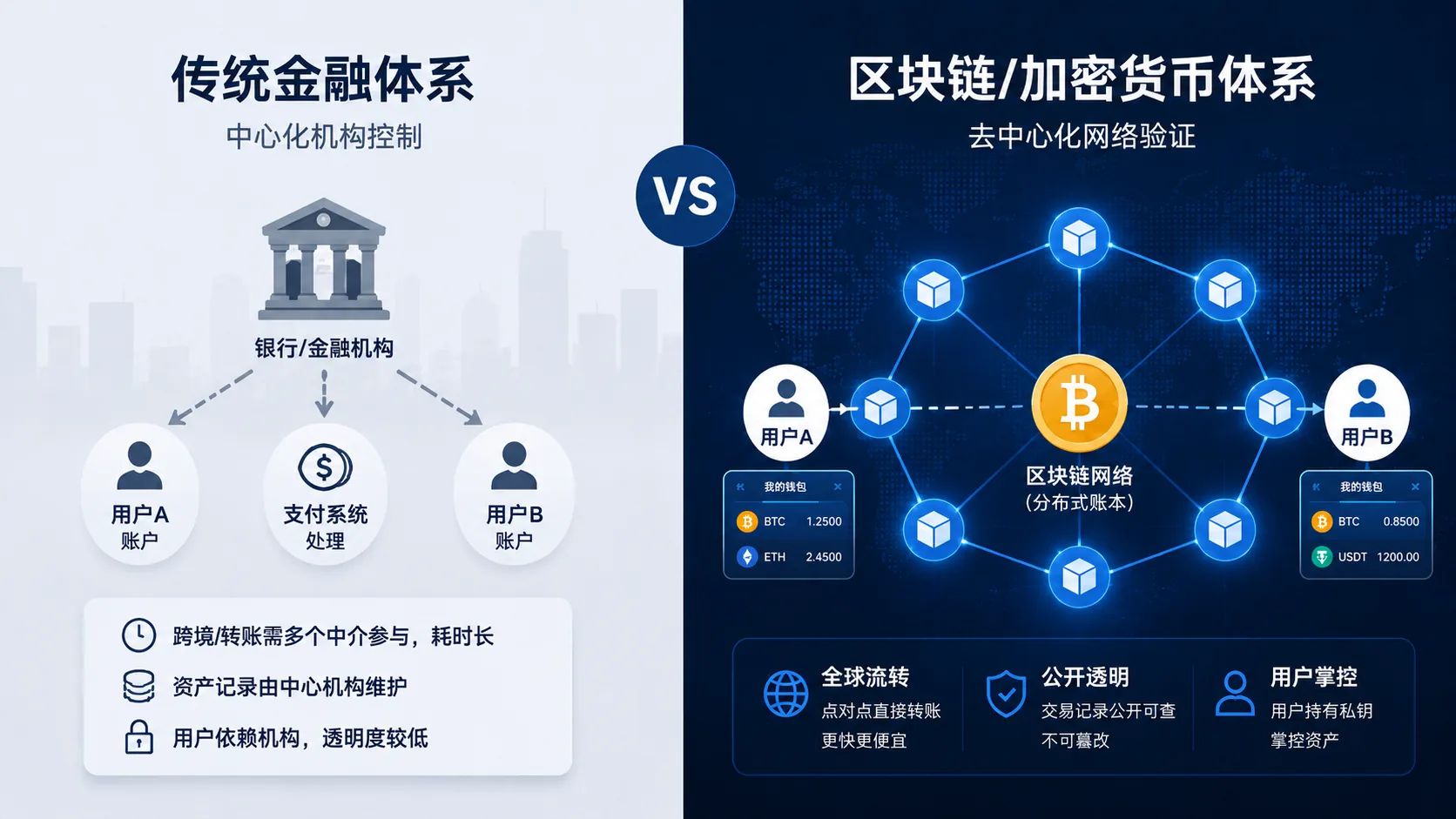
If you understand traditional finance as:
"A database maintained by institutions."
Then blockchain is more like:
"A public ledger jointly maintained by multiple nodes."
Users receive assets through wallet addresses and control assets through private keys.
But there's an important distinction here:
Being on-chain doesn't mean an asset automatically has value.
Blockchain can change how assets are recorded and improve transfer efficiency.
But it can't guarantee:
- That a project will succeed;
- That an issuer is reliable;
- That a token has long-term demand.
Judging a crypto project ultimately comes back to:
What problem it actually solves.
To understand the underlying technology:
What is blockchain? How it works, its uses, and risks (2026)
Why did cryptocurrency appear?
To understand crypto, you can't just look at the price.
The core question behind its appearance is:
In the digital age, can assets be recorded and transferred more freely?
The traditional financial system is already very mature, but it still has some limitations:
| Traditional finance | What blockchain tries to change |
|---|---|
| Cross-border transfers need multiple institutions | Let assets move through a global network |
| Asset records depend on centralized institutions | Transaction records are publicly verifiable |
| Financial services depend on platforms | Some functions run through code |
The idea Bitcoin first proposed was to build:
A digital asset network that doesn't rely on control by a single institution.
But this model also brings new responsibility.
In the past:
Asset security relied more on banks and brokers.
Now:
Users have more control, but also need to manage on their own:
- Wallets;
- Private keys;
- Transfer operations.
So the defining feature of crypto is:
More control, but higher usage requirements.
The 4 core asset categories beginners need to understand first
When first encountering cryptocurrency, many people easily fall into one misconception:
Studying too much.
Every day they follow:
- New coins;
- Hot projects;
- Airdrops;
- The so-called "next opportunity."
But in reality, beginners just need to understand a few core categories first.
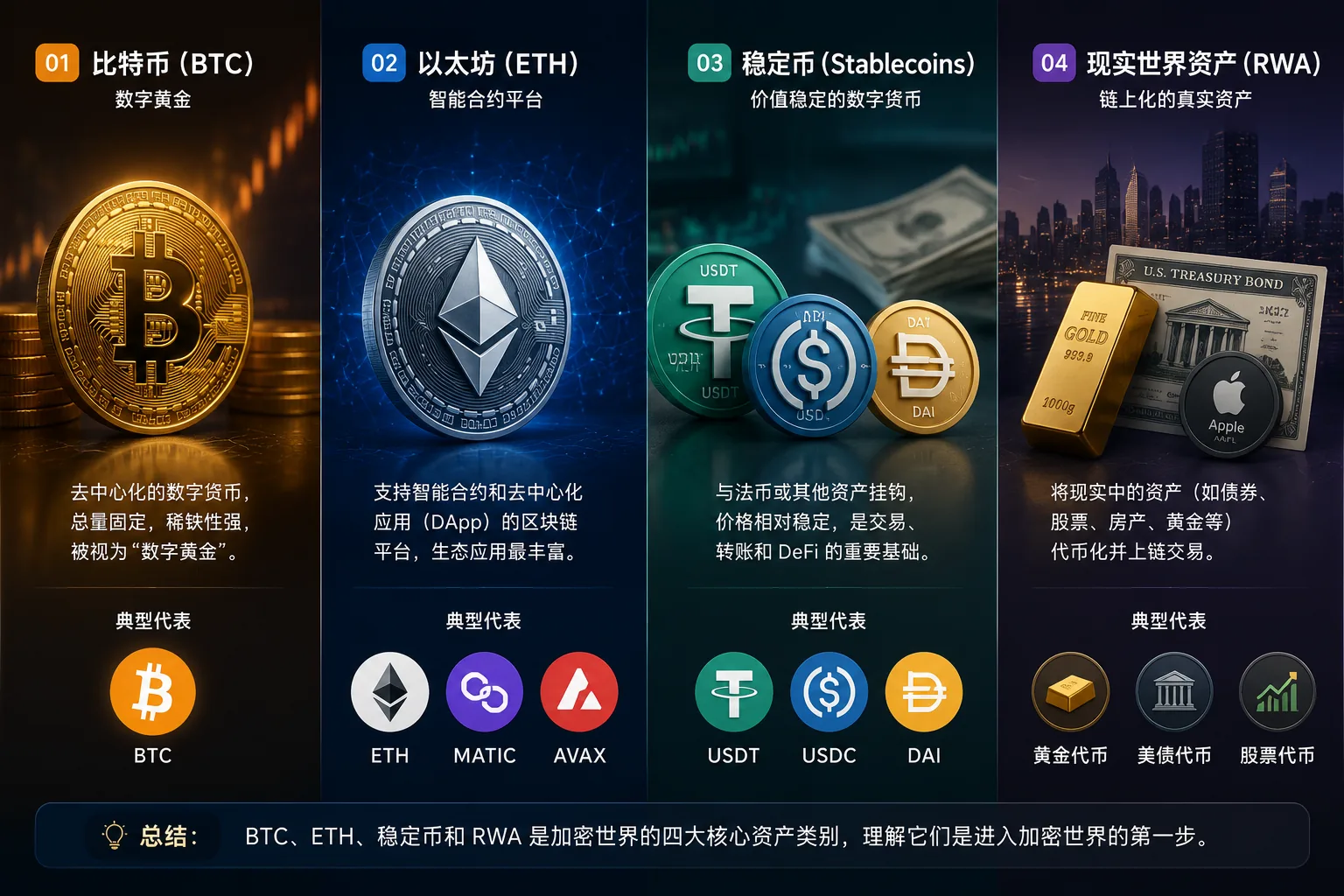
| Type | Main role | Core focus |
|---|---|---|
| Bitcoin BTC | Digital asset, store of value | Why the market recognizes it |
| Ethereum ETH | Blockchain application platform | Why it can run applications |
| Stablecoins USDT/USDC | Trading, payments, settlement | Issuer and network risk |
| RWA | Bringing real-world assets on-chain | Underlying asset and exit mechanism |
Bitcoin: why do some call it digital gold?
Bitcoin is the first cryptocurrency to truly run at scale.
Its characteristics:
- Limited total supply;
- Runs on a global network;
- Not issued by a single institution.
Many people call Bitcoin:
"Digital gold."
The reason is:
Both have scarcity.
But there are also differences.
Gold has physical existence.
Bitcoin relies on network consensus.
At the same time, Bitcoin's price is quite volatile, which is a risk beginners need to understand in advance.
Learning about Bitcoin isn't just about the price.
More importantly, it's understanding:
Why a digital asset can gain market recognition.
For details:
What is Bitcoin (BTC)? How it works, its value and risks (2026)
Ethereum: why does it matter?
If Bitcoin is more like a digital asset.
Then Ethereum is more like a blockchain application platform.
It supports:
- Smart contracts;
- DeFi;
- NFT;
- On-chain applications.
Many crypto applications aren't simply about sending tokens.
They're about running programs on a blockchain.
Understanding Ethereum can help beginners understand:
Why blockchain can not only record assets, but also run financial applications.
For details:
What is Ethereum? Smart contracts, gas fees and Web3
Stablecoins: one of the most real on-chain applications today
Looking at the current crypto ecosystem, I think stablecoins are the type of asset closest to real demand.
Representatives:
- USDT;
- USDC.
They are already widely used for:
- Settlement;
- Cross-platform transfers;
- On-chain finance;
- RWA asset flows.
Compared to the many tokens driven by market sentiment, stablecoins' biggest feature is:
They've already solved part of a real problem.
Many users first encounter cryptocurrency not through Bitcoin, but through stablecoins.
For example:
- Depositing on trading platforms;
- Transferring between platforms;
- Using funds in on-chain applications.
But stablecoins aren't dollar cash either.
They still involve:
- Issuer risk;
- Reserve transparency issues;
- Wrong network selection;
- Address freeze risk.
Therefore, when understanding stablecoins, you can't just look at "price stability."
You also need to understand:
Who issues them?
Where are the reserves?
Which network do they run on?
For details:
USDT vs USDC: which is safer and how to choose (2026)
RWA: a direction worth watching in the future
RWA (Real World Assets) refers to:
Bringing real-world assets onto the blockchain.
For example:
- US Treasuries;
- Gold;
- Funds;
- Stocks.
If the past few years of crypto were more about:
"Creating new digital assets."
Then a direction worth watching in the future is:
How to bring real-world assets on-chain.
This is also why I care about RWA.
What it connects isn't a new story, but real, existing assets.
For example:
On-chain gold hopes to give gold a more convenient digital transfer method.
On-chain stocks hope to let traditional financial assets be traded through blockchain networks.
But be aware:
Putting real-world assets on-chain doesn't mean risk disappears.
For example, with on-chain gold, you need to watch:
- Whether the gold actually exists;
- Who is responsible for custody;
- Whether there's auditing;
- Whether it can be redeemed normally.
On-chain stocks are the same.
Having "stock" in the name doesn't mean it's the same as a traditional stock account.
You need to look at:
- The underlying asset relationship;
- The rights the user actually has;
- The platform and regulatory structure.
For details:
Are RWA on-chain assets worth investing in? My real experience buying NVDAon
The misconceptions beginners most easily fall into
Misconception 1: treating every token as an opportunity
Many newcomers keep searching for:
"The next Bitcoin."
But projects that last usually aren't the ones with the biggest story.
Rather, it's because:
They solve a real problem.
Whether a project has value comes down to:
- Whether it has real users;
- Whether there's actual demand;
- Whether it can keep developing.
Misconception 2: looking only at price, not value
A rising price doesn't necessarily mean a project is good.
A falling price doesn't necessarily mean a project is worthless.
The market is heavily influenced by sentiment in the short term.
But in the long run, what really matters is:
- Whether the product exists;
- Whether users are growing;
- Whether the business model holds up.
Misconception 3: thinking a wallet is always safer than an exchange
Wallets do give users more control.
But they also add responsibility.
Many asset losses aren't from bad market judgment.
They come from:
- Seed phrase leaks;
- Wrong addresses;
- Malicious authorizations.
If you plan to use a personal wallet, first understand:
What is a crypto wallet? Wallet addresses, seed phrases and asset security (2026)
Misconception 4: jumping into complex applications before understanding the basics
DeFi, NFT and on-chain applications all have value.
But they aren't the first step in crypto.
If you:
- Don't understand wallets;
- Don't understand networks;
- Don't understand authorization;
Then jumping directly into complex applications usually brings more risk than opportunity.
Many beginners' problem isn't that they can't find opportunities.
It's that they entered scenarios they couldn't understand before learning the rules.
Directions worth watching in 2026
Stablecoins
Stablecoins have already proven real demand.
In the future they may continue to connect:
- Payments;
- Global fund flows;
- On-chain finance.
They're more like infrastructure in the crypto world than mere trading assets.
RWA
Digitizing real-world assets is an important direction where traditional finance and blockchain meet.
Especially:
- On-chain gold;
- On-chain stocks;
- Tokenized funds.
But it ultimately comes back to a few questions:
Where are the assets?
Who manages them?
What rights does the user have?
On-chain financial infrastructure
In the future there may be more:
- On-chain trading;
- Digital asset management;
- Financial applications.
But technological development doesn't mean every project will succeed.
What's really worth watching is still:
Whether there's real demand.
Entering crypto as a beginner — recommended order of understanding
Many newcomers just getting into cryptocurrency focus directly on:
- Which coin to buy;
- Which platform has lower fees;
- Which project might rise.
But these aren't actually the first step.
At different stages, the problems that actually need solving differ.
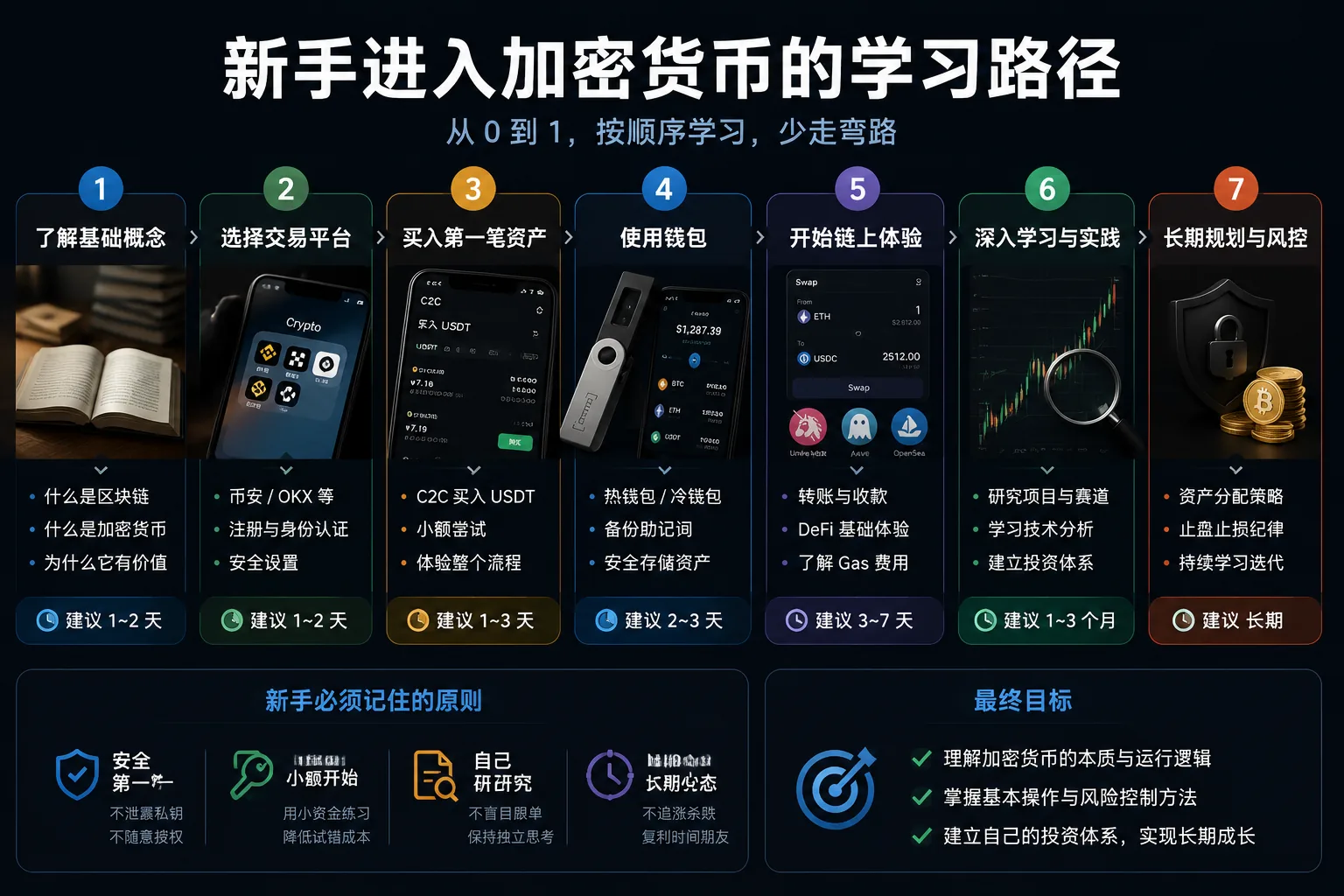
| Stage | Key understanding | Problem to solve |
|---|---|---|
| Build understanding | Blockchain, Bitcoin, Ethereum | Why does cryptocurrency exist? What problem does it solve? |
| Master basic operations | Wallets, addresses, networks, seed phrases | How to manage your assets safely? |
| Understand fund flows | USDT, USDC, trading platforms | Why do stablecoins matter? What's the difference between networks? |
| Explore on-chain applications | DeFi, NFT, RWA, on-chain stocks | Which directions have real demand? Which are just concepts? |
| Build a judgment system | Project analysis, risk judgment | How to judge whether a project is worth watching? |
Build understanding: first understand why it exists
At this stage, don't rush to operate.
The point is to understand:
- What problem blockchain solves;
- Why Bitcoin appeared;
- Why digital assets can have value.
The goal isn't memorizing a lot of projects.
It's building basic understanding.
Master basic operations: learn to manage on-chain assets
Entering the actual operation stage, you need to master:
- Wallets;
- Addresses;
- Networks;
- Seed phrases;
- On-chain queries.
Many asset losses aren't from bad market judgment.
They come from:
Wrong networks, leaked information, mistaken authorizations.
Understand stablecoins: learn how crypto funds flow
Stablecoins are the asset most users touch most often after entering crypto.
You need to understand:
- The difference between USDT and USDC;
- Differences between networks;
- How on-chain funds flow.
Explore applications: then look at DeFi, RWA and other directions
DeFi, NFT, RWA and on-chain stocks aren't without value.
But they're built on top of foundational skills.
If the foundation isn't solid, the more complex the tool, the higher the risk.
FAQ
Is cryptocurrency a scam?
You can't judge it that simply.
There are indeed a lot of scams in the market.
But Bitcoin, Ethereum, stablecoins and others have already formed real use cases.
The key isn't judging the whole industry, but judging specific projects.
What should a beginner buy first?
From a learning perspective:
Understanding blockchain, BTC, ETH, stablecoins and wallet security is more important than directly studying lots of small projects.
Is cryptocurrency very risky?
The risk is relatively high.
It mainly includes:
- Market volatility;
- Project risk;
- Platform risk;
- Operational risk.
Before understanding the rules, complex operations aren't recommended.
Related articles:
- New to crypto? Learn in this order to avoid detours — the minimum viable learning path for beginners
- What beginners really need to fear isn't the dip, but these 8 hard-to-fix mistakes — the most fatal mistakes beginners make
- What is Bitcoin (BTC)? How it works, its value and risks (2026) — the first lesson of the crypto world
Risk note: this article introduces basic crypto knowledge and a learning path, and does not constitute investment advice. Crypto asset prices are quite volatile; before actually operating, please fully understand the risks and refer to official information.
The CoinTrailHub editorial team focuses on crypto education for beginners, exchange security and P2P trading risk. This article is compiled from official sources and public data, reviewed by humans, and strives for accuracy but is not investment advice.
Last updated:2026-07-16 · Content reviewed by humans · Learn more
© 2026 CoinTrailHub · Original content. Reproduction or rewriting without permission is prohibited.