
PAXG vs XAUT: which is better? Gold token differences, fees, and redemption thresholds (2026)
Table of contents

Binance new user rewards
20% trading fee rebate
Official Binance registration. Complete identity verification (KYC) to trade and withdraw.
Cooperation note
This article has no promotional relationship with Paxos or Tether, and contains no referral codes or promotional links. All data is based on public information.
First, a clarification: PAXG and XAUT are both gold tokens, not stablecoins. They don't peg to $1 like USDT or USDC; instead, they represent the value of physical gold on the blockchain, and their price moves with the gold market. This article only compares the structures of gold tokens and does not constitute investment advice.
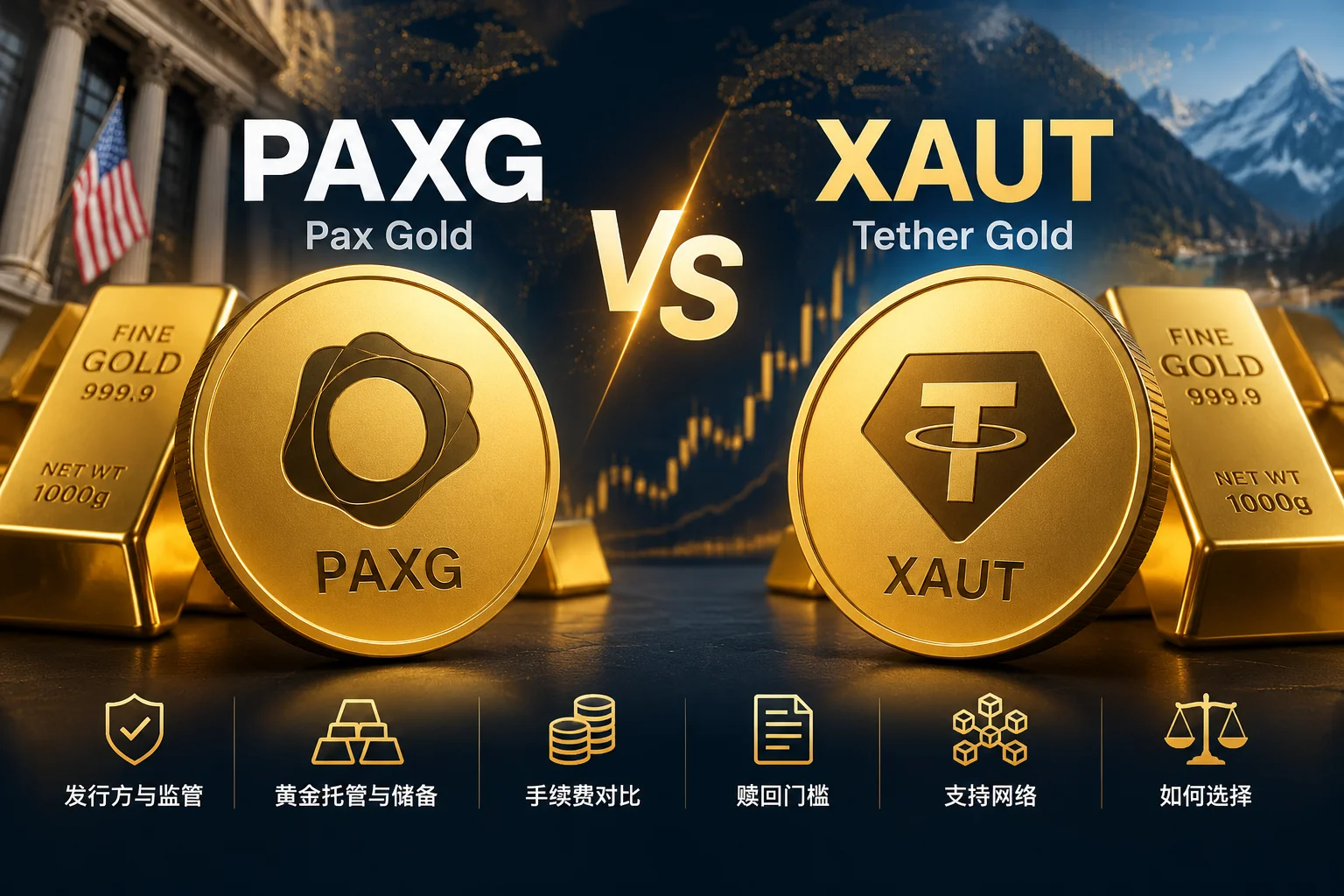
If you care more about the issuer's regulatory framework, reserve-disclosure method, and traditional-finance background, focus on PAXG; if you care more about multi-chain support, on-chain circulation, and network choice, focus on XAUT. There is no absolute better one; it mainly depends on your use case. Both are backed by 1 token = 1 troy ounce of physical gold, but their issuers, regulation, and fee structures differ clearly. The tables below explain it all at once.
About 11 minutes to read. First remember two things: gold tokens are not stablecoins — their price rises and falls with gold; and physical-redemption thresholds are institutional-grade (PAXG requires 430 tokens), so the real exit route for retail users is selling on a platform.
Key information
First, an overview table:
| Dimension | PAXG | XAUT |
|---|---|---|
| Name | Pax Gold | Tether Gold |
| Issuer | Paxos Trust Company | TG Commodities (under Tether) |
| Regulatory / operational framework | Paxos trust model, regulated by NYDFS | Operates under the issuer's local legal framework |
| Gold custody | LBMA-accredited vault system | Swiss vault system |
| Reserve attestation | Regular third-party attestation (Paxos publishes reports) | Regular third-party attestation (Tether publishes reports) |
| Common networks | Ethereum and others | Ethereum, TRON, and others |
This table shows one thing: both use LBMA London Good Delivery standard gold as their reserve basis; the main differences are in the issuer model, information-disclosure method, supported networks, and usage costs.
Who should / shouldn't read this
| Your situation | Suitable? |
|---|---|
| Want to understand what a gold token is | Yes |
| Want to compare PAXG and XAUT | Yes |
| Want to hold gold via blockchain | Yes |
| Only want to buy USDT / USDC | No — gold tokens are not stablecoins |
| Want to redeem physical gold bars | Check the redemption threshold first; retail users basically can't use it |
Table of contents
- What exactly are PAXG and XAUT? First, they're not stablecoins
- PAXG, XAUT, and their relationship with RWA
- Issuer and regulation: one in New York, one offshore
- Fee comparison: which has lower usage cost
- Redeeming physical gold: why retail users basically can't use it
- How to choose between PAXG and XAUT
- Common risks of gold tokens
- FAQ
- Related recommendations
What exactly are PAXG and XAUT? First, they're not stablecoins
Many users arrive here from topics like "stablecoin" or "on-chain assets." The first concept to correct is: gold tokens are not stablecoins.
| Type | Peg | Price characteristic |
|---|---|---|
| USDT / USDC | Dollar | Tries to stay at $1 |
| PAXG / XAUT | Physical gold | Follows the spot gold price |
That is, when gold rises, gold tokens usually rise; when gold falls, they fall too. They're closer to a "gold certificate on the blockchain" than a "one-dollar digital currency."
The two also share three things in common:
- Physical gold backing: each token corresponds to about 1 troy ounce (~31.1 grams) of gold meeting the LBMA London Good Delivery standard.[1]
- On-chain transferability: no need to ship gold bars or store the physical metal yourself — you can transfer via a wallet or trading platform.
- Secondary-market tradability: most ordinary users don't directly redeem gold bars; the actual path is "buy → hold → sell on a trading platform."
PAXG, XAUT, and their relationship with RWA
RWA (Real World Assets) refers to mapping real-world assets into digital form via blockchain technology. Gold tokens are a typical example of RWA — they convert traditional gold assets into digital certificates that can circulate on blockchain networks.
But note: tokenization doesn't change the risks of gold itself, nor does it eliminate the risks from the issuer, custodian, and technical systems.
To learn more about real-world asset tokenization, read Is RWA on-chain assets worth investing in?.
Issuer and regulation: one in New York, one offshore
This is the main difference in issuance model and information disclosure between the two.
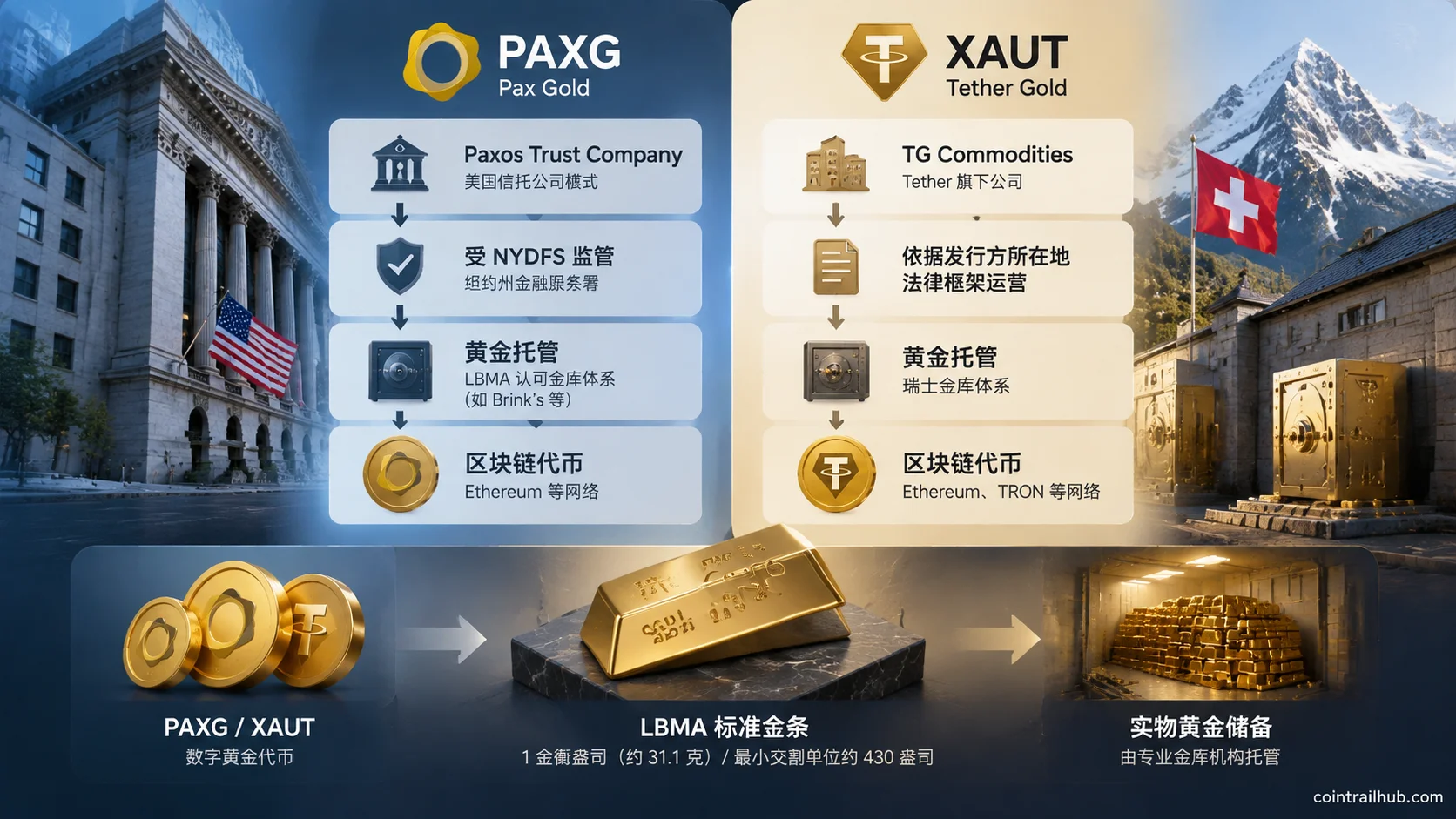
| Item | PAXG | XAUT |
|---|---|---|
| Issuer | Paxos Trust Company | TG Commodities (under Tether) |
| Regulatory / operational framework | Paxos trust model, regulated by NYDFS | Operates under the issuer's local legal framework |
| Gold custody | LBMA-accredited vault system | Swiss vault system |
| Reserve attestation | Regular third-party attestation (Paxos publishes reports) | Regular third-party attestation (Tether publishes reports) |
PAXG uses a US trust-company model, is regulated by the New York State Department of Financial Services (NYDFS), and regularly publishes third-party attestation reports; XAUT operates under the issuer's local legal framework and also discloses backing through reserve reports and other means.[2]
In one sentence: PAXG's disclosure method is closer to the traditional financial trust model, while XAUT leans more toward multi-chain ecosystem and on-chain circulation.
Fee comparison: which has lower usage cost
Many users' first instinct is to look at "purchase fee, redemption fee, transfer cost." But the real cost is not just issuer fees — it also includes platform spreads, liquidity, on-chain gas, and network choice. So we break it into three items below, to avoid mixing minting fees, transfer fees, and custody fees:
| Fee item | PAXG | XAUT |
|---|---|---|
| Minting / redemption fee | From ~0.125% (tiered, based on account net redemption volume) | ~0.25% (reference value) |
| On-chain transfer | Determined by network gas and platform withdrawal fees | Determined by network gas and platform withdrawal fees |
| Custody / management fee | None | None |
The figures in the table are reference values; the current official Paxos and Tether rates prevail. Two points are worth noting:
First, PAXG's minting/redemption fee is tiered — per Paxos's official fee schedule it is graded by the account's 30-day net redemption volume, starting at about 0.125%, with larger amounts triggering higher tiers; XAUT's official conversion fee should follow current rules, with some sources showing a reference conversion fee of about 0.25%.[3]
Second, neither has an ongoing custody or management fee — this is a core selling point that distinguishes gold tokens from gold ETFs and bank-custodied gold.
For ordinary users, most of the time they buy and sell on trading platforms, and the real cost comes mainly from buy/sell spreads, platform fees, and on-chain transfer fees. If you only buy a few dozen to a few hundred dollars' worth and hold occasionally, the fee difference is usually not the biggest factor — whether the platform you use has enough trading depth and a reasonable spread matters more. If you use a supported low-fee network, XAUT may have lower on-chain transfer costs, but actual fees depend on network conditions and platform charges.
Redeeming physical gold: why retail users basically can't use it
Many people see "1 token = 1 ounce of gold" and immediately think "if I buy a few, can I exchange them for small gold bars?" Reality isn't that simple.
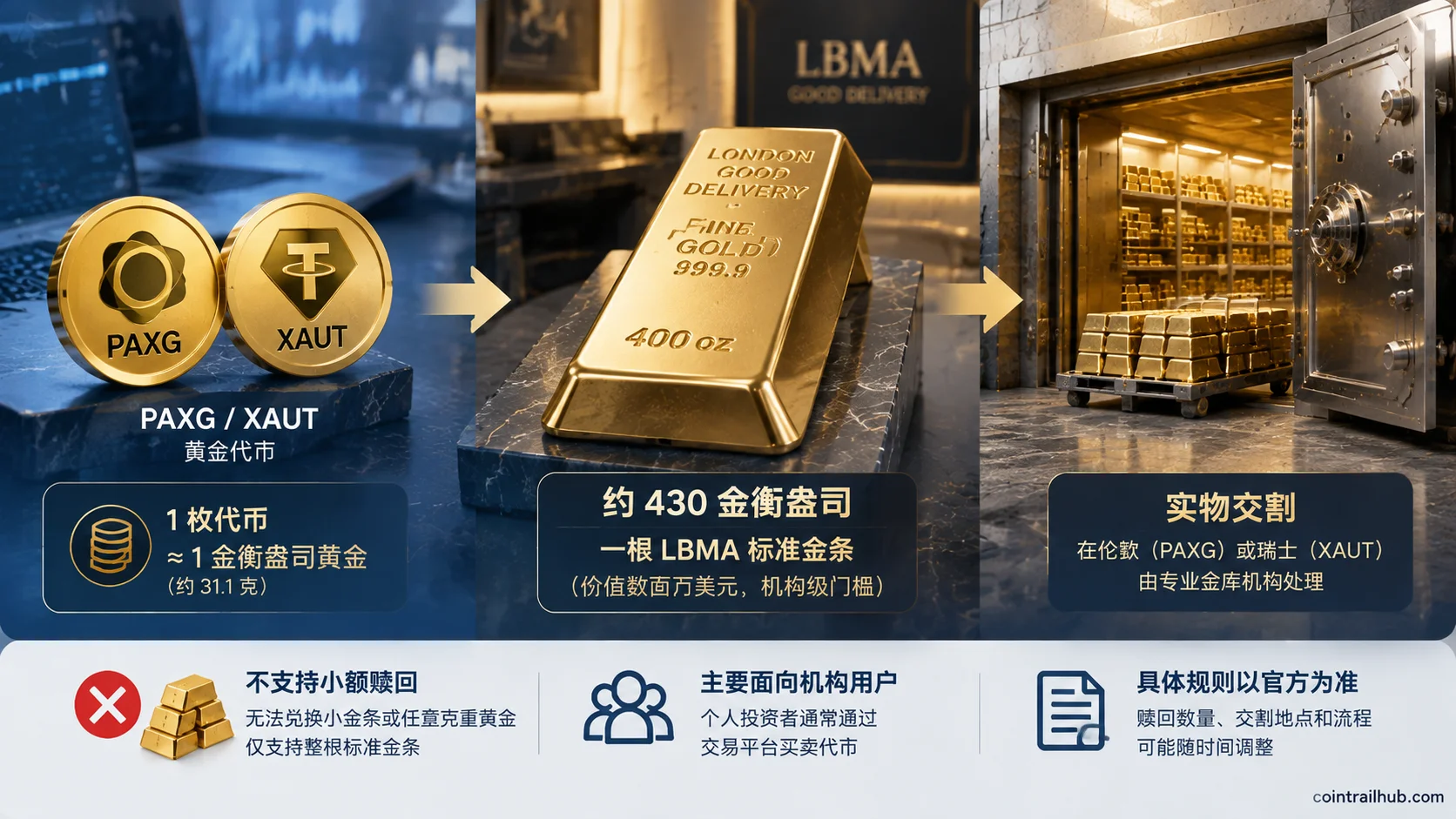
| Redemption item | PAXG | XAUT |
|---|---|---|
| Physical redemption threshold | About 430 troy ounces | About one standard gold bar |
| Corresponding specification | One LBMA London Good Delivery gold bar | One standard gold bar |
| Delivery location | London | Switzerland |
| Small-amount redemption | Not supported | Not supported |
Paxos's official terms confirm that redeeming physical gold requires at least 430 PAXG, corresponding to one London Good Delivery gold bar; XAUT's physical redemption is usually also at the level of about one standard gold bar.[4] At 2026 gold prices, one bar is worth millions of dollars — this is an institutional-grade threshold.
Why is the threshold so high? Because LBMA standard gold bars are a specification used by institutional markets, not small gold bars for retail purchases.
| User type | Suitable for direct redemption? |
|---|---|
| Ordinary retail | Basically not suitable |
| Small gold investor | Usually sells via a trading platform |
| Large holder | Can research the redemption process |
| Institutional user | More in line with the use case |
So for the vast majority of people, the exit route is not "redeeming physical gold," but selling the token on an exchange to convert back to USDT or fiat. This is the same for both PAXG and XAUT; what really differentiates them is which token your exchange supports and whether liquidity is sufficient.
How to choose between PAXG and XAUT
This isn't simply "which one is definitely better"; the more accurate approach is to look at the use case.
| Need | What to focus on |
|---|---|
| Care about issuer transparency | PAXG (trust model + regular disclosure) |
| Care about multi-chain use | XAUT (Ethereum, TRON, etc.) |
| Long-term gold exposure | Compare issuer, custody, and disclosure mechanisms |
| Frequent on-chain transfers | Compare supported networks and fees |
| Frequent trading | Look at platform liquidity and spreads |
| Want to redeem physical gold | Confirm redemption rules and thresholds first |
Care about transparent disclosure → focus on PAXG's public materials. Paxos uses a trust-company model, is regulated by the New York State Department of Financial Services (NYDFS), and regularly publishes third-party attestation reports. This suits long-term holders who value issuer background, regulatory environment, and reserve transparency.
Care about on-chain flexibility → focus on XAUT. XAUT is tied to the Tether ecosystem, supports networks like Ethereum and TRON, and has more on-chain circulation scenarios.[5] It suits users who are used to on-chain asset management and care about network support and transfer costs.
If you just want to trade the gold price, the key isn't the issuer but "which platform supports it, the buy/sell spread, trading depth, and withdrawal fees" — because the final execution cost is usually determined by trading-platform liquidity.
One-sentence version: long-term holding requires more attention to issuer background, reserve disclosure, custody method, and your own risk appetite; frequent trading and on-chain transfers require more attention to platform liquidity, supported networks, and actual fees.
Common risks of gold tokens
Although gold tokens are backed by physical gold, there are still several types of risk to know.
Risk 1: don't treat gold tokens as stablecoins
Gold token prices follow gold — when gold rises they rise, when gold falls they fall. They are not principal-protected assets, much less stablecoins.
Risk 2: issuer risk
Both PAXG and XAUT depend on the issuer, custodian, and reserve-disclosure mechanism. Before buying, check the latest reserve information, official announcements, and official contract addresses.
Risk 3: on-chain operational risk
Sending to the wrong network, wrong address, or a fake contract can cause asset loss. Especially for multi-chain assets like XAUT, before sending you must confirm the network, address format, and whether the receiving wallet supports it — don't judge by the letters "PAXG" or "XAUT" alone.
Risk 4: liquidity risk
Gold tokens are tradable, but different platforms have different depth, buy/sell spreads, and supported regions. For large trades, don't look only at price — look at the actual execution.
FAQ
Q1: Are PAXG and XAUT stablecoins?
No. Both are gold tokens whose price references the gold market and moves with gold. Stablecoins (USDT, USDC) aim to keep dollar value stable, while gold tokens aim to track gold assets.
Q2: Which is safer, PAXG or XAUT?
The two use different issuance and disclosure models, so it's hard to summarize in one word. PAXG is issued by Paxos Trust Company, with a disclosure method closer to the traditional financial trust model; XAUT is issued by TG Commodities under Tether, with a different issuance and reserve-disclosure method. Both use LBMA standard gold as their reserve basis. Judge by combining issuer background, custody method, information-disclosure mechanism, and your own needs.
Q3: Which has lower fees, PAXG or XAUT?
For small, low-frequency use, the difference is small. PAXG's minting/redemption fee is tiered, starting at about 0.125% and higher for large amounts; some sources show XAUT has a reference fee of about 0.25%, with the issuer's latest rules prevailing. The full cost also includes platform fees, buy/sell spreads, and on-chain gas.
Q4: Can PAXG and XAUT be redeemed for physical gold?
In theory yes, but the threshold is high. PAXG requires about 430 tokens (one LBMA bar) to redeem a standard gold bar; XAUT also requires meeting the issuer's minimum quantity and delivery conditions. For most ordinary users, the more common route is "buy → hold → sell on a trading platform."
Q5: Which chains do PAXG and XAUT support?
Supported networks change with the issuer. Currently PAXG mainly runs on Ethereum and other networks; XAUT supports Ethereum, TRON, and others. Before any actual transfer, confirm the token name, network type, and wallet support.
Q6: What's the difference between gold tokens and gold ETFs?
| Comparison | Gold token | Gold ETF |
|---|---|---|
| Trading method | Blockchain wallet / trading platform | Stock account |
| Trading hours | Usually near 24/7 | Stock-market trading hours |
| Transfer | Can be transferred on-chain | Usually cannot |
| Regulatory system | Crypto-asset framework | Securities-market framework |
Both are ways to gain gold-price exposure, but with different structures; which one suits you depends on your usage environment and asset-management approach.
Data verification notes
The key facts in this article were checked on 2026-10-02 against Paxos and Tether Gold official materials, item by item as follows:
- Gold reserve standard: both PAXG and XAUT are designed with 1 token corresponding to about 1 troy ounce (~31.1 grams) of gold meeting the LBMA London Good Delivery standard. Source: Paxos PAXG official site.
- PAXG issuance and regulation: issued by Paxos Trust Company under a trust model, regulated by the New York State Department of Financial Services (NYDFS), with regular third-party attestation reports. Source: Paxos PAXG official site.
- PAXG minting/redemption fee: tiered by the account's 30-day net redemption volume, starting at about 0.125%, with larger amounts triggering higher tiers. Source: Paxos PAXG terms.
- Physical redemption threshold: Paxos's official terms require at least 430 PAXG to redeem one London Good Delivery gold bar — an institutional-grade threshold. Source: Paxos PAXG terms.
- XAUT issuer and networks: issued by TG Commodities under Tether, supporting networks like Ethereum and TRON, and disclosing backing through reserve reports. Source: Tether Gold official site.
Related recommendations
- USDT vs USDC — a comparison of true dollar-pegged stablecoins
- RLUSD vs USDT and USDC — the comparison logic of another stablecoin
- TRC20, ERC20, BEP20 differences — a must-read before multi-chain transfers
- USDT in a wallet or on an exchange — token assets face storage questions too
- Seed phrase safe storage — the basic security of self-custody wallets
Disclaimer
This article is only for educating about gold tokens and comparing product structures, and does not constitute investment advice, trading advice, or financial advice.
Gold-token prices are affected by gold-market fluctuations, and carry gold-price risk, issuer risk, custody risk, smart-contract risk, and on-chain operational risk. Before using any digital-asset service, confirm the laws and regulations of your location and judge carefully based on your own situation.
- 2026-10-17UpdateAdded evidence-chain superscripts and "Data verification notes".
See ourEditorial Policy and the correction process in ourCorrections Policy.
The CoinTrailHub editorial team focuses on crypto education for beginners, exchange security and P2P trading risk. This article is compiled from official sources and public data, reviewed by humans, and strives for accuracy but is not investment advice.
Last updated:2026-10-02 · Content reviewed by humans · Learn more
© 2026 CoinTrailHub · Original content. Reproduction or rewriting without permission is prohibited.